
Reema Nanavaty: How Women’s Livelihoods Became a Global Development Story
From women-owned cooperatives in India to international discussions on economic security, SEWA director Reema Nanavaty’s 2026 Hillary Rodham Clinton Award highlights a development model built around workers’ collective power, ownership and access to markets.
Reema Nanavaty’s work has helped bring a question often overlooked in debates about economic growth to an international audience: what does development mean for women whose work sustains households and local economies but frequently goes unrecognised by formal institutions?
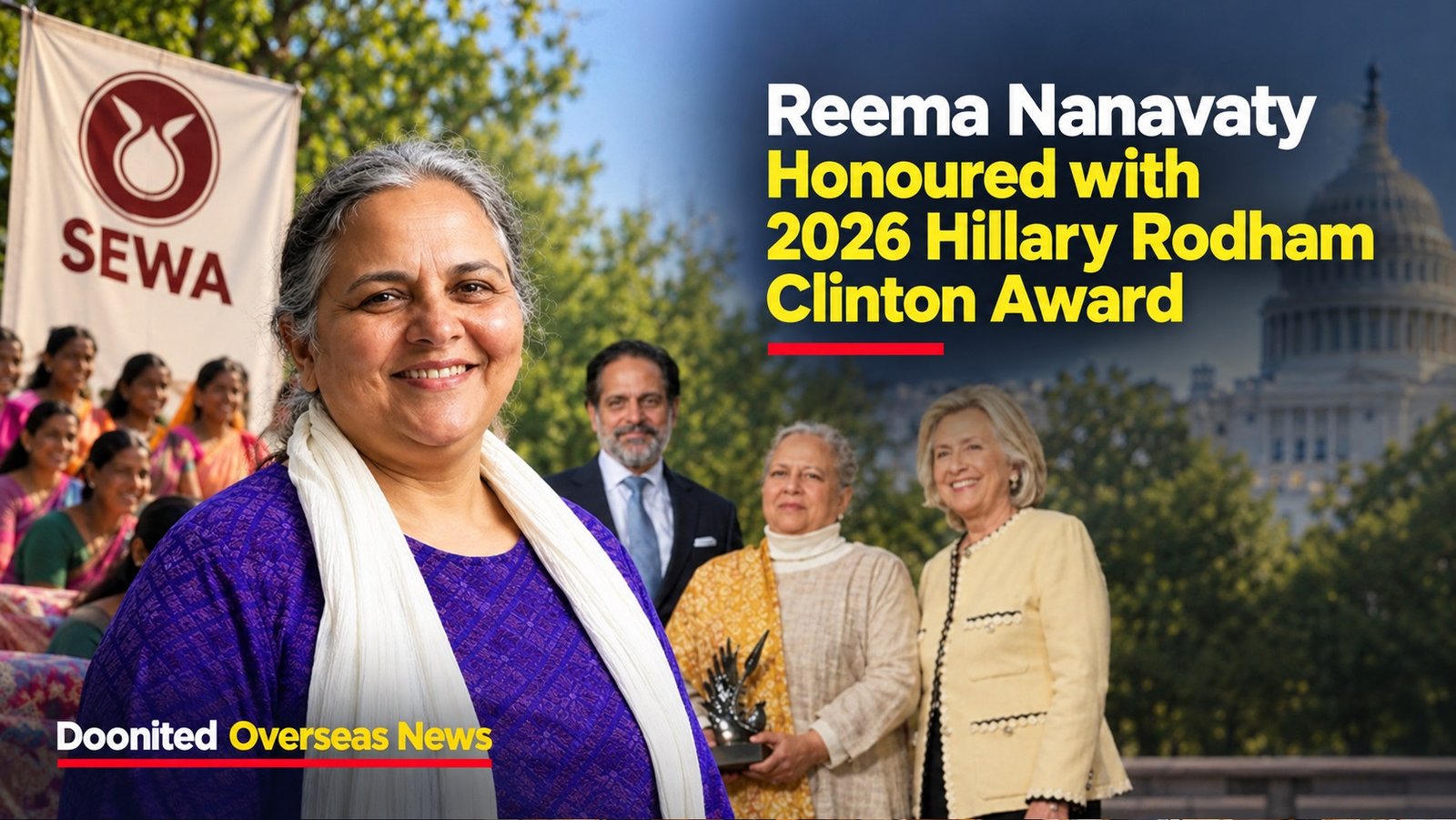
On 15 October 2026, Nanavaty, director and general secretary of India’s Self-Employed Women’s Association (SEWA), received the Hillary Rodham Clinton Award at Georgetown University in Washington, D.C. Former US Secretary of State Hillary Rodham Clinton presented the honour at an annual ceremony organised by the Georgetown Institute for Women, Peace and Security.
Georgetown recognised Nanavaty’s contribution to women’s economic empowerment, including the development of women-owned enterprises, access to renewable energy and initiatives supporting self-reliance, employment, education and social protection. The awards also recognised entrepreneur and philanthropist Tory Burch and Nobel Peace Prize laureate Muhammad Yunus.
The recognition places an Indian grassroots organisation within a wider international conversation about economic opportunity, social stability and the relationship between women’s livelihoods and security.
Why informal workers need more than employment
Nanavaty has worked with SEWA since 1984. The organisation was founded in 1972 by labour organiser Ela Bhatt to represent self-employed women, many of whom worked outside conventional employer-employee relationships.
SEWA’s members include home-based artisans, street vendors, agricultural workers, waste pickers, small producers and other women who earn their livelihoods through informal work. Their economic contribution can be substantial, yet the nature of their employment often leaves them with limited access to social protection, affordable finance and stable markets.
The International Labour Organization’s 2024 study of SEWA’s cooperative model describes the difficulties faced by informal workers, including insecure earnings and inadequate access to essential services. It also documents how women’s cooperatives can help workers organise economic activity and strengthen their position.
The challenge is not simply to help women find work. It is to improve the conditions under which they work, the income they retain and the security they can build for their families.
That distinction is central to SEWA’s approach.
From individual labour to collective ownership
Traditional responses to economic vulnerability often focus on relief payments, training or negotiations over wages. These interventions can be important, but they may not resolve the structural disadvantages faced by workers who depend on contractors, intermediaries or informal credit.
SEWA has developed a complementary approach: organising workers while supporting cooperatives and collective enterprises.
The model can give women a shared institutional structure through which to access finance, organise production, provide services and negotiate with buyers. Instead of remaining isolated producers, members can participate in enterprises that they collectively own or manage.
SEWA’s cooperative experience spans sectors including banking, insurance, childcare, dairy, organic agriculture, healthcare, waste management and cleaning services. Its first cooperative, SEWA Bank, was established in 1974 to address members’ difficulties accessing formal banking.
The subsequent development of cooperatives reflected a practical lesson: organising workers is not always enough if the commercial arrangements around their work remain unchanged.
Collective enterprises can help members pool resources, improve bargaining power and access services that would be difficult to secure individually. Federations can also connect smaller cooperatives, giving them a stronger collective voice.
This is not a guarantee of higher incomes. Cooperatives still need sound management, viable markets, reliable customers and financial discipline. But the structure creates opportunities for workers to exercise greater influence over the economic activity on which they depend.
Livelihood security extends beyond income
Nanavaty’s work also connects economic empowerment with food security, renewable energy and resilience to crises.
According to Georgetown’s account of the award, her work has included initiatives to expand renewable energy access and develop women-owned enterprises. Reporting by the Press Trust of India, published by NDTV, also highlights SEWA’s activities in agribusiness, food processing, waste recycling and textiles, as well as its food-security and green-energy initiatives.
These areas are increasingly interconnected.
A woman’s income can be disrupted by extreme weather, illness, rising input costs or a sudden loss of access to buyers. If her household also lacks savings, insurance or dependable public services, a temporary shock can become a long-term setback.
For women whose work depends on agriculture or outdoor activity, climate-related risks can threaten both productivity and household stability. Affordable energy can influence the cost and feasibility of small enterprises, while access to food and social protection can reduce the consequences of income interruptions.
The wider development lesson is that livelihoods cannot be strengthened through income generation alone. Financial services, infrastructure, social protection and resilience must work together.
Why the recognition matters beyond India
For overseas Indians and the wider diaspora, Nanavaty’s recognition offers a different perspective on India’s international contribution.
India’s global presence is often discussed through technology, business, scientific achievement, culture and professional migration. Social innovation is another important part of that story: Indian organisations can develop approaches to economic inclusion that attract attention from international institutions and offer lessons for other regions.
SEWA’s experience is particularly relevant to countries where informal workers, migrant communities, home-based producers and women entrepreneurs struggle to access finance, formal representation or stable markets.
The model is not automatically transferable. Labour laws, cooperative regulations, welfare systems and market conditions differ between countries. Replication would require adaptation to local circumstances rather than simply copying an Indian organisation’s structure.
Nevertheless, diaspora entrepreneurs, philanthropic organisations and community associations may find useful lessons in the emphasis on collective ownership, local leadership and long-term institution-building.
For those supporting development initiatives across borders, the example also raises a practical question: can funding and training be designed to help communities build durable economic institutions, rather than remain dependent on short-term projects?
Recognition is a milestone, not the finish line
SEWA’s scale and longevity make it an important case study, but the broader challenge remains considerable. Informal workers need dependable markets, access to affordable finance, effective social protection and institutions capable of responding to changing economic conditions.
Cooperatives also need transparent governance and meaningful participation from their members. Collective ownership is valuable only when workers have a genuine voice and enterprises can remain economically sustainable.
International awards can bring visibility to these issues, but visibility alone does not improve working conditions or household incomes. The real test lies in whether successful approaches can be strengthened, measured and adapted without losing the participation of the people they are designed to serve.
Nanavaty’s 2026 recognition at Georgetown therefore represents more than an individual achievement. It brings international attention to a development approach that treats women not merely as recipients of assistance, but as workers, producers, business owners and decision-makers.

World Beyond the News
Birds Can Navigate Using Earth’s Magnetic Field
Several bird species can sense Earth’s magnetic field, helping them navigate during long-distance migration.
Fermentation Is a Global Food Tradition
People across continents have used fermentation for centuries to preserve food and create distinctive flavours.
Modern Batteries Store Energy Chemically
Rechargeable batteries repeatedly move ions between electrodes, allowing electrical energy to be stored and released.
Why Songs Become Global Hits
Streaming platforms, short-form video, playlists and international collaborations can rapidly carry music across borders.