
Aneeshwar Kunchala: The Indian-Origin Young Conservationist Inspiring a Generation
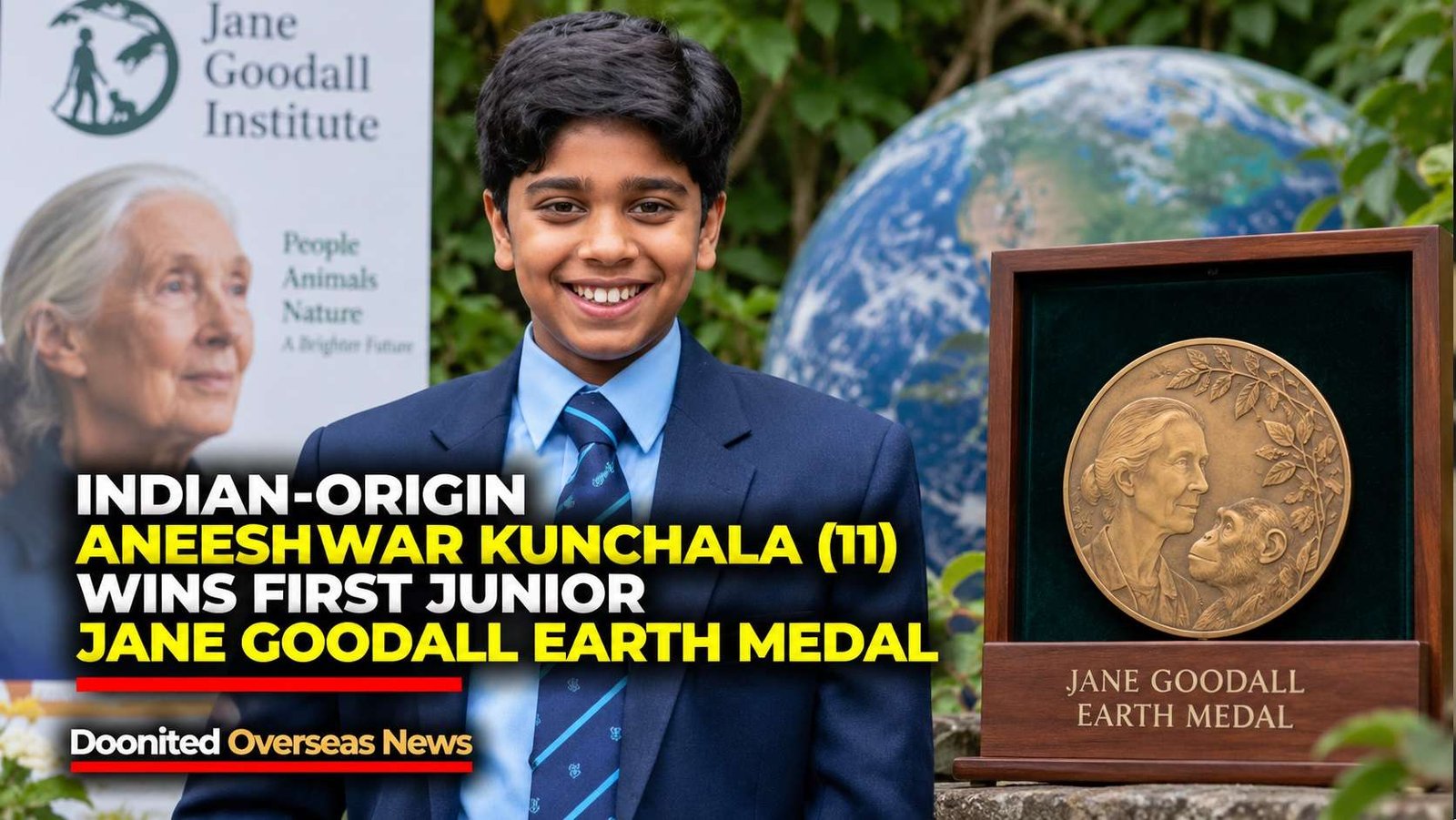
At 11, UK-based wildlife presenter Aneeshwar Kunchala has been named the first recipient of the Junior Jane Goodall Earth Medal. Inspired by a classroom lesson about a whale killed by plastic pollution, he is using television, writing and public speaking to encourage children to protect wildlife.
From one classroom lesson to an international conservation award
A photograph shown in a classroom can be easy to forget. For Aneeshwar Kunchala, it changed the direction of his young life.
When he was four, his teacher showed the class an image of a whale that had died after ingesting plastic. The experience left him distressed by the consequences of discarded waste and prompted him to think about how people could better protect animals and their habitats.
More than six years later, that early concern has developed into a public-facing career spanning wildlife documentaries, educational television, writing and environmental advocacy.
In October 2026, the 11-year-old, who lives in the United Kingdom and has family roots in Andhra Pradesh, India, was named the recipient of the inaugural Junior Jane Goodall Earth Medal by STARMUS, the international festival of science, exploration, music and the arts. The recognition celebrates his work promoting wildlife conservation, biodiversity and environmental awareness among young people.
The announcement connects an Indian-origin child’s achievements with a global environmental cause. It also highlights a growing role for young science communicators: making complex ecological problems understandable and encouraging audiences to take an interest in the natural world.
Building a voice through wildlife storytelling
Kunchala began making wildlife videos with his father in 2020. Early projects focused on animals around him, giving him a way to share his curiosity with a wider audience.
His work subsequently reached television. He appeared alongside naturalist and presenter Steve Backshall in the BBC children’s programme Steve and Aneeshwar Go Wild, which introduced young viewers to animals, habitats and conservation through exploration.
In 2022, Kunchala presented COP27: Six Ways to Save Our Planet, a documentary addressing environmental challenges and possible responses. Guinness World Records recognised him as the youngest male documentary presenter for the programme.
His television work has also included productions associated with Sky Kids and Channel 5. In 2025, Aneeshwar’s Outdoor Adventures was listed among his projects, extending his role as a presenter who uses exploration and storytelling to engage younger audiences.
These achievements reflect more than an unusual career for a child. Wildlife communication requires the ability to explain unfamiliar subjects in an accessible way, hold an audience’s attention and connect scientific information with everyday decisions.
For younger viewers, a presenter close to their own age can also make participation seem more attainable. Conservation may otherwise appear to belong exclusively to scientists, professional campaigners or governments. Kunchala’s work offers a different message: learning about wildlife and taking an interest in environmental problems can begin early.
Why the Junior Jane Goodall Earth Medal matters
The medal is associated with the legacy of Jane Goodall, the primatologist and conservationist whose decades of research on chimpanzees transformed scientific understanding of animal behaviour. Goodall also became internationally known for advocating environmental protection and encouraging young people to take responsibility for the planet.
The Junior Jane Goodall Earth Medal recognises the contribution of a younger generation to that broader mission.
Kunchala’s selection by STARMUS places youth-led conservation within a festival that brings together scientists, astronauts, researchers and communicators. The festival’s programme also included discussions and activities related to the natural world, demonstrating how environmental questions connect with science, technology and public understanding.
The award is an important recognition of Kunchala’s advocacy and communication. It should not, however, be confused with an assessment showing that his work has directly reduced pollution or reversed biodiversity loss. Measuring those outcomes requires separate evidence.
The value of environmental communication lies partly in helping people understand a problem and motivating them to act. Whether that awareness produces lasting change depends on what follows: individual behaviour, community initiatives, corporate responsibility and effective public policy.
From plastic pollution to biodiversity
The classroom image that first affected Kunchala illustrates a wider environmental problem. Plastic waste can injure or kill wildlife when animals become entangled in discarded material or mistake it for food. Marine animals are particularly vulnerable, although plastic pollution also affects freshwater environments and terrestrial ecosystems.
Reducing the threat requires more than asking individuals to dispose of rubbish responsibly. Waste collection and recycling systems, product design, the use of unnecessary single-use plastics, litter prevention and action against pollution all influence how much plastic reaches natural environments.
Biodiversity presents an equally broad challenge. Protecting wildlife requires the preservation of habitats, the responsible management of land and water, and responses to pressures including pollution, climate change and the loss of natural spaces.
Kunchala’s communication work can help younger audiences understand these connections. But the broader lesson is that environmental awareness is a starting point, not a substitute for action by governments, businesses and communities.
For children who want to participate, practical activities can include recording local wildlife observations, taking part in supervised habitat-restoration projects, reducing avoidable waste and supporting credible conservation organisations. Such activities are most valuable when they are age-appropriate, safe and connected to evidence about what helps local ecosystems.
A book, a magazine column and a wider audience
Kunchala has extended his work beyond television. His book, Adventures of a Young Naturalist: Arctic Expedition, was launched in 2024, using exploration and storytelling to introduce readers to the natural world.
In 2026, he also became the first young columnist for National Geographic Kids UK. The magazine’s profile describes a regular column offering young readers nature-related activities, seasonal wildlife observations and opportunities to take part in citizen science.
Citizen science allows members of the public to contribute observations or other information to research projects. Depending on the project, participants might record birds, monitor seasonal changes or document species in their local area. When collected systematically, these observations can help researchers build a broader picture of wildlife and environmental change.
For children, this approach offers a practical bridge between learning and participation. Instead of encountering conservation only as a distant global issue, they can observe nature in their own neighbourhoods and understand how local evidence contributes to wider scientific questions.
Kunchala has also received recognition including the Diana Award and the British Citizen Youth Award. His profile illustrates how environmental communication can combine several forms of engagement—broadcasting, writing, art and public appearances—rather than relying on a single platform.
What his story means for the Indian diaspora
Kunchala’s family roots in Andhra Pradesh add an international dimension to his story, while his work is based primarily in Britain. His experience reflects the way diaspora identities can connect people to more than one cultural setting while allowing them to contribute to causes that cross national boundaries.
Environmental protection is particularly suited to this global perspective. Wildlife habitats, migratory species, oceans and air pollution do not conform to national borders. Plastic waste discarded in one place can travel through rivers and coastlines, while biodiversity loss in one region can affect wider ecological systems.
For Indian-origin families abroad, Kunchala’s achievement is a reminder that diaspora visibility is not limited to business, politics or professional success. Young people can also build public influence through science communication, education and environmental service.
The next measure of his contribution will be the reach and practical effect of the work that follows. Awards can amplify a message, but lasting progress requires sustained engagement and the participation of institutions, communities and policymakers.
At 11, Kunchala has already built an unusual platform for communicating about wildlife. His story began with a troubling image of a whale, but its wider significance lies in what he has done with that response: turning concern into a sustained effort to help other children understand the natural world.
The challenge ahead is to ensure that inspiration becomes informed action—and that the next generation inherits not only a stronger desire to protect wildlife, but also the knowledge and systems needed to do so.

World Beyond the News
Dolphins Use Individual Signature Whistles
Bottlenose dolphins develop distinctive whistles that function somewhat like individual acoustic identifiers.
The Pacific Is Earth’s Largest Ocean
The Pacific Ocean covers more area than any other ocean basin and stretches between Asia, Australia and the Americas.
Artificial Intelligence Learns Statistical Patterns
Modern machine-learning systems identify patterns in large datasets and use those patterns to generate predictions or outputs.
Why Some Stories Spread So Quickly
Emotion, novelty, visual appeal and easy sharing can make a story travel rapidly across social platforms.