
From Mumbai to California: Swapnil Motghare Helps Track AI’s Impact on Jobs
Indian-trained economist Swapnil Motghare is part of the research team behind California’s AI-Unemployment Tracker, a public tool designed to detect early signs of workforce disruption. Its findings offer a more nuanced picture than the headline fear of AI-driven mass unemployment.
A new way to examine AI and employment
Artificial intelligence is transforming workplaces, from software development and customer service to administration, research and professional services. Yet one of the biggest questions surrounding its adoption remains difficult to answer: how much of the resulting change is translating into actual job losses?
In California, economist Swapnil Motghare has helped develop a research tool intended to make that question easier to investigate.
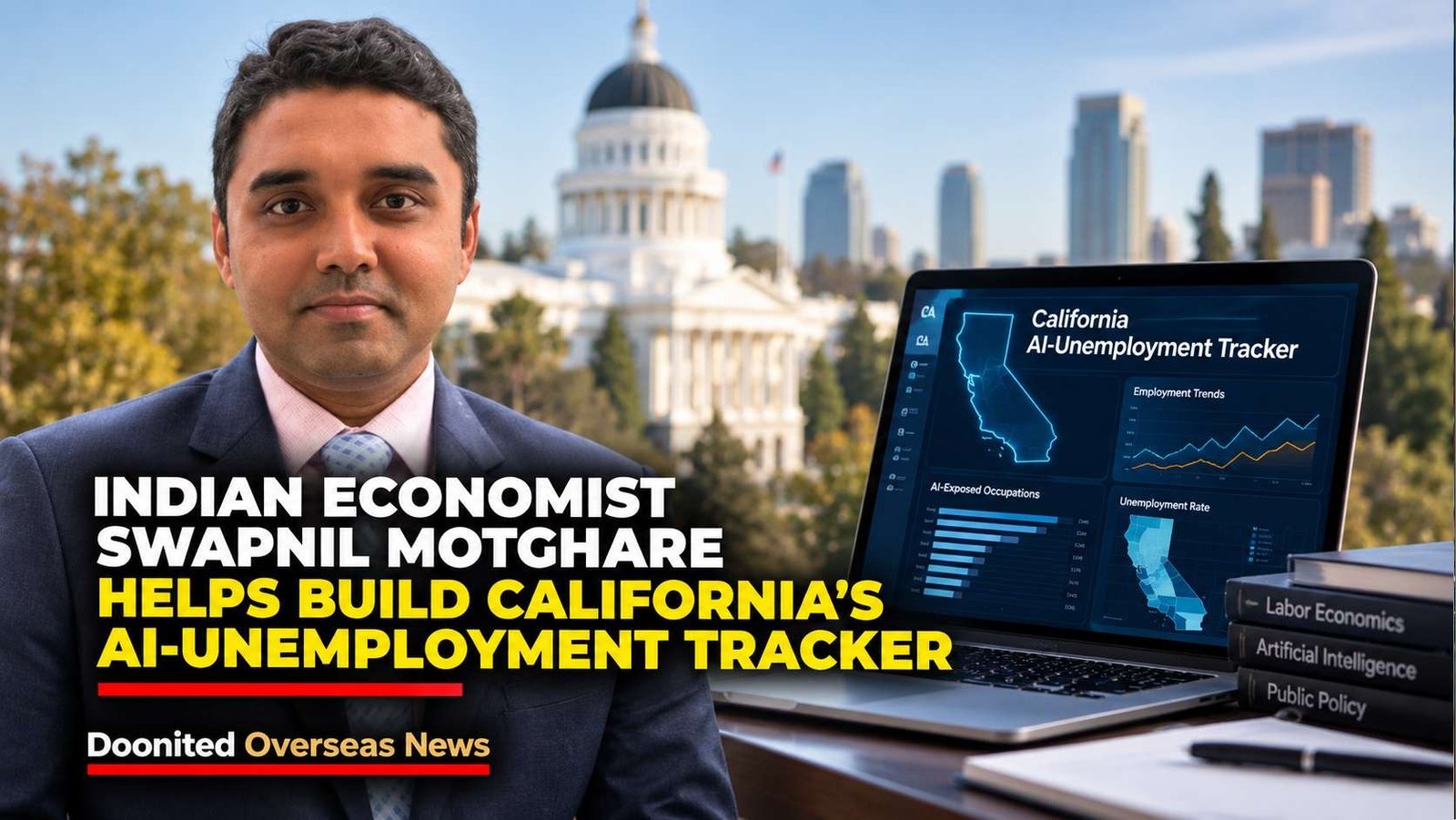
A researcher at the California Policy Lab, based at the University of California, Los Angeles (UCLA), Motghare is part of the team behind the California AI-Unemployment Tracker (CAIT). Launched in June 2026, the initiative connects unemployment insurance records with measures of how exposed different occupations are to artificial intelligence.
Rather than relying on company announcements, individual layoff reports or predictions about which professions might disappear, the tracker examines patterns in unemployment claims. It allows policymakers and the public to investigate how those patterns vary by occupation, industry, region and demographic group.
The project is significant because it attempts to measure the labour-market consequences of technological change as they emerge. It also demonstrates how researchers can use administrative data already collected by governments to inform decisions about employment support and workforce policy.
For the Indian diaspora, Motghare’s contribution is a story about the international reach of Indian-trained talent—and about how economics, data and public policy intersect in a period of rapid technological change.
From mechanical engineering to labour economics
Motghare’s career did not begin in economics.
According to an interview published by New India Abroad, he studied mechanical engineering in Mumbai before joining the inaugural batch at the Indian Institute of Management Shillong. He subsequently spent approximately three years working as a supply-chain manager in Jamshedpur.
That experience introduced him to how organisations make decisions and manage operations. It also preceded a change in professional direction, as he became increasingly interested in the economic questions behind individual and institutional behaviour.
He moved to the United States to pursue graduate studies in economics, completing a master’s degree at the University of Texas at Austin and a PhD at the University of Arizona.
His academic work has covered both labour and development economics. During his doctoral research, he examined the behaviour of New York City taxi drivers and studied gender quotas in village councils in Jharkhand.
These subjects might initially appear unrelated to the modern technology industry. Their common thread, however, is the examination of how people respond to economic incentives and how institutions shape opportunities.
His later work increasingly focused on employment, unemployment insurance and the consequences of losing a job. Following postdoctoral research at the University of Notre Dame, he worked with Indiana’s unemployment insurance agency to study labour-market outcomes.
That experience helped establish the direction of his current research: using evidence to understand what happens to workers when economic conditions change and which policies can help them recover.
Inside California’s AI-Unemployment Tracker
California’s tracker emerged from a collaboration involving the state government, the Employment Development Department (EDD) and the California Policy Lab, a nonpartisan research centre within the University of California system.
The initiative was announced on June 25, 2026, as part of California’s wider effort to prepare workers and communities for the potential economic disruption associated with AI.
Motghare contributed to the research team responsible for developing the tool. Its underlying approach combines two different measures of AI exposure with unemployment insurance claims data.
The first measure estimates potential AI exposure: whether large language models could reduce the time needed to complete at least half of an occupation’s tasks.
The second measures observed AI exposure, drawing on research into how frequently tasks associated with different occupations are performed using Anthropic’s Claude platform.
These measures help researchers classify the kinds of work associated with unemployment claims. They do not, by themselves, explain why a particular worker lost a job.
The distinction matters. A profession can be highly exposed to AI without experiencing immediate employment losses. Businesses may use AI to improve productivity, change job responsibilities, reduce hiring, reorganise teams or develop new services. Some may eventually eliminate positions, while others may retain workers but expect them to perform different tasks.
By connecting exposure measures with unemployment claims, the tracker offers a way to investigate whether employment-related patterns are changing across different groups of workers.
Its data are updated monthly, and the underlying tabulated information is publicly available. This gives researchers, journalists and policymakers an opportunity to examine the trends rather than relying solely on broad claims about AI’s impact.
What the data reveal—and what they do not
The initial research accompanying the tracker did not find evidence of a statewide surge in unemployment insurance claims among workers in highly AI-exposed occupations following the public release of ChatGPT in late 2022.
However, the findings also identified patterns that deserve attention.
Claims increased among college-educated workers in highly AI-exposed occupations relative to comparable workers in less-exposed occupations. The San Francisco Bay Area, along with technology-intensive sectors, also showed signs of elevated claims.
These findings suggest that the statewide picture may conceal differences between industries, regions and worker groups.
The September 2026 update provides a useful reminder that the trends are not moving in a single direction. The California Policy Lab reported that the three-month moving average of initial claims from occupations with high potential AI exposure fell from approximately 52,200 to 49,900, a decline of about 4.4 per cent. Using the observed AI-exposure measure, the comparable average fell from approximately 71,800 to 65,300, a decline of about 9.1 per cent.
These figures are not seasonally adjusted and describe different exposure measures. They should not be combined or interpreted as a count of people whose jobs AI directly eliminated.
Indeed, the tracker’s researchers explicitly caution against treating its results as causal proof of AI-driven unemployment.
The data cover people who file eligible unemployment insurance claims after losing covered employment. They therefore exclude some affected workers, including those who find new jobs quickly, do not qualify for benefits, do not apply or work in categories not adequately represented in the claims data.
Occupational information is also self-reported, and historical figures can be revised as additional claims are processed.
The tracker is consequently best understood as an early-warning system, not a definitive register of AI-caused layoffs.
That limitation does not undermine its value. It defines the question the tool can answer: where are unemployment patterns changing among workers whose occupations are exposed to AI, and where should researchers investigate further?
Why the research matters for workers
For people facing redundancy, the distinction between a general economic slowdown and technology-related displacement may seem less important than finding another job. But it matters for policymakers designing support programmes.
If particular groups of workers are experiencing sustained difficulties, governments need evidence to determine whether existing unemployment benefits, job-search assistance and retraining programmes are adequate.
Motghare’s broader research interests include unemployment insurance and re-employment services. These programmes can help workers manage the financial and practical consequences of job loss while searching for new employment.
California is also examining policy options such as short-time compensation, which allows employers to reduce working hours rather than immediately resorting to layoffs, alongside employment services and targeted training.
The effectiveness of such measures depends on the circumstances. Training, for example, is not automatically useful simply because it is offered. It needs to connect workers with realistic employment opportunities and skills that employers value.
Likewise, unemployment benefits can provide important financial support, but their impact depends on eligibility, benefit design and the availability of suitable jobs.
Reliable labour-market evidence can help governments identify where assistance may be needed and evaluate whether interventions are working.
The tracker also offers a potential model for other jurisdictions. As Motghare told New India Abroad, unemployment insurance systems and re-employment programmes operate across the United States. Other states could explore whether comparable data and occupational exposure measures would allow them to develop similar monitoring systems.
However, replicating the dashboard would require more than copying its design. Researchers would need access to suitable administrative records, consistent occupational classifications, appropriate privacy safeguards and a transparent methodology.
A national version could improve the visibility of emerging trends, but it would still need to distinguish correlation from causation.
An Indian-trained researcher in a global debate
Motghare’s career also highlights a less-publicised path for Indian professionals working abroad: applied public-policy research.
Indian-origin professionals are widely visible in technology, finance, entrepreneurship and corporate leadership. Research conducted within public institutions and universities can be less prominent, despite its potential to influence decisions affecting millions of people.
Motghare’s work brings together technical analysis and a practical policy question. It asks not only what AI systems can do, but how labour markets respond and what institutions can do to support people when employment changes.
His experience also reflects the increasingly international nature of research careers. Education in India, graduate training in the United States and collaboration with public agencies have contributed to a career focused on the economic consequences of technological change.
For Indian students considering overseas study, his trajectory is a reminder that economics can lead to careers beyond academia, banking or corporate consulting. Applied research can involve government agencies, universities, independent research organisations and international policy networks.
At the same time, the availability of such careers depends on specialised training, research opportunities, funding and the ability to work across disciplines. One individual’s career should not be taken as evidence that every aspiring researcher will have the same opportunities.
The next question is whether governments act on the evidence
The emergence of AI-related employment concerns has created demand for better data. But collecting information is only the first step.
The harder task is to determine which changes are temporary, which reflect broader economic conditions and which may be associated with technological adoption. Researchers must also establish whether policy responses help affected workers return to sustainable employment.
California’s tracker provides a framework for investigating those questions. Its findings so far point to a mixed picture: no clear statewide surge in claims attributable to AI, but meaningful patterns among certain highly exposed, college-educated workers and in parts of the technology-intensive economy.
Motghare’s contribution sits within that larger collaborative effort. The project is not a forecast of mass unemployment, nor proof that AI has had no effect on jobs. It is an attempt to build a more evidence-based understanding of a changing labour market.
As AI adoption expands, that distinction will become increasingly important. Governments need to recognise emerging risks without overstating what the evidence establishes, while employers and workers need to prepare for changes in tasks, skills and job structures.
For the global Indian community, Motghare’s work offers a story of professional achievement with a wider public purpose. Its ultimate significance will depend not only on the quality of the data, but also on whether policymakers use the evidence to help workers navigate the next phase of technological change.

World Beyond the News
Birds Can Navigate Using Earth’s Magnetic Field
Several bird species can sense Earth’s magnetic field, helping them navigate during long-distance migration.
Fermentation Is a Global Food Tradition
People across continents have used fermentation for centuries to preserve food and create distinctive flavours.
Modern Batteries Store Energy Chemically
Rechargeable batteries repeatedly move ions between electrodes, allowing electrical energy to be stored and released.
Why Songs Become Global Hits
Streaming platforms, short-form video, playlists and international collaborations can rapidly carry music across borders.