
South Korea Expands Visa Access in India: Four Centres Now Serve Indian Travellers
South Korea has quietly made one practical change that could make a considerable difference to Indian travellers: applying for a Korean visa no longer necessarily means treating New Delhi as the centre of the universe.
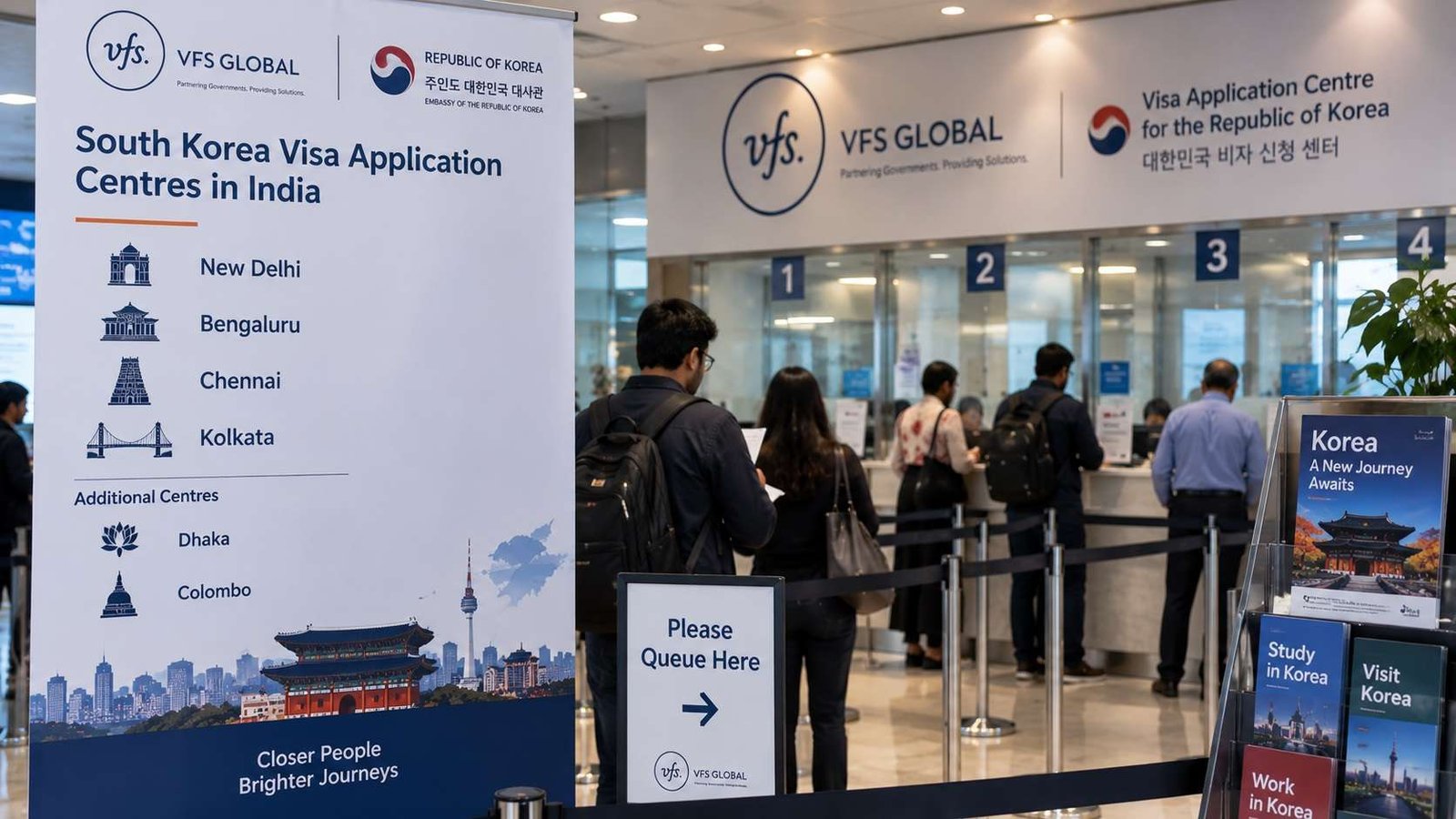
The country has expanded its visa application infrastructure across South Asia, with four Korea Visa Application Centres now operating in India—in New Delhi, Bengaluru, Chennai and Kolkata.
The wider regional network has reached six centres, with additional locations in Dhaka, Bangladesh, and Colombo, Sri Lanka. The new New Delhi centre was inaugurated on 15 September 2026 by Lee Seong-ho, Ambassador of the Republic of Korea to India.
For Indian travellers, students, business visitors and other applicants, the significance is straightforward: more people can access the application process closer to where they live.
And in a country as geographically large as India, that is not a small administrative detail.
Four Indian Cities, One Korean Visa Network
The four Indian Korea Visa Application Centres are located in:
- New Delhi
- Bengaluru
- Chennai
- Kolkata
The expansion means applicants from southern and eastern India have more geographically convenient locations for submitting applications and completing required procedures.
The New Delhi centre is located at Shivaji Stadium Metro Station, Mezzanine Level, Baba Kharak Singh Marg, Connaught Place. The Bengaluru centre is at Gopalan Innovation Mall on Bannerghatta Main Road, while centres in Chennai and Kolkata are also operating at designated VFS locations.
The regional network now looks like this:
| Country | Korea Visa Application Centres |
|---|---|
| India | New Delhi, Bengaluru, Chennai, Kolkata |
| Bangladesh | Dhaka |
| Sri Lanka | Colombo |
| South Asia total | 6 |
Globally, VFS Global says it now manages nine Korea Visa Application Centres across six countries.

What Does VFS Actually Do?
This is an important distinction for applicants.
VFS Global is essentially the administrative gateway.
Its responsibilities include accepting visa applications, collecting supporting documents according to the applicable checklist and enrolling biometric information.
It does not decide whether an applicant deserves a Korean visa.
The decision to grant or refuse a visa remains with the relevant Korean diplomatic authority.
That distinction is worth remembering because visa-application centres can sometimes be mistaken for visa-approval centres.
They are not.
A modern reception desk cannot approve a weak application.
Why the Expansion Matters for Indians
India is not a small outbound-travel market.
The growth of Korean popular culture has also created a new generation of Indian travellers familiar with South Korea before ever setting foot there.
K-pop, Korean dramas, Korean cuisine, beauty products and the country’s technology brands have helped make Korea increasingly visible to Indian consumers.
For some travellers, the journey starts with a drama series.
For others, it starts with Seoul’s technology ecosystem, Korean universities, business opportunities or simply curiosity about a country that has managed to become a global cultural brand.
The visa infrastructure therefore has to serve a much wider audience than traditional corporate travellers.
And geography matters.
Someone living in Kolkata should not necessarily have to organise an expensive trip to Delhi merely to complete a physical application procedure if an authorised centre is available much closer to home.
The same applies to applicants in Bengaluru and Chennai.
Bengaluru and Chennai: The Southern Advantage
The presence of dedicated centres in Bengaluru and Chennai is particularly relevant to India’s southern technology and education corridors.
Bengaluru has a substantial concentration of technology companies, start-ups, engineers and international business activity.
Chennai is an important automotive, manufacturing, education and technology centre.
Both cities also have large populations of international travellers.
The Korean business ecosystem itself has significant interests in India, particularly in areas such as automobiles, electronics, technology and manufacturing.
For business travellers, the new network can reduce the logistical burden associated with submitting documents and biometrics.
It does not, however, change the underlying visa eligibility requirements.
That is an important distinction.
Kolkata Adds an Eastern Gateway
Kolkata’s inclusion gives eastern India a dedicated Korean visa application point.
For applicants from West Bengal and neighbouring eastern regions, this can mean less travel simply to submit paperwork.
It is one of those improvements that may sound boring until you calculate the actual journey involved.
A visa application is already an exercise in documentation.
Adding an inter-city trip to the process can turn documentation into a small expedition.
Decentralisation removes at least one layer of that inconvenience.

Does This Mean Visas Will Be Faster?
Not necessarily.
This is where applicants should be careful with expectations.
The expansion can improve accessibility and administrative convenience, but it does not constitute a published guarantee that Korean visa decisions will be made faster.
VFS Global’s role remains administrative, while the Korean diplomatic authorities retain decision-making responsibility.
More centres can distribute applicant traffic.
They cannot guarantee approval.
Nor can they automatically eliminate every processing delay.
Applicants should therefore continue to allow adequate time between application and intended travel.
What Applicants Should Still Check
Before visiting a centre, applicants should use the official Korea visa/VFS process to establish:
Which visa category applies.
Tourism, business, study, employment and other purposes can involve different requirements.
Which documents are required.
A complete application is more useful than a beautifully organised folder containing the wrong documents.
Whether an appointment is required.
Applicants should confirm the current centre procedure before travelling.
Biometric requirements.
Where biometrics are required, applicants should plan their visit accordingly.
Passport collection or delivery arrangements.
Applicants should understand how and where the passport will be returned.
The official VFS platform provides application, appointment and tracking functions for its client governments, but applicants should always ensure they are using the Korea-specific portal and current checklist rather than an unrelated VFS service page.
Korea’s India Relationship Is Bigger Than Tourism
The visa-centre expansion also sits within a broader India–South Korea relationship.
Travel is only one part of the picture.
The two countries have extensive links in technology, automobiles, electronics, manufacturing, education, trade and investment.
Companies such as Samsung, Hyundai and LG have made South Korea a familiar corporate presence in India, while Indian technology and services companies operate internationally, including in the Korean market.
The movement of people therefore supports more than tourism.
Students travel for education.
Executives travel for meetings.
Researchers travel for collaboration.
Artists and cultural professionals travel for events.
Families travel for holidays.
And young Indians increasingly travel because South Korea has become culturally interesting in its own right.
A visa centre may look like a purely administrative building.
In reality, it is part of the infrastructure that allows all these forms of interaction to happen.
The Hallyu Effect Meets India’s Travel Boom
There is also an undeniable cultural factor.
South Korea’s Hallyu, or Korean Wave, has transformed the country’s international image.
K-pop and Korean dramas have created audiences that may now want to experience Korean food, neighbourhoods, fashion, music venues and everyday life firsthand.
For Indian travellers, this creates an unusual tourism pathway.
Traditional tourism often works from destination to consumer:
“Here is a beautiful place. Come and see it.”
The Korean Wave often works in reverse:
“I already know something about your culture. Now I want to see where it comes from.”
That is powerful tourism marketing.
And it did not begin in a tourism ministry office.
It began with entertainment.
A More Convenient Application Does Not Mean a Casual Application
There is one practical lesson Indian applicants should not overlook.
The new centres make the process more geographically accessible.
They do not make the visa criteria optional.
Applicants still need to prepare the correct documentation, follow the relevant procedures and demonstrate that their application meets the requirements for the visa category concerned.
This is particularly important during peak travel periods.
A convenient centre is helpful.
A complete application is more helpful.
And an application submitted well before the planned journey is better than discovering a missing document while standing at the counter.
DOONITED EDITORIAL PERSPECTIVE
The interesting story here is not really about six buildings.
It is about mobility infrastructure.
India’s relationship with South Korea is no longer limited to a relatively narrow group of business executives or technology professionals. Korean culture has entered Indian homes, smartphones, restaurants, shopping habits and entertainment choices.
As interest grows, administrative infrastructure has to catch up.
The expansion from a more concentrated application network to four Indian cities is therefore a practical response to a much broader people-to-people relationship.
But there is an important reality check.
A better front door does not change what happens behind it.
VFS can make submitting an application easier. It cannot guarantee that the application will succeed.
That distinction should remain firmly in the minds of applicants.
The Learning Point
For Indians planning a South Korea trip, the biggest immediate benefit is accessibility, not an automatic visa advantage.
Applicants in northern, southern and eastern India now have more convenient physical access to authorised application centres.
The sensible strategy remains unchanged: identify the correct visa category, use the official checklist, prepare complete documentation, complete biometrics where required and apply with sufficient time before travel.
South Korea may be making the journey to the visa counter shorter.
The journey to Seoul still requires the paperwork.
World Beyond the News
Dolphins Use Individual Signature Whistles
Bottlenose dolphins develop distinctive whistles that function somewhat like individual acoustic identifiers.
The Pacific Is Earth’s Largest Ocean
The Pacific Ocean covers more area than any other ocean basin and stretches between Asia, Australia and the Americas.
Artificial Intelligence Learns Statistical Patterns
Modern machine-learning systems identify patterns in large datasets and use those patterns to generate predictions or outputs.
Why Some Stories Spread So Quickly
Emotion, novelty, visual appeal and easy sharing can make a story travel rapidly across social platforms.