
Cricket Meets Baseball: How MLB Used Suryakumar Yadav to Bring America’s Game to Mumbai
Major League Baseball’s first MLBx event in India brought cricket stars, former American baseball champions and professional softball players together in Mumbai. Beyond the spectacle, the event represents a strategic attempt to introduce baseball to a country where cricket dominates the sporting landscape.
When Suryakumar Yadav stepped onto a baseball field in Mumbai, he was trading his familiar cricket bat for a different kind of sporting challenge. Alongside former Major League Baseball (MLB) champions and American softball stars, India’s T20 World Cup-winning captain became part of an experiment designed to connect two bat-and-ball cultures.
The inaugural MLBx: Mumbai event took place on 24 October 2026 at the Mumbai Football Arena in the Andheri Sports Complex. The competition brought together Indian cricketers, former MLB players and professional softball athletes for a fast-paced, mixed-gender three-on-three baseball contest.
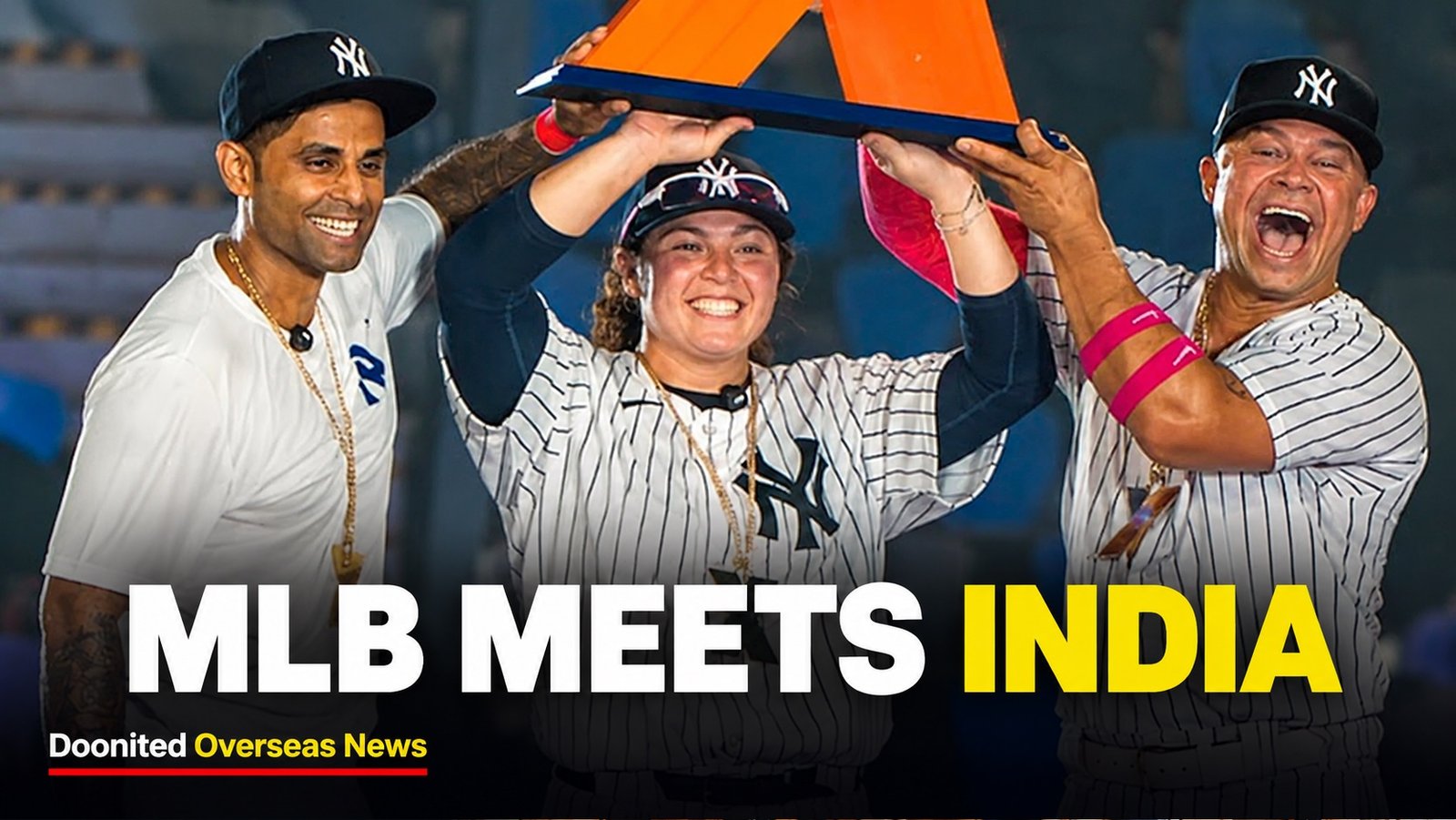
Yadav’s New York Yankees team won the tournament, defeating the Los Angeles Dodgers in the final. But the bigger ambition extended beyond the result: Major League Baseball wanted Indian audiences to experience a sport that remains far less familiar in India than cricket.
For an American league seeking international audiences, Mumbai offered a powerful combination of sporting celebrity, entertainment culture and a large potential fan base.
A new format for a different audience
MLBx is a modified baseball competition designed to make the sport faster and more accessible to spectators. Rather than following a traditional full-length baseball game, teams compete in a condensed format that rewards powerful hitting and defensive catches.
The Mumbai event featured four teams representing the New York Yankees, Los Angeles Dodgers, Boston Red Sox and Chicago Cubs. Each combined a former MLB player, an Indian cricketer and an athlete from the Athletes Unlimited Softball League.
The participants included Yadav, Shardul Thakur, Jitesh Sharma, Kashvee Gautam, Deepak Chahar and Radha Yadav. They played alongside former MLB stars Nick Swisher, Adrián González, Jonny Gomes and Jake Arrieta, as well as softball players Rachel Garcia and Jordan Woolery.
The scoring system rewarded home runs, accurate target hits and catches, with bonus points available for consecutive home runs. The format placed a premium on explosive hitting, quick decisions and athletic fielding.
Swisher, Yadav and Garcia represented the Yankees. Their team ultimately defeated González, Sharma and Woolery’s Dodgers in the final, winning 78–59.
Garcia was named the tournament’s most valuable player, underlining that the event was not simply a contest between cricket and baseball celebrities. Softball athletes were central competitors in their own right.
Why cricket and baseball make an intriguing pairing
Cricket and baseball share a basic sporting premise: a batter attempts to score while the opposing side tries to prevent runs and dismiss players. Both reward timing, hand-eye coordination, strategic thinking and the ability to read the ball.
Their differences, however, are substantial.
Cricket uses a pitch with wickets at each end, while baseball involves running around four bases. Cricket batters can score behind them and across a much wider field of play; baseball batters must hit into fair territory. Baseball also places a central emphasis on pitching technique, with fielders using gloves as standard equipment.
A cricketer’s experience may offer useful foundations for hitting, but it does not automatically translate into baseball proficiency. Timing, stance, bat mechanics, pitch recognition and the rules of play all require adjustment.
That distinction made the Mumbai event more than a novelty. It allowed audiences to see accomplished cricket players learning a different sport while former baseball professionals demonstrated the techniques developed through years of specialised training.
Thakur highlighted the similarity in hitting a ball hard while acknowledging the differences in technique. Yadav also expressed confidence that baseball could grow in India, pointing to physical preparation and disciplined practice as important ingredients.
The crossover created a common language for fans without pretending that the two games are interchangeable.
MLB’s wider ambitions in India
The event forms part of MLB’s broader effort to build international interest in baseball.
The league announced the Mumbai event in August 2026, identifying India as a significant potential growth market. Its partnerships include work with Suryakumar Yadav as an MLB ambassador and collaborations with RISE Worldwide and JioStar.
The event also went beyond the competition itself. Organisers included live music, interactive batting and pitching experiences, baseball-themed installations and food adapted to local tastes. Performances by Badshah, KR$NA and DJ OG SHEZ helped connect the event to India’s entertainment culture.
That combination matters because a sport cannot build a lasting audience simply by bringing famous players to a new market. It also needs opportunities for people to understand the game, try it themselves and find reasons to return.
The event’s organisers reported attendance by thousands of fans, including students from 35 schools. Such participation offers an initial measure of reach, although it does not establish how many attendees will become regular baseball players or followers.
The distinction between a successful event and sustainable sporting growth is important. A packed venue can generate publicity, but long-term development usually requires accessible coaching, equipment, local competitions and pathways for young players.
What the crossover means for global Indian sport
For overseas Indians and the wider diaspora, MLBx: Mumbai illustrates how sport can connect audiences across countries and sporting traditions.
Indian cricketers already enjoy international recognition, while American baseball has a global following that includes established audiences in countries such as Japan and South Korea. Bringing these athletes together gives both sides an opportunity to introduce their sport to people who might not otherwise follow it.
The model also shows how global sports organisations increasingly combine competition with music, food and interactive experiences to attract younger audiences.
Yet the event should be treated as a beginning rather than evidence that baseball is about to challenge cricket’s dominance in India. Cricket benefits from an established professional ecosystem, extensive media coverage, familiar local competitions and generations of participation. Baseball would need sustained investment and grassroots access to develop comparable reach.
The more realistic opportunity is to build a dedicated audience, create entry points for children and young athletes, and encourage Indian players to explore another international sport.
For MLB, Mumbai was a chance to make baseball tangible to a new audience. For Indian cricket fans, it was an invitation to see familiar sporting heroes outside their usual setting.
The Yankees’ victory supplied the evening’s headline. The larger test will be what happens after the lights go out: whether the excitement of a one-night crossover can translate into continued interest, local participation and a lasting place for baseball in India’s diverse sporting culture.

World Beyond the News
Octopuses Can Change Their Appearance
Octopuses can rapidly alter their skin colour and texture to communicate, camouflage themselves and respond to danger.
Some Cities Exist Across Two Continents
A small number of cities are geographically associated with two continents, creating unusual cultural and geographic identities.
Earth’s Climate Is Measured in Many Ways
Scientists track temperature, atmospheric gases, sea level, ice cover and other indicators rather than relying on a single climate number.
Streaming Changed How Audiences Discover Shows
Recommendation systems and global streaming releases allow audiences to discover programmes far beyond their original markets.