
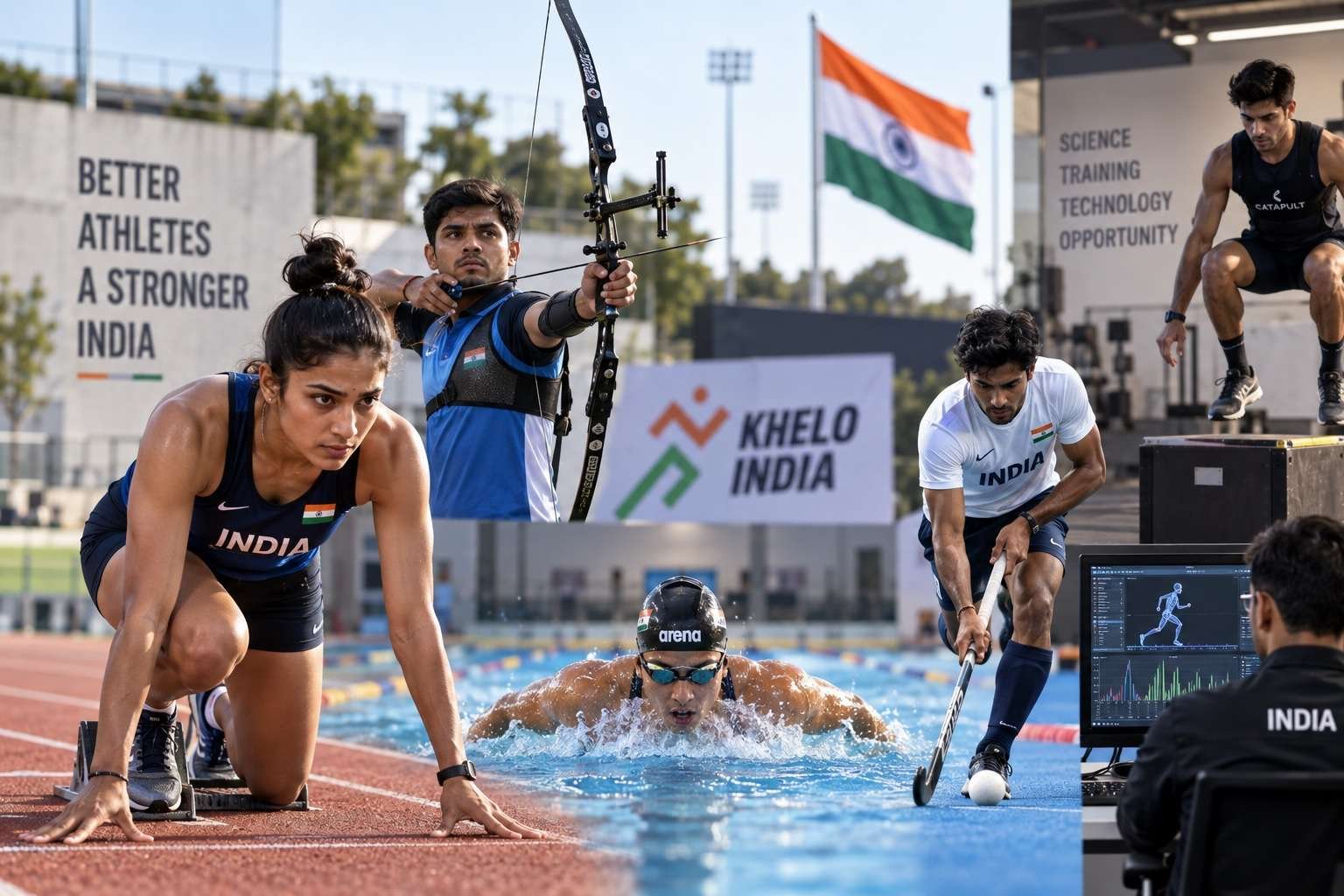
Beyond Cricket: How India Is Building a New Generation of Global Athletes
For a long time, India’s sporting ecosystem had a slightly peculiar hierarchy.
Cricket lived upstairs.
Everything else was expected to knock politely before entering.
That is changing.
Not because cricket has become less important—it hasn’t—but because India is gradually building something that did not exist at comparable scale before: a multi-sport athlete-development ecosystem combining government programmes, private investment, sports science, technology and international competition exposure.
The change is visible in athletics, badminton, boxing, wrestling, shooting, weightlifting, hockey and para-sports.
And increasingly, the Indian athlete is being trained not simply by a coach with a stopwatch, but by a team of coaches, physiotherapists, nutritionists, psychologists, biomechanists, analysts and medical specialists.
That may sound less romantic than the old sporting story.
It may also be much more important.
The biggest change is happening before the athlete becomes famous
India’s new sports strategy is increasingly concerned with the part of sport that spectators never see.
Talent identification.
Training loads.
Recovery.
Nutrition.
Injury prevention.
Biomechanics.
Psychological preparation.
Performance analytics.
And long-term athlete development.
The government describes Khelo India as a framework that combines grassroots participation with talent identification, training infrastructure, competitions and high-performance development. Its current architecture explicitly includes sports science and technology.
As of July 2026, the government reported:
- 1,067 Khelo India Centres
- 267 supported academies
- 2,745 Khelo India Athletes receiving support
- 349 new sports infrastructure projects approved
- More than 63,000 athletes participating in Khelo India Games since 2018.
That is not yet a guarantee of Olympic medals.
But it is something India historically lacked in sufficient depth:
a pipeline.
From finding talent to developing talent
One of India’s biggest sporting problems has never been a complete absence of talent.
The problem has often been finding it early enough and then giving it the right environment.
A talented sprinter from a small town, for example, does not become an international athlete simply because someone notices that the youngster runs quickly.
The athlete needs proper coaching.
A suitable track.
Strength and conditioning.
Nutrition.
Recovery.
Competition.
Medical support.
And eventually international exposure.
Khelo India’s current framework is explicitly designed around such progression, with pathways connecting grassroots centres, intermediate facilities and elite training environments.
The newer system is therefore trying to replace:
“We found a talented athlete.”
with:
“We found the athlete—and now we know what to do next.”
That is a major institutional change.
Sports science enters the dressing room
The phrase “sports science” can sound wonderfully sophisticated.
But its practical meaning is straightforward.
Why is an athlete getting injured?
How much training is too much?
How efficiently does the athlete move?
What should the athlete eat?
How quickly do they recover?
What technical change can produce a measurable improvement?
At the High Performance Centre in Guwahati, the government has highlighted sports-science laboratories, recovery and rehabilitation facilities, physiological and biomechanical assessment and athlete-support systems.
Khelo India’s current infrastructure strategy similarly includes biomechanics, nutrition, recovery, performance analytics and sports medicine.
This represents an important philosophical shift.
The athlete is no longer simply told:
“Train harder.”
The better question is:
“Train smarter—and prove that it is working.”
Private investment is filling another gap
Government programmes can build the national foundation.
But elite sport also requires specialised institutions capable of operating at very high performance levels.
This is where private-sector investment has become increasingly important.
The Inspire Institute of Sport (IIS) in Vijayanagar, Karnataka, is one of the most prominent examples.
JSW describes IIS as India’s first privately funded high-performance training centre. Its facilities include strength-and-conditioning laboratories, recovery and rehabilitation suites, video analytics, nutrition programmes and access to international coaches and former Olympians.
JSW says its wider sports programmes support more than 800 elite athletes across disciplines, including athletics, boxing, wrestling, judo and swimming.
The significance goes beyond one corporate group.
It demonstrates a broader principle:
elite sport increasingly requires specialised institutions rather than occasional bursts of sponsorship.
International exposure changes the athlete
There is another crucial ingredient.
Competition abroad.
An athlete can train perfectly for months in India and still discover that international competition feels entirely different.
Different opponents.
Different conditions.
Different pressure.
Different officiating environments.
Different travel demands.
Different expectations.
That is why India’s athlete-support systems increasingly include foreign training and international competition exposure.
The Target Olympic Podium Scheme (TOPS), for example, provides support for foreign training, international competitions, coaching camps and specialised equipment. PIB reported that as of April 2026, TOPS supported 51 Core Athletes, 52 Para Core Athletes and 130 Development Athletes.
That is important because medals are not produced only inside training centres.
They are produced when preparation survives contact with the world’s best.
Technology is becoming the new coach’s assistant
The next stage is data.
India’s emerging sports ecosystem increasingly uses performance tracking, video analysis and data-driven athlete development.
The government’s KIRTI talent-identification programme, for example, uses standardised assessment protocols and advanced IT tools including AI and data analytics. PIB reported 174 Talent Assessment Centres and more than 187,000 assessments completed.
Khelo India’s new infrastructure plans also envisage increasingly connected data systems and technology-led sports science and medicine.
This could eventually change talent discovery itself.
Instead of relying almost entirely on a coach’s eye, systems can increasingly compare measurable attributes.
Speed.
Power.
Reaction time.
Endurance.
Movement efficiency.
Growth patterns.
The human coach remains essential.
But the coach gets better information.
And that is probably the sensible way to use AI in sport.
Not to replace judgement.
To improve it.
The results are visible—but don’t exaggerate them
India’s international results have improved.
At the Olympics, India won two medals at Rio 2016, seven at Tokyo 2020 and six at Paris 2024.
The Paralympic trajectory has been even more striking: India’s medal count rose from four at Rio 2016 to 19 at Tokyo 2020 and 29 at Paris 2024, its best-ever Paralympic performance.
At the 2023 Asian Games in Hangzhou, India won 107 medals, its highest-ever Asian Games total.
These are substantial improvements.
But they should not be confused with becoming a global sporting superpower overnight.
India still faces enormous competition from countries with much deeper sporting systems and longer histories of investment.
The lesson is therefore not:
“India has solved sport.”
It is:
“India has begun building the machinery required to solve sport.”
That is more credible—and arguably more exciting.
Beyond cricket means more than winning medals
There is also an economic dimension.
A stronger sporting ecosystem creates jobs for people who never become Olympic athletes.
Sports physiotherapists.
Strength-and-conditioning coaches.
Nutritionists.
Sports psychologists.
Data analysts.
Biomechanists.
Sports managers.
Equipment manufacturers.
Event professionals.
Broadcasters.
Sports lawyers.
Performance scientists.
India’s 2026–27 Budget also includes a ₹500 crore initiative for sports-goods manufacturing, intended to expand domestic manufacturing, research, materials science and India’s participation in global sports supply chains.
That means India’s sports revolution could eventually become an industrial story as well.
The athlete may be the most visible part.
The ecosystem behind the athlete could become a much larger economic opportunity.
The uncomfortable question: who gets access?
This is where the success story needs some honesty.
Elite sports science is expensive.
High-quality facilities are expensive.
International travel is expensive.
Specialist coaching is expensive.
A wealthy athlete can often find a pathway much more easily than a talented child from a poor family.
That is why the grassroots component of Khelo India matters enormously.
The government says the revamped programme aims to ensure that talent is not lost because of geography, economic background or lack of opportunity.
But intention is not the same as outcome.
The real test will be whether a talented athlete from a remote district can actually progress from discovery to sustained elite training without being stopped by money, geography, education or family circumstances.
That is where India’s sporting revolution will either become genuinely national—or remain concentrated around successful centres.
DOONITED Editorial Perspective
India does not need to become a country where every child dreams of becoming an Olympic champion.
That would be neither realistic nor healthy.
It needs something more fundamental:
a country where a talented child has a realistic pathway if sport is genuinely their ability.
That means discovering talent early.
Training it scientifically.
Protecting the athlete from preventable injuries.
Providing education alongside sport.
Giving athletes international exposure.
And creating careers for the enormous professional ecosystem surrounding elite sport.
Cricket demonstrated that Indian sport can become a serious professional industry.
The next challenge is making that professionalism available to more sports and more athletes.
The scoreboard will eventually tell us whether India succeeds.
But the more important transformation may already be happening in laboratories, training centres and district-level competitions—places where there are no cameras and no endorsement deals.
The bigger insight
India’s sporting future will not be decided only by how many medals it wins.
It will be decided by how reliably it can produce high-quality athletes year after year.
One Neeraj Chopra can inspire a generation.
One Mirabai Chanu can change expectations.
One PV Sindhu can make millions of children pick up a racket.
But a genuine sporting nation needs hundreds of athletes, thousands of coaches and a deep professional ecosystem behind them.
That is the transition India is attempting now.
From finding exceptional individuals…
to building a system capable of producing excellence repeatedly.
And that is a much bigger sporting revolution than simply moving cricket down one place on the popularity chart.

World Beyond the News
Bees Communicate Where Food Is
Honeybees use movement patterns known as waggle dances to communicate information about food locations.
Street Food Reflects Local History
Many famous street foods developed from migration, trade, local ingredients and the everyday needs of working communities.
A Day on Venus Is Extremely Long
Venus rotates so slowly that one rotation relative to distant stars takes longer than its trip around the Sun.
Human Achievement Continues to Push Limits
Athletes, engineers, scientists and explorers regularly establish new benchmarks in speed, endurance, scale and precision.