
Its Athletes for an Unusual Asian Games in Japan
Imagine preparing for the biggest sporting competition in Asia and discovering that your bedroom may look more like a shipping container than an athletes’ village.
Now imagine your country’s sports authorities deciding that the best response is to build a similar container back home—and actually make athletes sleep in it.
That is exactly what India has been doing.
As the Aichi-Nagoya Asian Games approach, Indian athletes are preparing not only for opponents, venues and pressure but also for an unusual living environment in Japan.
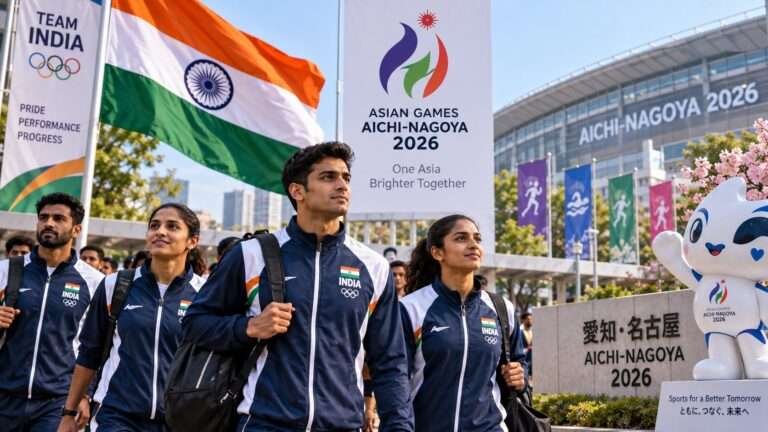
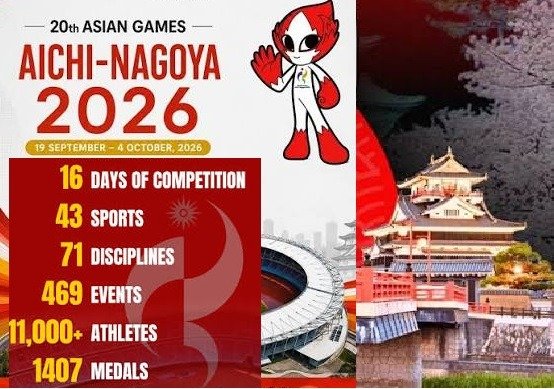
The Games run from September 19 to October 4, 2026, bringing together more than 11,000 athletes and 6,000 officials from 45 countries and regions.
And there is no conventional, single athletes’ village.
Instead, organisers are using a mixture of hotels, a cruise ship and temporary container-style accommodation.
India has decided that its athletes should not discover this surprise after landing in Japan.
So it has created its own little version of Japan at home.
Welcome to India’s “Little Japan”
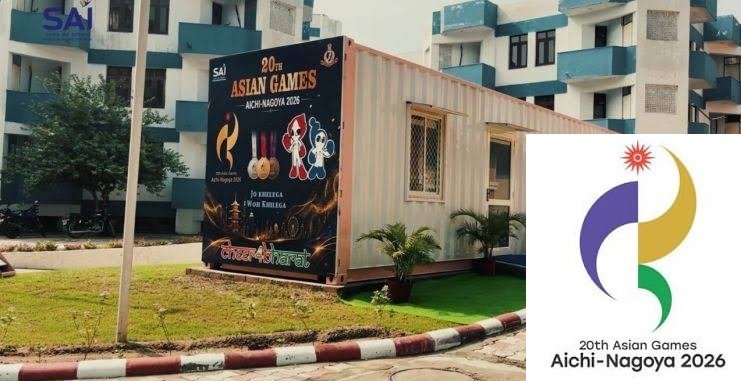
At Sports Authority of India (SAI) centres in Bengaluru and Patiala, athletes have been spending nights in specially prepared container-style rooms.
The Bengaluru units are based on approximately 40-foot containers and have been converted into accommodation with bedrooms, bathrooms, a small kitchen/pantry and living facilities. The purpose is not to recreate poverty or hardship.
It is to eliminate the element of surprise.
Reuters reported that SAI built two air-conditioned container-style units at its Bengaluru campus, each measuring about 40 feet by 10 feet and containing two twin bedrooms, two bathrooms, a small kitchen and a living area with television and music facilities. The units are intended to be reused after the Asian Games.
The thinking is remarkably practical.
An elite athlete spends years preparing to react to the smallest changes in technique.
Why not prepare for changes in accommodation too?
The room is only half the experiment
India’s preparation has gone beyond four walls.
The Bengaluru centre has reportedly been decorated with Japanese-themed elements including cherry blossoms and traditional lanterns.
Japanese books such as Ikigai and Kaizen have been placed inside.
And then there is the food.
Sushi has entered the training menu.
Ramen, tempura and yakitori have also been introduced as part of the Japanese-food familiarisation programme.
This may sound slightly amusing.
Indian athletes preparing for an Asian Games by reading Ikigai while eating sushi inside a converted shipping container sounds like the beginning of an unusually serious reality show.
But underneath the humour is a genuine sports-science principle:
reduce avoidable distractions before competition.
An athlete should be thinking about the starting line, not wondering whether dinner is going to agree with the stomach.
Why doesn’t Japan have a traditional athletes’ village?
The absence of a conventional athletes’ village is one of the defining logistical features of Aichi-Nagoya 2026.
The organisers decided against constructing a dedicated village and instead developed a distributed accommodation model.
The OCA has previously described plans for a cruise ship, temporary container homes and hotels. The cruise ship, Costa Serena, is being used as a floating accommodation facility, while temporary container homes at Garden Pier are part of the wider arrangement.
The model emerged partly from concerns over cost and accommodation capacity.
The scale of the Games is enormous.
The OCA says the event will involve more than 17,000 athletes and officials, while the organisers and OCA have confirmed that all registered participants have been provided with Games-appropriate accommodation.
That is an important clarification because earlier reports about accommodation shortages created considerable concern.
The problem was not ultimately that thousands of registered athletes would have nowhere to sleep.
The issue was that there would be no single purpose-built village serving everyone.
That is a very different situation.
A floating village—and a container village
The accommodation strategy is unconventional enough to sound fictional.
Some participants will stay in ordinary hotels.
Some will stay aboard the Costa Serena cruise ship.
Others will live in temporary container-style accommodation.
The cruise ship is effectively being turned into a floating Games village, while Garden Pier has been designated for temporary accommodation. Earlier OCA plans envisaged approximately 4,600 people on the cruise ship and around 2,400 in temporary container homes, although accommodation arrangements have evolved as the Games have approached.
There are obvious advantages.
Building a permanent athletes’ village for a 16-day event can leave a host city with an enormous post-Games real-estate problem.
Temporary accommodation and existing hotels can potentially reduce that legacy burden.
But there are disadvantages too.
Accommodation quality can vary.
Travel times can differ.
Athletes lose some of the traditional village experience—the spontaneous interaction between competitors from different countries, common dining spaces and the sense of living together in one sporting community.
A cruise ship, hotel and container complex can house people.
They do not necessarily create the same village atmosphere.
Then came the weather test
The unusual accommodation plan received a very real-world test this week.
Severe rainfall and flooding affected Nagoya, and approximately 400 athletes and staff staying in the Garden Pier container accommodation were temporarily evacuated to higher ground.
The athletes were reported safe.
Authorities said the Asian Games venues and athletes were not seriously affected, and preparations for the Games remained on track.
This development deserves attention because it adds an important qualification to the “container rooms are innovative” narrative.
Innovation is useful.
But location, drainage, weather resilience and emergency evacuation procedures matter just as much.
A container can be air-conditioned, beautifully furnished and decorated with Japanese lanterns.
It is still necessary to ask the most boring—but most important—question:
How does it perform when the rain arrives?
Fortunately, in this instance, the emergency response reportedly worked and the athletes remained safe.
That is the outcome that matters.
India has chosen preparation over complaint
There has been discussion around accommodation standards at the Games, including concerns from some sporting delegations.
India’s response has been notably pragmatic.
Rather than spending its energy complaining about an unusual arrangement, SAI has tried to make the unusual arrangement familiar.
That is an important difference.
An athlete who has never slept in a compact room may find the first night distracting.
An athlete who has already experienced it at home has one less surprise.
The same principle applies to food.
Changing diet suddenly before competition can create unnecessary problems.
Introducing athletes gradually to Japanese cuisine gives them an opportunity to understand what works for them before they arrive.
This is not about forcing an Indian athlete to become Japanese overnight.
It is about making Japan less unfamiliar.
But does sleeping in a container really improve performance?
Here we should maintain some healthy scepticism.
There is a difference between acclimatisation and performance enhancement.
There is a reasonable practical case for familiarising athletes with unfamiliar accommodation.
But there is not enough evidence to claim that sleeping in a container automatically makes someone perform better on the field.
Elite sport is influenced by training, coaching, nutrition, recovery, psychology, competition conditions and countless other variables.
The container is one small piece of the puzzle.
The danger would be turning a sensible logistical exercise into a marketing gimmick.
Fortunately, the units have another life after the Games.
Reuters reports that the Bengaluru facilities are planned to be repurposed as guest rooms.
So at least the experiment does not have to end with the Olympic-style question: “What are we going to do with this giant building now?”
India’s real preparation is much bigger
The container story is entertaining because it is visual.
But India’s preparation for the Asian Games extends far beyond accommodation.
The Ministry of Youth Affairs and Sports has been coordinating the Indian contingent, and the government has formally processed participation for the Aichi-Nagoya Games.
India enters the Games after a record medal haul at the previous Asian Games in Hangzhou, where it won 107 medals.
The challenge now is not simply to repeat a number.
It is to develop a sporting system capable of producing strong performances across athletics, shooting, badminton, wrestling, archery, hockey, weightlifting, swimming, cricket and other disciplines.
Accommodation may make the headlines.
Training makes the medals.
And then there is the Japanese experience
There is another layer to India’s preparation that deserves more attention.
International competition is also cultural exposure.
Athletes have to navigate a different language, food, transportation system, climate, social environment and sporting culture.
The Bengaluru “Little Japan” experiment is therefore not entirely about containers.
It is about reducing cultural friction.
Even something as simple as understanding unfamiliar food or knowing what to expect from accommodation can save mental energy.
At elite level, small advantages matter.
Sometimes the difference between being comfortable and uncomfortable is not measured in seconds.
It is measured in concentration.
DOONITED Editorial Perspective: The container is actually the metaphor
There is a temptation to laugh at the image of Indian athletes sleeping in shipping containers before travelling to Japan.
And yes, it is funny.
Indian athletes preparing for Japan by turning Bengaluru into a miniature Japan—with sushi, lanterns, Ikigai and containers—is certainly not the most conventional sports story.
But the deeper story is about professional preparation.
India’s sporting ambitions are becoming increasingly sophisticated.
The athlete is no longer expected simply to train hard and “adjust.”
The system is beginning to ask:
What will the athlete eat?
Where will the athlete sleep?
How will the athlete recover?
What unfamiliar conditions might affect concentration?
How can those conditions be simulated before departure?
Those are the questions asked by high-performance sporting systems.
The important lesson is therefore not:
“India has built container rooms.”
It is:
“India is increasingly trying to prepare athletes for the entire competition environment, not just the competition itself.”
That is a much more meaningful development.
The medal race begins before the starting gun
The Aichi-Nagoya Asian Games will ultimately be judged by sporting performance.
Nobody awards a medal for successfully sleeping in a container.
Nobody gets a podium place for eating sushi.
But if those preparations remove one distraction from an athlete’s mind, they have served their purpose.
And that may be the best way to understand India’s unusual “Little Japan.”
It is not a gimmick.
It is a rehearsal.
The athletes will soon leave Bengaluru and Patiala for Japan.
The containers will remain behind.
The medals will be decided elsewhere.
And after all the jokes about sushi, lanterns and shipping containers disappear, one principle will remain:
In elite sport, preparation is not what happens before the real competition. Preparation is already part of the competition.

World Beyond the News
Birds Can Navigate Using Earth’s Magnetic Field
Several bird species can sense Earth’s magnetic field, helping them navigate during long-distance migration.
Fermentation Is a Global Food Tradition
People across continents have used fermentation for centuries to preserve food and create distinctive flavours.
Modern Batteries Store Energy Chemically
Rechargeable batteries repeatedly move ions between electrodes, allowing electrical energy to be stored and released.
Why Songs Become Global Hits
Streaming platforms, short-form video, playlists and international collaborations can rapidly carry music across borders.