

Container Rooms, Comebacks and a New Generation Ready to Take the Fight to Asia
India’s preparations for the Aichi-Nagoya Asian Games 2026 have entered an unusual final stretch.
There are elite athletes, world champions, Olympic medallists and defending champions.
There are also — rather surprisingly — shipping containers.
Yes, containers.
As India prepares to send a 768-member delegation to Japan, the country’s sports establishment has gone beyond conventional training. Athletes have been sleeping in specially modified container-style accommodation in India to experience the sort of living arrangements they may encounter in Japan.
If this sounds like an elaborate reality show called Bigg Boss: Athlete Edition, there is actually some serious science behind it.
And that strange preparation is only one part of a much bigger story.
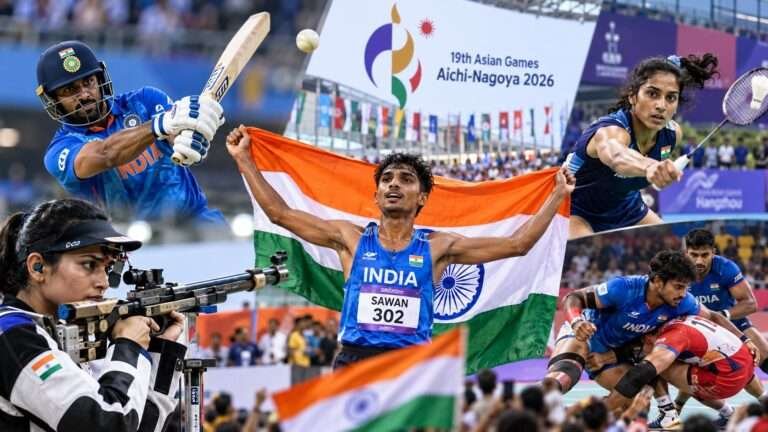
India is arriving at the 20th Asian Games with a large contingent, several established stars, a few painful absences and a growing group of athletes who are beginning to believe they belong on the biggest stages in Asia.
768 Indians, 36 sports and one complicated mission
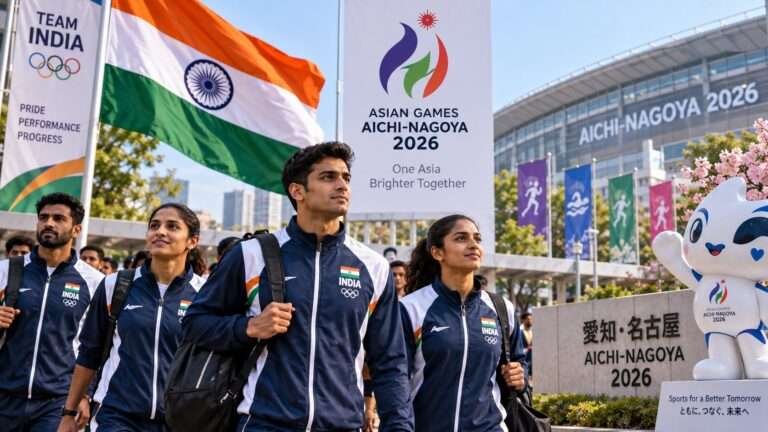
The Sports Ministry has cleared a 768-member Indian contingent, comprising 503 athletes, 246 officials/support staff and 19 contingent staff.
The Games will be held in Aichi-Nagoya from September 19 to October 4, with India competing across 36 sports. The athlete contingent itself was expanded from the earlier 492 approved in August.
The numbers are impressive.
But the more important statistic will come later:
the medal tally.
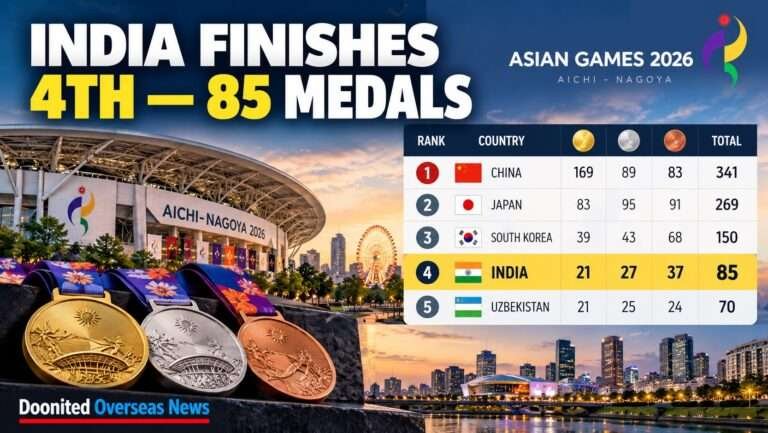
India won a record 107 medals at the Hangzhou Asian Games, including 28 gold medals, finishing fourth overall.
The challenge in Japan is therefore not simply to participate.
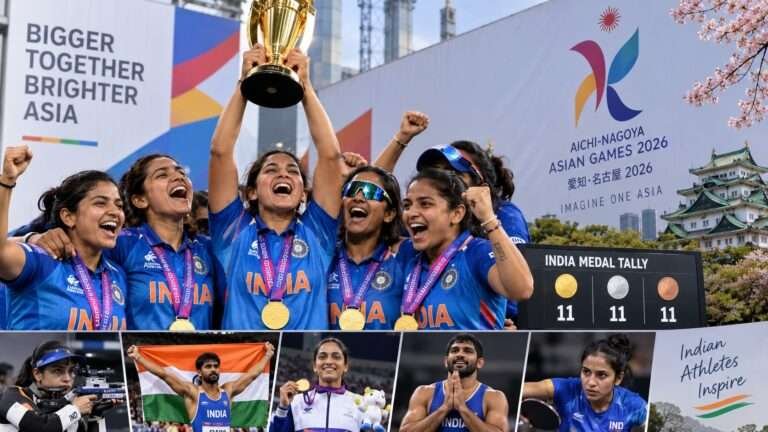
It is to prove that Hangzhou was not a one-off.
The strange case of the Indian shipping containers
One of the most unusual preparations involves accommodation.
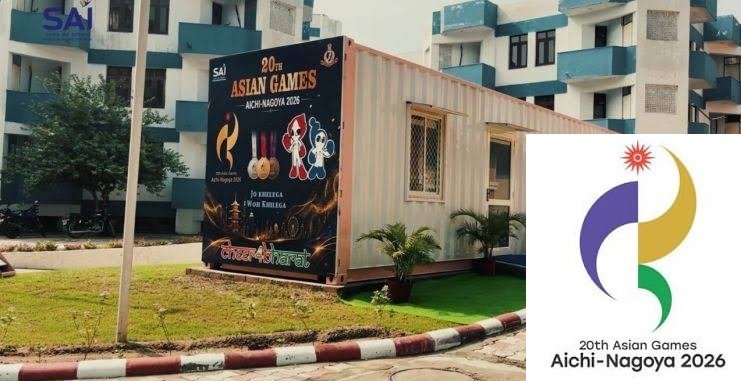
Aichi-Nagoya 2026 is not following the traditional model of a single giant athletes’ village. Accommodation arrangements include hotels, a cruise ship and temporary container-style facilities.
To reduce the shock of arriving in Japan and discovering that the bed is not exactly what the athlete imagined, the Sports Authority of India has created replica container accommodation at its facilities.
Reuters reported that SAI constructed air-conditioned units at its Bengaluru campus. Each 40-foot-by-10-foot unit contains two twin bedrooms, bathrooms, a small kitchen and a living area. Similar preparation has also been undertaken at Patiala.
The logic is simple.
Athletes train their bodies for years.
Why not train them for their living environment too?
Sleep affects recovery. Recovery affects performance. Unfamiliar surroundings can disturb routines.
At the elite level, sometimes the difference between winning and losing is not another hour in the gym.
It is getting a proper night’s sleep.
India has apparently decided to test that theory before reaching Japan.
The biggest absence: Neeraj Chopra
There is, however, a major disappointment.
Neeraj Chopra will not be in Aichi-Nagoya.
The Olympic and world champion suffered an ankle ligament tear during training after producing a season’s best 88.05m at the Lausanne Diamond League. He subsequently ended his 2026 season and withdrew from the Asian Games.
Yashvir Singh, a Commonwealth Games bronze medallist, has replaced him in India’s athletics squad.
For India, it is a significant loss.
Chopra was not simply another athlete in the contingent. He was a favourite for gold and one of the most recognisable faces of Indian sport.
But elite sport has a cruel rule:
The starting line does not care about reputation.
Injury can remove even the biggest champion from a competition overnight.
India will therefore have to compete without the man who had been expected to lead the javelin challenge.
That also creates an opportunity for someone else.
Yashvir Singh now has perhaps the most obvious version of the sporting dream:
replace the country’s biggest star — and make the opportunity count.
PV Sindhu, Manu Bhaker and Mirabai Chanu carry experience
India still has a formidable group of established names.
Two-time Olympic medallist PV Sindhu will lead the badminton challenge alongside the reigning Asian Games men’s doubles champions Satwiksairaj Rankireddy and Chirag Shetty.
Shooting will feature Manu Bhaker, who is competing in both the 10m air pistol and 25m sports pistol events.
Weightlifting will again look toward Mirabai Chanu, while boxing and wrestling bring several athletes with international pedigree.
These names provide something every major multi-sport team needs:
experience under pressure.
Because Asian Games medals are not won merely by being talented.
They are won by surviving the moment when thousands of people are watching and your hands suddenly remember that they are, unfortunately, attached to a nervous human being.
Then comes Sheetal Devi
If Neeraj Chopra represents the established superstar, Sheetal Devi represents something equally powerful: the expansion of India’s sporting imagination.
At the World Archery Para Series Stage 3 in Ahmedabad, Sheetal reached the women’s compound individual final after defeating compatriot Sarita 145-143 in an all-Indian semifinal.
That guarantees India at least a silver medal in the event.
She will face Kazakhstan’s Aizada Seidan for gold.
Sheetal’s story is remarkable because she competes without arms, using her feet, legs and body control to operate the bow.
But there is a danger in repeatedly describing athletes such as Sheetal only through their disability.
The more important sporting fact is this:
She is an elite archer.
Her medals are not charity.
Her opponents are not giving her points.
She has earned her place through technique, concentration and extraordinary control.
That is how disability sport should increasingly be viewed — not simply as inspiration, but as high-performance sport.
Satwik and Chirag arrive with momentum
Badminton has supplied another timely boost.
Satwiksairaj Rankireddy and Chirag Shetty finally conquered the China Masters, defeating China’s He Ji Ting and Ren Xiang Yu 11-21, 21-13, 21-17 in the final.
The victory came after they had finished runners-up at the tournament in 2023 and 2025.
This time, they did not leave Shenzhen with silver.
They left with the trophy.
It was their second title of the 2026 season, after the Singapore Open Super 750.
And the timing could hardly be better.
They are the defending Asian Games men’s doubles champions.
Momentum is not a medal.
But confidence at the right moment can be worth quite a lot.
Cricket provides a different kind of headline
While Asian Games preparations dominate the immediate sporting calendar, Indian cricket is producing its own drama.
The BCCI has withdrawn Rohit Yadav from India’s Under-19 squads for the Australia series after scrutiny revealed discrepancies in his age records.
Aryan Savsani has replaced him in the one-day squad and Tanmay Baloda in the multi-day squad.
The episode is uncomfortable but important.
Age-group sport exists precisely to create a fair pathway for young athletes.
If age manipulation occurs, genuine younger players can lose opportunities to competitors who are older or physically more developed.
So this is not merely an administrative problem.
It is a question of sporting integrity.
And perhaps the lesson is simple:
Talent should win the race — not paperwork that has been creatively edited.
Ishan Kishan makes a different statement
Meanwhile, Ishan Kishan has produced a performance that cannot be ignored.
The wicketkeeper-batter smashed 270 from 334 balls in the Duleep Trophy final, including 30 fours and seven sixes, helping East Zone reach 708.
Whether that automatically earns him a Test recall is another question.
It should not.
One innings does not erase selection competition or guarantee an international place.
But it does something important:
It puts the name back into the conversation.
In domestic cricket, the best argument a player can make is still the oldest one:
score runs.
Karan Singh quietly wins in Bali
Away from the giant headlines, Indian tennis has another encouraging story.
Karnal’s Karan Singh won the ITF Men’s World Tennis Tour M15 title in Bali, defeating New Zealand’s Isaac Becroft 7-5, 7-6(3).
He did not drop a set during the tournament.
The victory is his third title of 2026 and fourth career title, with his 2026 tally including a doubles title in Astana.
These tournaments may not receive the television attention of Grand Slams.
But this is where professional tennis careers are built.
A player does not suddenly wake up one morning as a Grand Slam contender.
There is a long, unglamorous staircase between junior tennis and the world’s biggest courts.
Karan Singh is climbing it.
India’s real sporting challenge
The excitement surrounding the Asian Games is understandable.
But there is a larger question behind India’s growing medal ambitions.
Can India turn individual success into a deep sporting system?
That means better coaching.
Better sports science.
More competition.
Stronger grassroots programmes.
Reliable injury management.
Transparent selection.
Better facilities outside the traditional metropolitan centres.
And perhaps most importantly, a pathway in which athletes do not have to become national sensations before receiving serious support.
India has repeatedly demonstrated that exceptional individuals can emerge.
The harder task is producing exceptional athletes consistently.
DOONITED Editorial Perspective: The container is actually the metaphor
The most amusing part of India’s Asian Games preparation may also contain the most serious lesson.
India is putting athletes into shipping-container rooms so they can prepare for Japan.
At first glance, it sounds bizarre.
But elite sport has always been about controlling details that ordinary people barely notice.
Sleep.
Food.
Travel.
Recovery.
Temperature.
Equipment.
Mental preparation.
The container is therefore not really the story.
Preparation is.
And that is where Indian sport appears to be changing.
The country is increasingly treating athletes as high-performance professionals rather than simply talented individuals who are expected to “do their best.”
That shift matters.
At the same time, India should resist the temptation to judge the entire sporting system by the medals won in September.
A successful Asian Games campaign would be wonderful.
But one gold medal does not build a sporting ecosystem.
Nor does one disappointing performance destroy one.
The real victory would be creating a system in which today’s Sheetal Devi, Manu Bhaker, Satwik-Chirag or Karan Singh is not an isolated success story, but one of many athletes coming through the pipeline.
Because medals are the scoreboard.
The system is the real competition.
And if India gets that part right, the medal table may eventually take care of itself.
The takeaway
India goes into Aichi-Nagoya with 503 athletes, established Olympic stars, defending champions, emerging talent and a few painful absences.
Neeraj Chopra’s injury is a major setback. But PV Sindhu, Manu Bhaker, Mirabai Chanu, Satwik-Chirag and many others give the contingent considerable experience.
Sheetal Devi’s latest para-archery performance provides another reminder that India’s sporting story is becoming broader.
And the container-room experiment, strange as it sounds, tells us something important about modern elite sport:
Winning increasingly begins long before the competition begins.
Sometimes it begins with a training session.
Sometimes with rehabilitation.
Sometimes with a young player winning an obscure tournament in Bali.
And apparently, sometimes it begins by sleeping in a shipping container.

World Beyond the News
Bees Communicate Where Food Is
Honeybees use movement patterns known as waggle dances to communicate information about food locations.
Street Food Reflects Local History
Many famous street foods developed from migration, trade, local ingredients and the everyday needs of working communities.
A Day on Venus Is Extremely Long
Venus rotates so slowly that one rotation relative to distant stars takes longer than its trip around the Sun.
Human Achievement Continues to Push Limits
Athletes, engineers, scientists and explorers regularly establish new benchmarks in speed, endurance, scale and precision.