
Nithya Raman’s Los Angeles Victory: From Kerala to Leading One of America’s Largest Cities
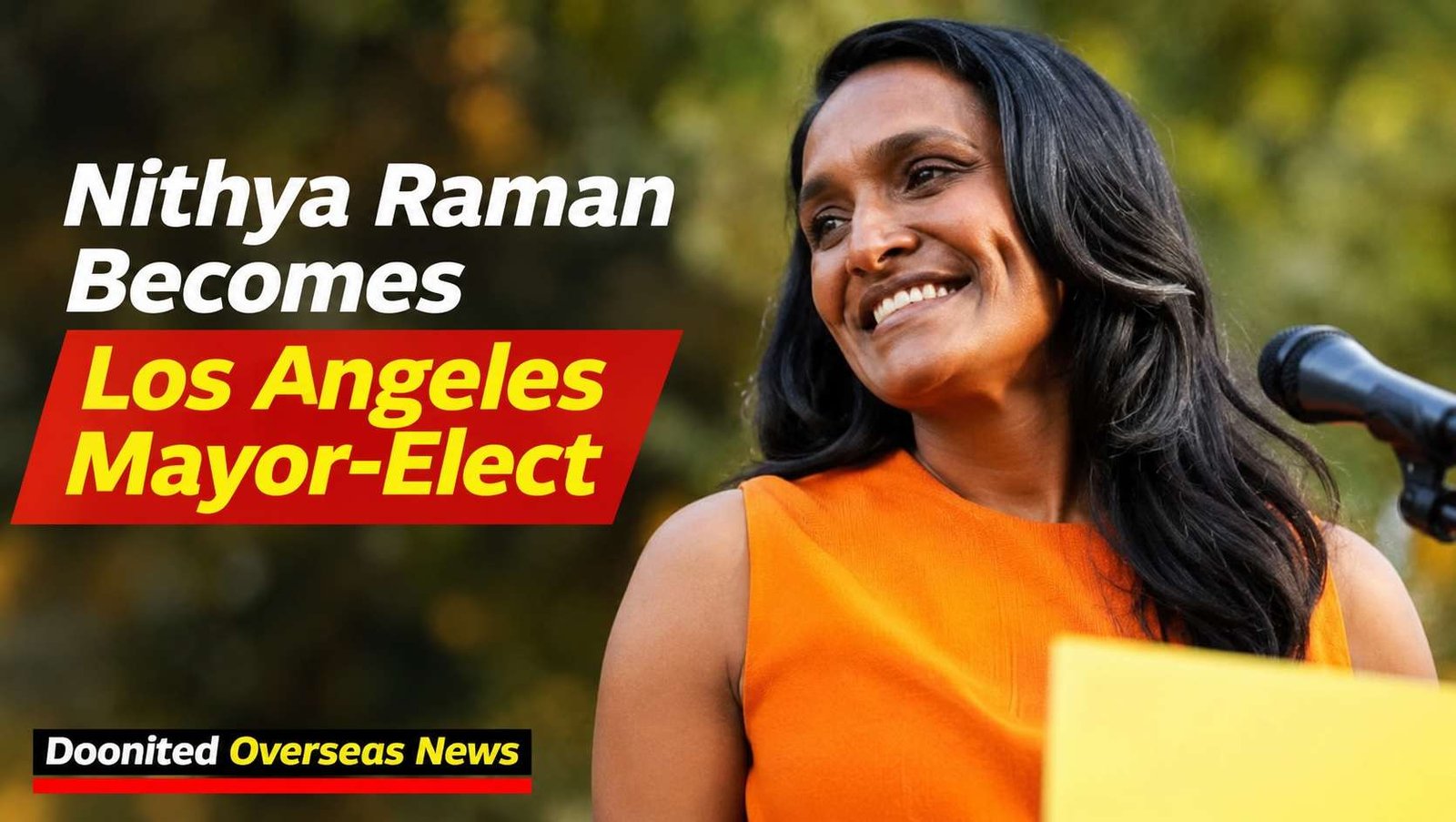
Born in Thrissur and raised largely in the United States, Nithya Raman has defeated incumbent Karen Bass to become Los Angeles’s next mayor. Her journey from urban-planning work in India to political leadership in California offers a significant story of immigrant participation—and places her at the centre of some of America’s most difficult urban challenges.
When Nithya Raman moved to the United States with her family at the age of six, a future in American city government was far from inevitable. Four decades later, the India-born urban planner has made political history by defeating incumbent Mayor Karen Bass in Los Angeles, becoming the first South Asian mayor-elect of the city.
The November 3, 2026 election was a major upset. Bass conceded on November 5 after the continuing ballot count established Raman’s lead. The latest figures published by the Los Angeles County election-results portal show Raman with 608,897 votes, or 54.81 per cent, against Bass’s 502,000 votes, or 45.19 per cent. The result makes Raman the first challenger to unseat a sitting Los Angeles mayor since 2005.
For the Indian diaspora, her victory is a milestone in political representation. But Raman’s story is also distinctive because her professional experience connects urban challenges in India with the problems facing one of the largest cities in the United States.
From Thrissur to Harvard and MIT
Raman was born in Thrissur, Kerala, and moved to the United States with her family when she was six. Her family settled in Massachusetts, where she grew up and pursued her education.
She graduated in Social Studies from Harvard University in 2003 and subsequently completed a master’s degree in urban planning at the Massachusetts Institute of Technology in 2008.
Her academic interests were closely connected to questions of public infrastructure, inequality and the way cities serve their residents. Rather than moving directly into American electoral politics, she returned to India after her undergraduate studies and became involved in urban development work.
That experience would become an important part of her professional identity.
India’s urban poor and the origins of Transparent Chennai
Raman worked with organisations supporting low-income communities and people facing displacement in Indian cities. In Delhi, she was involved in work concerning slum residents and resettlement, including the pressures surrounding preparations for the 2010 Commonwealth Games.
She later founded Transparent Chennai in 2010, a civic initiative that used maps, data and community participation to document gaps in urban services.
The initiative focused on issues that often remain poorly represented in official planning: public toilets, sanitation, bus routes and basic infrastructure in low-income neighbourhoods. By documenting these gaps, the organisation sought to give residents better evidence with which to demand public services and participate in municipal decision-making.
The approach reflected a central idea in Raman’s later work: city planning should not be limited to large infrastructure projects or official statistics. It should also consider the everyday experience of residents who are often left out of planning processes.
Her experience in India provides a meaningful connection to her subsequent work in Los Angeles, although the two cities have different administrative systems and social conditions.
From neighbourhood activism to City Hall
Raman moved to Los Angeles in 2013 and became involved in neighbourhood-level work on homelessness. She co-founded the SELAH Neighborhood Homeless Coalition, which brought together community groups and residents concerned about the growing homelessness crisis.
Her involvement in local issues eventually led her into electoral politics. In 2020, she defeated incumbent David Ryu to represent Los Angeles City Council District 4. She was re-elected in 2024.
During her time on the council, she focused on affordable housing, renter protections, homelessness services and neighbourhood improvements. Her official council profile describes her work on homelessness, housing affordability and climate goals.
Her political support included the Los Angeles chapter of the Democratic Socialists of America. That endorsement should not be mistaken for evidence that all Indian-American voters supported her political programme. Her victory emerged from a citywide contest involving housing, public services, leadership and dissatisfaction with the incumbent administration.
The challenges awaiting the new Mayor
Raman’s election victory does not mean that Los Angeles’s problems have been solved. In fact, the city’s challenges will test her ability to turn campaign commitments into workable policy.
Homelessness remains among the most urgent concerns. The city must improve access to housing and support services while addressing the needs of people living in encampments. Raman has advocated stronger accountability for public spending on homelessness and changes to the way the city evaluates its programmes.
Housing affordability is another major challenge. She has proposed increasing housing construction, expanding affordable options and making it easier to build in parts of the city where development has been restricted.
Public safety, street conditions, transport, parks and the delivery of basic municipal services will also demand attention. Los Angeles is preparing for the 2028 Olympic Games, which adds pressure to improve infrastructure, transport and the city’s international image.
The mayor will also need to work with the City Council, public agencies and community organisations. Winning the election gives Raman a mandate to lead, but it does not give the mayor unilateral control over every city policy or budget decision.
The Associated Press has highlighted the difficult financial and political environment awaiting her, including a strained city budget, homelessness and the need to build trust across communities.
What her victory means for the diaspora
Raman’s rise is significant for Indian-origin communities in the United States because it demonstrates a route into public leadership that begins with professional expertise and local participation.
Her journey did not begin with a high-profile political campaign. It developed through education, urban research, community organising and engagement with neighbourhood problems. Her experience also illustrates how skills acquired in India can inform public-service work overseas.
For younger Indian-origin residents, particularly those studying urban planning, public policy, architecture, social work and civic administration, her career offers an example of how professional knowledge can translate into public leadership.
Yet her mayoralty will ultimately be judged by the people of Los Angeles, not by her ancestry or birthplace.
Raman now faces the task of governing a diverse city with competing priorities and limited resources. Her experience in India may provide valuable perspectives, but the real test will be whether she can deliver better housing, more effective homelessness programmes, safer neighbourhoods and more responsive public services.
From Thrissur to Los Angeles, her journey has reached a historic milestone. The next chapter will determine whether that achievement becomes a lasting record of effective urban leadership.

World Beyond the News
Dolphins Use Individual Signature Whistles
Bottlenose dolphins develop distinctive whistles that function somewhat like individual acoustic identifiers.
The Pacific Is Earth’s Largest Ocean
The Pacific Ocean covers more area than any other ocean basin and stretches between Asia, Australia and the Americas.
Artificial Intelligence Learns Statistical Patterns
Modern machine-learning systems identify patterns in large datasets and use those patterns to generate predictions or outputs.
Why Some Stories Spread So Quickly
Emotion, novelty, visual appeal and easy sharing can make a story travel rapidly across social platforms.