
Many Faiths, One Light: Melbourne’s Interfaith Diwali Gathering Turns Cultural Celebration into a Dialogue on Understanding
Can a festival rooted in one religious tradition become a meeting point for people of many faiths without losing its original meaning? A gathering in Melbourne offered one answer.
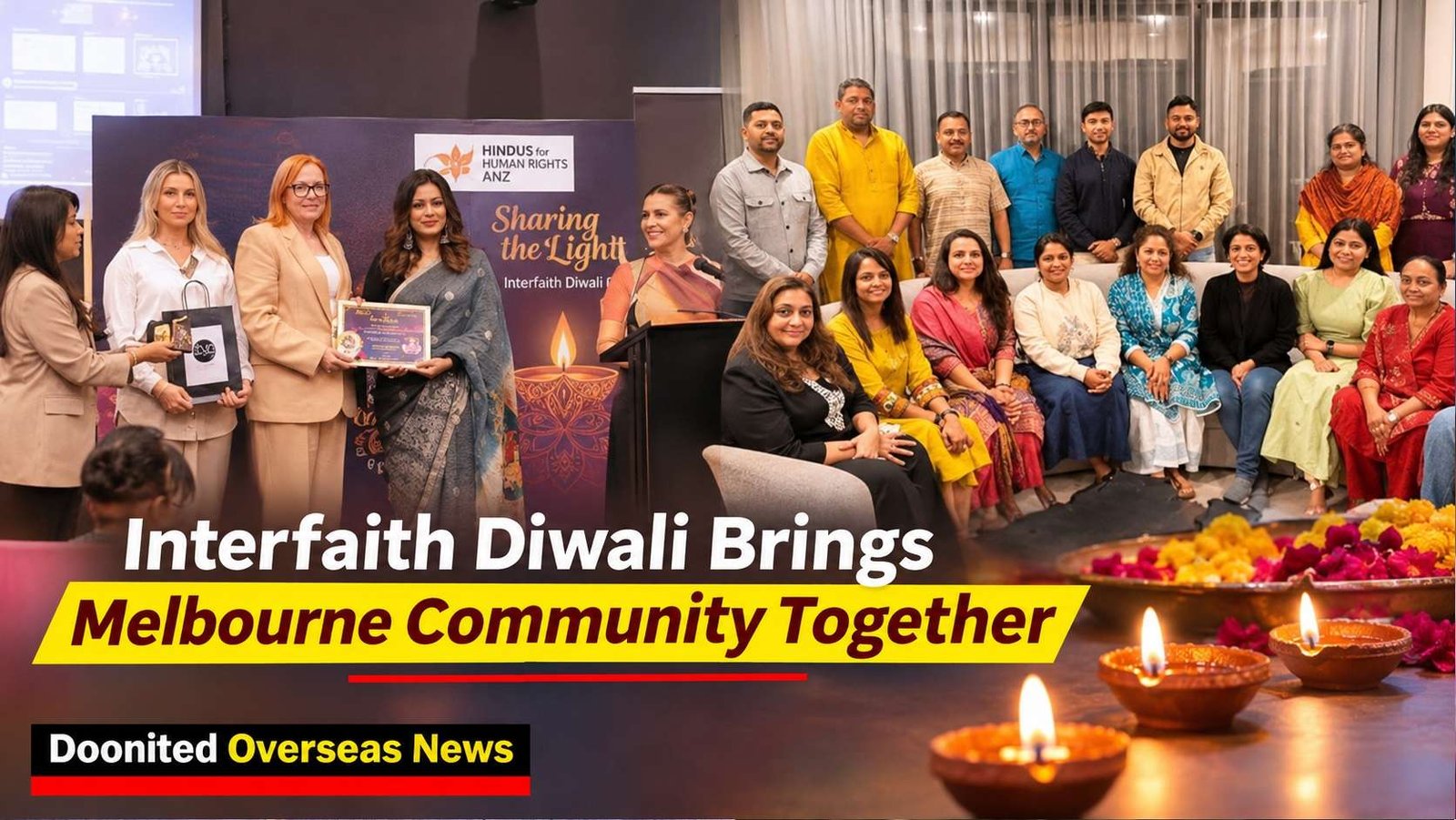
More than 100 people from different religious and cultural backgrounds attended Sharing the Light, an interfaith Diwali celebration held on October 25, 2026, at Manningham Uniting Church and Community Centre in Templestowe. Organised by Hindus for Human Rights Australia & New Zealand (HfHR ANZ), the event brought together representatives of Hindu, Sikh, Muslim, Jain, Jewish, Christian, Bahá’í and Buddhist traditions, alongside people from Greek, Palestinian, Tibetan and Chinese communities.
Rather than treating Diwali simply as a festival of lights, the gathering explored how light appears in different religious teachings, cultural practices and everyday expressions of hope.
For Australia’s Indian diaspora, the event demonstrated how a festival associated with Indian heritage can also create opportunities for wider community engagement. Its significance lay not in suggesting that all faiths share identical beliefs, but in allowing different communities to explain their traditions in their own voices.
A Hindu festival in a Christian community centre
The choice of venue carried a message of its own. A celebration associated with Hindu traditions took place at a Uniting Church community centre, providing a setting for religious and cultural exchange.
The evening began with an Acknowledgement of Country recognising the Wurundjeri Woi-wurrung people of the Kulin Nation, the Traditional Owners of the land. Manningham councillor Carli Lange, speaking on behalf of the mayor and council, welcomed participants. Elmina Joldic, Director of Operations and Strategy at the Ethnic Communities’ Council of Victoria, also addressed the gathering.
Nandini Sen Mehra, Director of Hindus for Human Rights, described the event as an opportunity to approach other traditions with curiosity and respect.
The programme included a semi-classical Kathak performance by Sanditi, followed by a ceremonial lamp-lighting involving community representatives and councillors. The gathering then moved into a series of reflections on the meaning of light across faiths and cultures.
Different traditions, different meanings of light
The speakers demonstrated that the symbolism of light is not confined to one religious community.
Maneeza Rahmany reflected on light in Islam as a source of spiritual guidance and hope. Fayez Othman spoke about olive-oil lamps in Palestinian traditions and the Quranic imagery of divine light.
Tenzin Norzin discussed Tibetan Buddhist butter lamps and their association with wisdom and prayer. Priyanka Jain presented the significance of light in Jain observances, while Swami Sunishtananda explained its place in Hindu philosophy as a symbol of inner wisdom and human connection.
Siamak Naimi discussed the Bahá’í understanding of spiritual light. Konstandina Dounis spoke about the symbolism of fire in ancient Greek traditions, and Jia Hu introduced Chinese celebrations, including the Lantern Festival.
Jewish traditions were represented by Lital Weizman, who brought a Hanukkah menorah and discussed the significance of candle-lighting, including Shabbat practices. A Christian reflection by Reverend Alison Sampson of Manningham Uniting Church was read by Stephanie Jones.
The contributions did not erase the differences between these traditions. Instead, they showed how a familiar symbol can carry distinct theological, historical and cultural meanings.
Bandi Chhor Divas and the shared significance of Diwali
One of the important connections explored during the gathering was the Sikh observance of Bandi Chhor Divas, which coincides with Diwali in 2026.
Gurvinder Singh Atwal recounted the Sikh tradition associated with the sixth Sikh Guru, Guru Hargobind Sahib. According to Sikh tradition, the Guru secured the release of 52 detained rulers when he was freed from imprisonment at Gwalior Fort. The occasion is remembered as Bandi Chhor Divas, or the Day of Liberation.
The observance is particularly significant because it connects the symbolism of light with freedom, compassion and the refusal to accept liberation for oneself alone.
Diwali and Bandi Chhor Divas have distinct religious histories, even though their celebrations often fall together. Recognising both allows interfaith gatherings to acknowledge shared calendar moments without treating different traditions as interchangeable.
The programme also included an Ambedkarite perspective on Dr B.R. Ambedkar and Navayana Buddhism through a display exploring light across faiths and cultures.
Culture as a bridge between generations
Music and dance helped give the gathering a celebratory character. Classical vocalist Bimal performed a song by the mystic poet Kabir, accompanied by Jigar on tabla. The evening concluded with a Garba performance led by Krishna and her team, with guests joining the dance.
Dr Shanti Raman, Chair of HfHR ANZ, said such gatherings were intended to strengthen relationships between communities through intercultural celebration.
The event received support from Manningham City Council’s Community Grants programme, NRI Affairs and The Humanism Project. Its free-entry format also made it accessible to people beyond a single religious or cultural organisation.
What the gathering means for Australia’s Indian diaspora
Australia’s Indian-origin communities are diverse in language, regional background, religious affiliation and migration history. Their public celebrations increasingly take place within a wider multicultural environment, involving neighbours, civic institutions and communities with different histories.
That creates an opportunity—and a responsibility. Cultural outreach is most meaningful when it does not reduce religious traditions to decorative symbols or assume that everyone interprets them in the same way.
Sharing the Light offered a practical example of how an Indian festival can become a platform for dialogue while retaining its cultural identity. Its acknowledgement of First Nations custodianship also situated the gathering within Australia’s own history and responsibilities.
A single event cannot establish how much interfaith understanding has improved across Melbourne. But it can create relationships, introduce unfamiliar traditions and give communities a reason to meet beyond moments of disagreement or crisis.
The lasting value of the gathering may therefore lie not simply in the lamps that were lit, but in the conversations that followed. For the Indian diaspora, Diwali’s international reach is not only about taking a festival abroad; it is also about creating spaces where heritage can be shared, understood and respected.

World Beyond the News
Bees Communicate Where Food Is
Honeybees use movement patterns known as waggle dances to communicate information about food locations.
Street Food Reflects Local History
Many famous street foods developed from migration, trade, local ingredients and the everyday needs of working communities.
A Day on Venus Is Extremely Long
Venus rotates so slowly that one rotation relative to distant stars takes longer than its trip around the Sun.
Human Achievement Continues to Push Limits
Athletes, engineers, scientists and explorers regularly establish new benchmarks in speed, endurance, scale and precision.