
India and Ireland in 2026: A Relationship Moving From Friendship to Partnership
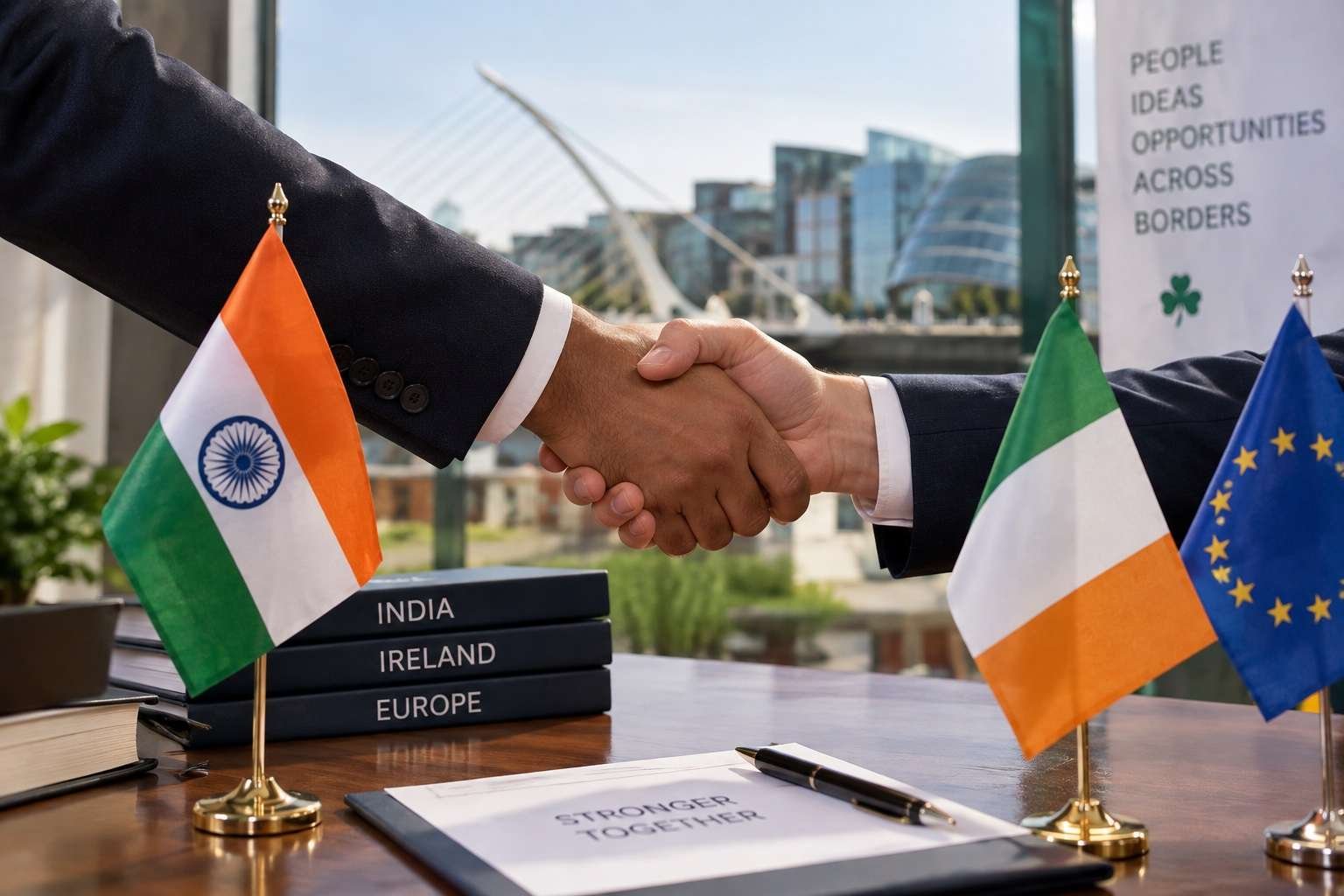
India-Ireland relations are entering a more practical phase — one where diplomacy is increasingly being measured not only by handshakes, but by trade, students, businesses, communities and the ability to deal honestly with problems.
At first glance, India and Ireland might seem like an unlikely pair.
One is a population giant in South Asia. The other is a relatively small European nation.
Yet the relationship between them has been quietly expanding for decades — through education, technology, pharmaceuticals, business, culture and, increasingly, through the Indian community living and working in Ireland.
Today, more than 80,000 Indians are estimated to live in Ireland, while more than 8,000 Indian students were studying there in 2023, according to Ireland’s official international website. Two-way trade in goods and services has also grown substantially, with Ireland reporting annual trade of more than €16 billion.
The interesting question is no longer whether India and Ireland have a relationship.
It is what that relationship can become next.
From diplomatic friendship to economic opportunity
India and Ireland established diplomatic relations in 1949, and Ireland opened its embassy in New Delhi in 1964. The relationship has historical depth as well as modern economic relevance. Irish and Indian nationalists once found common ground in their respective struggles against British rule, while writers such as Rabindranath Tagore and W.B. Yeats created another bridge through literature and culture.
But today’s relationship is considerably more practical.
Information technology, pharmaceuticals, education, investment and trade are among the areas where both countries see potential.
Ireland’s membership of the European Union gives Indian companies a potential gateway into the wider European market. For Ireland, India’s huge consumer market and expanding economy offer the reverse opportunity.
The relationship therefore has a useful geographical symmetry:
Ireland can help connect India with Europe; India can connect Ireland with one of the world’s largest and fastest-growing markets.
That sounds good in a diplomatic speech.
The harder part is turning it into actual investment, contracts, research partnerships and jobs.

The Joint Economic Commission
The institutional side of the relationship has also been developing.
During External Affairs Minister Dr S. Jaishankar’s March 2025 visit to Ireland, India and Ireland agreed to establish an India-Ireland Joint Economic Commission to strengthen economic and commercial engagement. An agreement on diplomatic exchanges was also signed during the visit.
This is worth remembering because some recent online material incorrectly places this development in September 2026.
The underlying development is real; the date circulating in some material is not something DOONITED can independently confirm.
That distinction may sound like a small editorial detail.
It isn’t.
If India-Ireland relations are becoming more important, accurate reporting about those relations becomes important too.
The Indian community: a relationship with a human face
Diplomacy normally looks glamorous from a distance.
Ambassadors, ministers, agreements and conference rooms.
But international relationships ultimately survive on people.
Ireland’s official website estimates that more than 80,000 Indians now live in the country. It describes Indians as one of Ireland’s fastest-growing immigrant communities.
Indian professionals, students, entrepreneurs and families have therefore become an important part of the everyday India-Ireland relationship.
The Indian Embassy in Dublin has also maintained direct engagement with the community through hybrid Open House sessions, allowing Indian nationals to raise consular concerns and grievances with embassy officials. A June 2026 Open House, for example, was offered both in person and online.
This may not make international headlines.
But for an Indian student dealing with a documentation problem, a worker facing an employment-related difficulty or a family trying to navigate consular procedures, an embassy that actually listens can be considerably more useful than a beautifully worded communiqué.

The uncomfortable part: safety
There is, however, another side to the story.
India-Ireland relations cannot be honestly discussed without acknowledging concerns about racist attacks and the safety of some members of the Indian community.
The Irish Government publicly condemned attacks against members of the Indian community in 2025. The Irish Minister for Justice said such attacks were unacceptable and noted that Garda investigations were underway.
Ireland’s national police service, An Garda Síochána, subsequently reported that the total number of recorded hate crimes and hate-related incidents increased from 676 in 2024 to 780 in 2025, an increase of about 15.4%.
Calculation:
(780 − 676) ÷ 676 × 100 ≈ 15.4%
Anti-race remained the most prevalent recorded discriminatory motive, accounting for 40% of motives in 2025.
These numbers should not be used to portray Ireland as universally unsafe.
They do, however, demonstrate that racism is not merely an internet argument.
It is a real policing and social issue.
The Indian Embassy itself currently advises Indian citizens to take reasonable precautions, particularly after dark and in deserted areas, following reports of physical attacks, burglaries and muggings. The Embassy explicitly says there is no cause for alarm and describes the advice as precautionary.
That balanced position is important.
Acknowledging a safety problem is not the same as declaring an entire country unsafe.
In fact, mature bilateral relations should be strong enough to discuss uncomfortable subjects without either exaggeration or denial.
India Day returns — and its return means something
Against this background, Ireland India Day 2026 carried more significance than a normal cultural festival.
Held on 30 August at Trim Castle Hotel in County Meath, the event brought together cultural, business, educational and community activities under the theme of strengthening Irish-Indian friendship. The programme included an EU-India trade symposium, business networking and cultural performances.
The location itself was symbolic.
Trim Castle is one of Ireland’s great historic landmarks.
And this year, an old European castle became a meeting point for a modern India-Ireland relationship.
There is even a little irony here.
Centuries ago, castles were built to keep outsiders out.
In 2026, Trim Castle hosted an event designed to bring two societies closer together.
History occasionally has a sense of humour.
The event’s return was particularly significant because India Day had been cancelled in 2025 amid safety concerns following attacks and hostile communications directed towards the Indian community. It returned in 2026 with a strong emphasis on friendship, resilience and community.

Education is becoming a major bridge
For Indian families, perhaps the most tangible connection with Ireland is education.
Irish universities have attracted growing numbers of Indian students, and Ireland’s own government describes Indian students as an increasingly important part of its international education landscape.
But students should not view Ireland only through university rankings or glossy advertisements.
The Indian Embassy currently warns prospective students to research institutions carefully, particularly after several colleges faced closures and investigations. It also warns about accommodation shortages and scams targeting international students.
This is an important lesson for Indian families:
A foreign university offer is not automatically a foreign-success offer.
The institution, course, immigration conditions, accommodation, cost of living and employment prospects all deserve scrutiny before money changes hands.
The DOONITED Perspective
India-Ireland relations are at an interesting stage.
The friendship already exists.
The diaspora already exists.
Students are already travelling.
Businesses are already trading.
Cultural connections are already visible.
The next challenge is to make these connections more productive and more resilient.
That means converting diplomatic agreements into measurable economic activity, helping students make informed decisions, supporting legitimate businesses, protecting communities and dealing firmly with racism when it occurs.
It also means resisting two opposite temptations.
The first is diplomatic exaggeration: everything is wonderful.
The second is social-media pessimism: everything is terrible.
Neither is journalism.
The more useful conclusion is somewhere in between.
India and Ireland have a relationship with considerable potential — but potential becomes meaningful only when institutions, businesses and communities turn it into results.
The takeaway
For Indians watching Ireland from home, the country represents more than a study destination.
It is increasingly an important European partner for India in education, technology, business, investment and people-to-people relations.
For Indians already living in Ireland, the story is even more personal: their safety, professional success and social integration directly influence the future character of bilateral relations.
And for Ireland, the growing Indian community is not simply an immigrant statistic.
It is part of the country’s modern connection with one of the world’s most important economies.
The real measure of India-Ireland friendship will therefore not be the number of ceremonies held or flags displayed.
It will be whether students can study safely, businesses can build genuinely useful partnerships, communities can live without fear and diplomatic promises eventually produce practical results.
That is where friendship becomes partnership.

World Beyond the News
Dolphins Use Individual Signature Whistles
Bottlenose dolphins develop distinctive whistles that function somewhat like individual acoustic identifiers.
The Pacific Is Earth’s Largest Ocean
The Pacific Ocean covers more area than any other ocean basin and stretches between Asia, Australia and the Americas.
Artificial Intelligence Learns Statistical Patterns
Modern machine-learning systems identify patterns in large datasets and use those patterns to generate predictions or outputs.
Why Some Stories Spread So Quickly
Emotion, novelty, visual appeal and easy sharing can make a story travel rapidly across social platforms.