
Why Lawrence Wong’s Message Matters Beyond Social Media
A few ugly social-media posts can sometimes reveal something much larger than the people who wrote them intended.
Singapore is discovering that again.
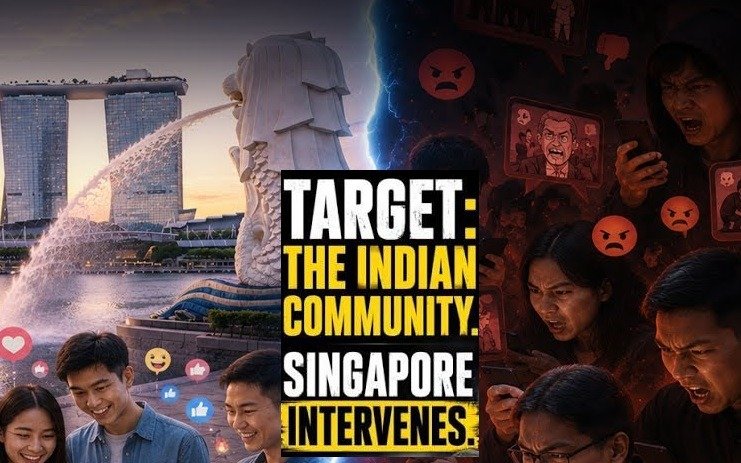
Prime Minister Lawrence Wong has publicly condemned racist and xenophobic online remarks targeting the Indian community, warning that prejudice against any community must never be allowed to become accepted or normalised.
His intervention came after a fresh wave of inflammatory online discussion linked to two sensitive subjects: the recent Nepal-Tibet disaster, in which Singaporeans were among those missing, and Singapore Airlines’ investment in Air India. According to Singapore’s authorities, some of the online discussion crossed from legitimate debate into anti-Indian abuse.
For India’s global diaspora, the episode deserves attention—not because Singapore is suddenly an unsafe country for Indians, but precisely because its political leadership has chosen to confront racial hostility publicly rather than pretend that online abuse is harmless.
When criticism becomes something else
Singapore is no stranger to vigorous debate.
Questions about immigration, foreign workers, employment, economic competition and the role of foreigners in Singaporean society are legitimate subjects for public discussion.
But there is a line between criticising a government policy and blaming an entire ethnic community.
Wong’s message was essentially about that distinction.
He said Singaporeans could and should have robust debates, but arguments should not become a cover for hostility towards communities or foreigners. He also warned that unchecked prejudice can deepen mistrust between communities and pull society apart.
It is a deceptively simple principle.
You can dislike a policy.
You can question a corporate transaction.
You can criticise immigration.
But the nationality or ethnicity of millions of ordinary people cannot reasonably become the defendant in every argument.
Unfortunately, social media has never been particularly good at understanding this distinction.

The latest controversy has a deeper history
The current episode did not appear out of nowhere.
In June 2026, Singapore’s Ministry of Home Affairs said it had identified online content targeting the Indian community and undermining Singapore’s model of multiculturalism.
The authorities issued Disabling Directions against 14 social-media posts, requiring platforms including YouTube, Facebook and X to restrict access to the posts for users in Singapore.
The material reportedly included inflammatory narratives portraying Singapore as being “overrun” by Indians. Some posts selectively used photographs of crowded areas around Little India and Indian religious gatherings to support that narrative.
Singapore’s Ministry of Home Affairs assessed that the posts were likely to constitute an offence under Section 298A of the Penal Code concerning the promotion of enmity, hatred or ill-will between racial groups.
That is a significant response from a country whose social stability depends heavily on managing relations among different ethnic communities.
But don’t turn it into an international conspiracy story
There is another important fact that should not get lost in the excitement.
Singapore’s investigation found that the content likely originated from a China-based platform and was subsequently circulated through other platforms and websites.
That does not, by itself, establish that the Chinese government or another government organised the campaign.
In July, Singapore’s Minister of State for Home Affairs Goh Pei Ming explicitly said there was no evidence that the posts constituted a coordinated campaign by a particular government or organisation.
That distinction matters.
In the age of viral posts, it is remarkably easy to jump from “this content originated on a platform in country X” to “country X created an operation against country Y.”
Those are completely different claims.
Good journalism should resist that temptation.

Why Indians should pay attention
According to Singapore’s Department of Statistics, Indians accounted for 9.0% of Singapore’s resident population in 2025. Singapore is therefore not dealing with an invisible or insignificant community. Indians are an established part of the country’s multicultural social fabric.
Singapore has also had long-running public debates about foreign talent, employment and immigration. Indian nationals and people of Indian origin have inevitably been part of those conversations.
That makes the current episode particularly instructive.
A multicultural society does not become harmonious by eliminating disagreement.
It becomes harmonious by ensuring that disagreement does not automatically become racial hostility.
That is a much harder task.
The Air India connection makes the story more interesting
One trigger for the latest online abuse was the Singapore Airlines investment in Air India.
There is a legitimate economic question here.
When a major Singaporean company invests in an Indian aviation group, people are entitled to ask about commercial strategy, ownership, competition, jobs and the future of the airline business.
None of those questions requires hostility towards Indians.
This is where online debate can become intellectually lazy.
A business transaction is a business transaction.
A person’s ethnicity is not a financial instrument.
And an airline investment does not suddenly make every Indian in Singapore responsible for it.
If the internet ever learns that distinction, economists around the world may finally get a peaceful night’s sleep.
Lawrence Wong’s response carries a larger message
Wong’s remarks are significant because Singapore’s leadership understands that social cohesion is not maintained merely through laws.
It is also maintained through political language.
When a prime minister says that prejudice should not be normalised, he is setting a standard for how public debate should operate.
Senior Minister Lee Hsien Loong reinforced that message, saying racist comments directed at the Indian community were troubling and urging Singaporeans to stand together regardless of race, language or religion.
That response is particularly relevant because Singapore’s national identity is explicitly built around multiculturalism.
If political leaders ignore racial hostility because it exists only online, the problem can become larger precisely because people begin to believe that nobody cares.

The danger is bigger than racism
There is a second lesson here for Indians—and indeed for every diaspora community.
Online abuse does not need to represent the majority of a population to cause damage.
A handful of highly inflammatory posts can be amplified thousands or millions of times through algorithms, screenshots and reposts.
The result can create a distorted impression of an entire society.
That does not mean genuine discrimination should be dismissed as “just social media.”
Singapore’s authorities themselves have said that unchecked behaviour can deepen mistrust and threaten racial harmony.
The challenge is therefore to avoid two opposite mistakes:
Do not dismiss genuine hate as harmless.
But also:
Do not mistake hateful viral content for the opinion of an entire country.
Both errors are dangerous.
Singapore’s response is also a test of digital citizenship
The government has taken legal and regulatory action against harmful content, but officials have also emphasised the importance of citizens being discerning about what they consume and share online.
That may ultimately be more important than any individual takedown.
Because governments cannot remove every offensive comment from the internet.
People have to learn to stop rewarding the content.
Every outrageous post needs an audience.
Every manufactured ethnic argument needs people willing to forward it.
Every stereotype becomes more powerful when thousands of ordinary users decide to click “share” before asking a very unfashionable question:
Is this actually true?
The DOONITED perspective
Singapore’s latest episode should not be turned into an India-versus-Singapore story.
That would completely miss the point.
The more interesting story is that Singapore’s leadership has publicly drawn a line between legitimate disagreement and ethnic hostility.
That line matters to Indians because the Indian diaspora is now an important part of societies across the world. Indians work, study, build businesses, raise families and contribute to economies far beyond India’s borders.
They should be judged by what they do—not by viral stereotypes about what an entire community supposedly represents.
At the same time, Indian communities abroad also have a responsibility.
Being targeted by prejudice does not give anyone a licence to answer prejudice with another stereotype. The strongest response is often participation: good citizenship, professional integrity, respect for local laws and cultures, and the confidence to challenge misinformation with facts rather than fury.
Singapore’s multicultural experiment is not perfect. Its own leaders acknowledge that racial and xenophobic tensions can resurface, including during earlier debates over foreign workers and India-related policies.
But perhaps that is precisely why this moment deserves attention.
A healthy society is not one in which nobody says anything offensive.
It is one in which society recognises the danger, calls it out and refuses to let it become normal.
For Indians watching from India or from Singapore, that is the reassuring part of this story.
The loudest voice on social media does not necessarily represent the country.
And Singapore’s leadership has just made that point rather loudly.

World Beyond the News
Bees Communicate Where Food Is
Honeybees use movement patterns known as waggle dances to communicate information about food locations.
Street Food Reflects Local History
Many famous street foods developed from migration, trade, local ingredients and the everyday needs of working communities.
A Day on Venus Is Extremely Long
Venus rotates so slowly that one rotation relative to distant stars takes longer than its trip around the Sun.
Human Achievement Continues to Push Limits
Athletes, engineers, scientists and explorers regularly establish new benchmarks in speed, endurance, scale and precision.