
Culture Across Borders: How Indian Communities Keep Traditions
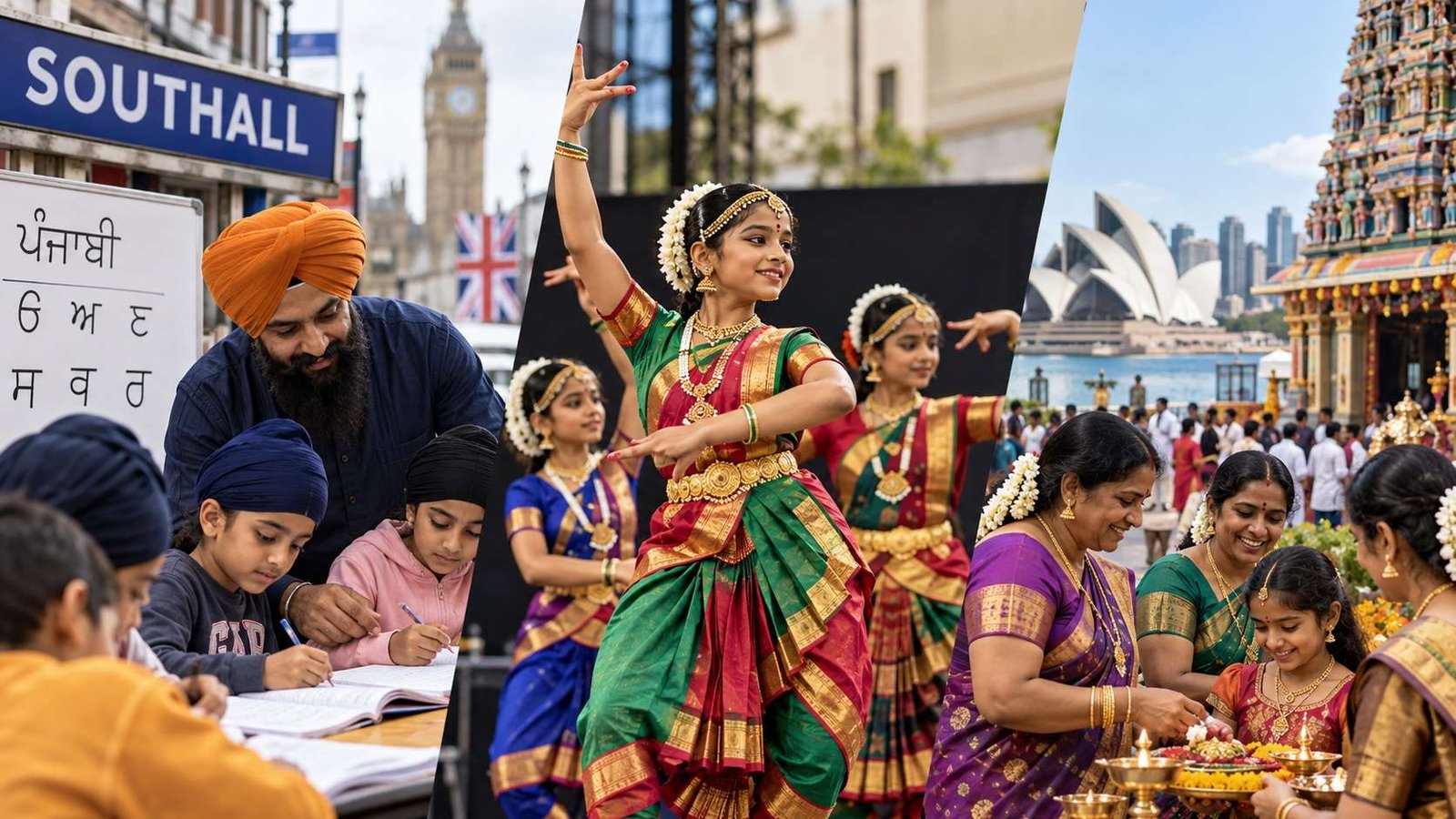
A child growing up in Leicester may learn Bharatanatyam in a studio after school. A family in western Sydney may organise its calendar around a Tamil temple festival. In Southall, a young Sikh student may spend part of the weekend learning to read Gurmukhi.
These are not simply cultural activities placed on top of everyday life. They are ways of passing knowledge from one generation to the next—often in countries where the language of school, work and friendship is not the language of grandparents.
For Indian-origin communities abroad, cultural continuity is rarely automatic. It takes teachers, volunteers, rented halls, rehearsals, fundraising, family commitment and, increasingly, digital tools. The work is often done outside paid hours, between school runs and weekend shifts. Heritage, it turns out, has a timetable—and someone has to book the room.
The Indian diaspora is frequently described as a community of tens of millions. India’s diaspora population is estimated at around 35 million in a 2026 NITI Aayog document, while UN data separately tracks international migrants by country of origin.
These figures are not interchangeable: “diaspora” can include people of Indian origin who are citizens of other countries, while international migrant statistics generally measure people living outside their country of birth.
Behind the headline number are communities with different languages, faiths, migration histories and relationships with India. Their efforts to preserve culture are not identical—and that diversity is part of the story.
Southall: Language is more than conversation
In Southall, West London, Punjabi learning is supported by organisations that teach language alongside religious and cultural knowledge. The Sikh Missionary Society UK, based on Featherstone Road, offers Punjabi and Gurmukhi classes as well as kirtan instruction.
Singh Sabha Southall Education Centre also runs weekly Punjabi, kirtan and santhiya classes, combining language learning with Sikh history, music and practice.
For young learners, reading and writing can open a different door from speaking Punjabi at home. A child may understand family conversation but struggle to read a sign, a poem or a passage from a religious text. Formal learning helps bridge that gap.
It also connects language to literature and history. Punjabi is not merely a tool for speaking to relatives; it carries poetry, humour, memory and ways of describing the world that do not always translate neatly into English.
The challenge is making lessons meaningful to children whose daily lives are firmly rooted in Britain. A language class that feels like an extra school subject may compete poorly with football, gaming and the universal weekend ambition of doing absolutely nothing. Classes that connect language to music, stories, family history and friendships have more ways to make the learning feel relevant.
Leicester: Tradition with room to move
In Leicester, Nupur Arts demonstrates how cultural preservation can extend beyond the classroom. Founded in 1990 by artistic director Smita Vadnerkar, the organisation teaches Bharatanatyam and other dance forms, and develops South Asian arts through classes, outreach and public performances. Its work has reached students across generations and backgrounds.
Classical dance is a demanding form of cultural transmission. Students learn movement, rhythm, expression and a vocabulary shaped by traditions that may have originated far from their own neighbourhood. Rehearsal turns heritage into a physical practice: a sequence is not simply remembered; it is repeated, corrected and eventually embodied.
But tradition need not mean freezing culture in one historical moment. Diaspora artists can retain classical technique while exploring the experiences of growing up between cultures. A British-Indian teenager’s relationship with identity may involve family expectations, contemporary music, school life and questions that earlier generations did not face in quite the same way.
That is not necessarily a dilution of tradition. It can be a sign that the tradition is being used, questioned and carried forward—rather than displayed like an heirloom that nobody is allowed to touch.
Nupur Arts’ public programming, including festivals and performances, also places South Asian dance within Leicester’s wider cultural life. That matters: cultural institutions can serve their own communities while also inviting neighbours to encounter the art on its own terms.
Mays Hill, Sydney: A temple as a cultural institution
At 217 Great Western Highway in Mays Hill, the Sydney Murugan Temple serves as a place of worship and a centre for Tamil religious and cultural life. Its stated objectives include preserving and enhancing the role of Tamil in religious, philosophical and related activities. The temple also provides a Saiva school syllabus and digital services for its community.
For many diaspora families, a temple can do several jobs at once. It is a place for prayer, a gathering point for festivals, a setting where children hear Tamil in a meaningful context, and a meeting place for people whose homes may be scattered across a large metropolitan area.
The cultural value lies partly in repetition. A festival returns each year; familiar songs and rituals are encountered again; children gradually learn what different moments mean. Community identity is reinforced not by a single grand event, but by a pattern of participation.
Yet migration changes the conditions in which traditions are practised. Families must negotiate work schedules, school calendars, transport, public-space rules and the expectations of children raised in Australia. A ritual that was absorbed almost casually in one setting may need explanation and planning in another.
That extra effort can deepen understanding—but it can also create pressure. Young people should be invited to ask questions, not simply told that participation is a test of loyalty. A tradition that can explain itself has a better chance of being chosen freely.
The family classroom: What survives between generations?
The examples in Britain and Australia point to a common pattern: cultural continuity often depends on institutions that families can access regularly. But the home remains the first place where language is heard, used and valued.
A weekend class can teach vocabulary and script. It cannot, on its own, make a language part of everyday life. That happens when children hear it during dinner, use it to speak to relatives, encounter it in music, or discover that it gives them access to stories they cannot experience in quite the same way in translation.
The same is true of food, festivals and religious practice. Children may initially associate a celebration with special clothes, a crowded hall and a long programme. Understanding its history and meaning can turn an annual event into something more personal.
This is where families face a delicate balance. If heritage is presented only as an obligation, children may experience it as another demand placed on their time. If it is offered as a source of connection, creativity and belonging, they have more room to make it their own.
There is no single formula. Some young people become fluent speakers; others connect through dance, music, volunteering or food. Cultural identity is not an examination in which everyone must receive the same grade.
Digital networks: Useful bridges, imperfect substitutes
Digital communication has made it easier for geographically dispersed families to share language resources, organise gatherings and maintain contact with relatives. Video calls can bring grandparents into a child’s week; messaging groups can coordinate community events; online material can supplement classroom learning.
But technology is a tool, not a cultural inheritance machine. A child can receive dozens of festival greetings on a phone without learning why the festival matters. A video can demonstrate a dance movement, but it cannot fully replace the correction, encouragement and shared discipline of learning in a room with other students.
Digital spaces also tend to favour what is easy to share: colourful costumes, food photographs and celebratory messages. The less photogenic work—learning grammar, practising music, studying history, keeping accounts and finding volunteers—remains essential.
The strongest approach is likely to combine the convenience of digital access with the depth of face-to-face participation. Technology can help people stay connected; community institutions give that connection a place to take root.
Preservation must include honest questions
Cultural preservation deserves recognition, but it should not be romanticised. Community schools and arts organisations depend on funding, suitable premises, qualified teachers and volunteers who can sustain the work. Their availability may vary widely by city, language and community size.
There is also a question of whose culture is being preserved. Indian identity is not one language, one religion or one set of customs. A programme that focuses on a single tradition may serve its community well, but it should not be mistaken for a complete picture of India.
Nor should the burden fall entirely on children or on a handful of parents. Institutions need to make learning accessible, welcoming and relevant. They should recognise that young people may identify with more than one culture, and that belonging to the country where they were born does not diminish their connection to their family’s heritage.
The goal is not to recreate an Indian town in every overseas suburb. It is to give the next generation enough knowledge, access and confidence to decide what they want to carry forward.
DOONITED View
The most durable cultural institutions do more than preserve the past. They create opportunities for the next generation to participate in it—and, in time, reshape it.
Southall’s Punjabi classes, Leicester’s South Asian arts programmes and Sydney’s Tamil temple community show different ways this work can happen. Their methods differ, but the underlying task is similar: make language, art and tradition part of contemporary life rather than leave them as distant symbols of ancestry.
There is a useful distinction between keeping culture unchanged and keeping it alive. The first may be impossible across generations and continents. The second requires adaptation, patient teaching and room for honest questions.
The real measure of success is not whether every child speaks a heritage language perfectly or follows every custom. It is whether the next generation has a genuine opportunity to understand its inheritance—and the freedom to engage with it meaningfully.
Learning Point
Culture survives through practice, not nostalgia alone. Language classes, temples, arts organisations, family conversations and digital networks all help when they make participation regular and meaningful. The work is most likely to endure when communities preserve knowledge while allowing younger generations to make it their own.


World Beyond the News
Octopuses Can Change Their Appearance
Octopuses can rapidly alter their skin colour and texture to communicate, camouflage themselves and respond to danger.
Some Cities Exist Across Two Continents
A small number of cities are geographically associated with two continents, creating unusual cultural and geographic identities.
Earth’s Climate Is Measured in Many Ways
Scientists track temperature, atmospheric gases, sea level, ice cover and other indicators rather than relying on a single climate number.
Streaming Changed How Audiences Discover Shows
Recommendation systems and global streaming releases allow audiences to discover programmes far beyond their original markets.