
From Civil Engineering Graduates to a $20 Million AI Legacy: The Sinha Couple’s Bet on America’s Next Generation
When Anuradha and Vikas Sinha left India after completing their engineering education, there was no obvious indication that decades later their names would be attached to a major American academic institution devoted to artificial intelligence.
Today, there is.
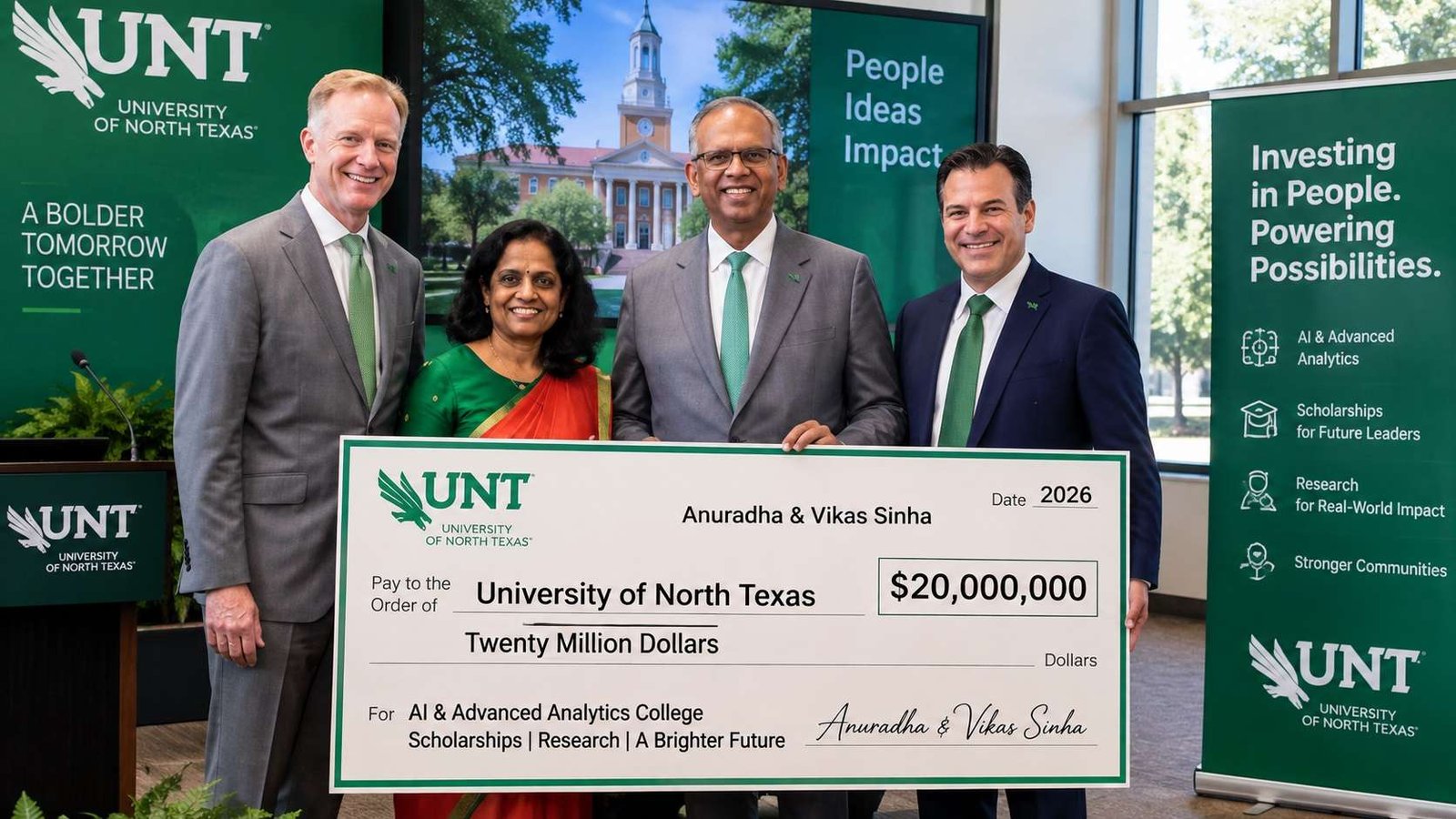
The Indian-origin couple has committed US$20 million to the University of North Texas (UNT) to create the Anuradha and Vikas Sinha College of Artificial Intelligence and Advanced Analytics. The new college will bring together education and research in artificial intelligence, cybersecurity, data science, advanced analytics, health informatics and other information-related disciplines.
It is an unusually large philanthropic investment in a field that is rapidly becoming central to almost every part of the economy.
But the most interesting part of this story isn’t the $20 million.
It is where the money came from, where it is going, and why the couple chose education.
A journey that began with engineering in India
Anuradha and Vikas Sinha both earned bachelor’s degrees in civil engineering from Sri Venkateswara University in India before moving to the United States for further education. Both subsequently earned graduate degrees from Florida Atlantic University. Vikas later studied at Northwestern University and earned his PhD from UNT in 2023.
Vikas went on to become a technology executive and currently serves as vice president of Broadcom’s Mainframe Software Division. He has also served on the UNT College of Information Leadership Board since 2023.
There is something particularly fitting about that trajectory.
A civil engineering graduate eventually becoming deeply involved in artificial intelligence and information technology might sound like an unusual career detour.
But careers rarely follow the straight lines drawn in university brochures.
Engineering teaches people how to solve problems.
Technology keeps changing the problems.
And apparently, Vikas Sinha kept following the interesting ones.

The university that called back
The connection between Vikas Sinha and UNT is also more personal than a conventional donor-university relationship.
UNT’s own account says Sinha first became aware of the university while looking for a doctoral programme that would work alongside his professional career.
He initially encountered a residency requirement that did not suit his circumstances. UNT later developed a doctoral pathway specifically designed for working professionals, creating the opportunity for him to pursue his PhD without abandoning his career.
That detail explains something important about the couple’s philanthropy.
They are not simply funding a university they happen to admire.
They are investing in an institution that changed the direction of their own lives.
Vikas’s story therefore becomes part of the argument behind the gift: education can create opportunities that continue far beyond the classroom.
What exactly will the $20 million create?
The gift will establish six permanent endowments supporting:
- College leadership
- Student scholarships
- Endowed professorships
- Entrepreneurship and incubation
- Advanced research
- Emerging technologies
That structure is important.
A donation used entirely for a single building would create a visible landmark.
An endowment can create something potentially more durable: a continuing source of support for people, research and programmes.
The new college is intended to become an academic and research hub for the development, application and responsible use of artificial intelligence, intelligent systems and data analytics.
And the scope is deliberately broad.
The college will connect expertise in:
Artificial intelligence → cybersecurity → data science → advanced analytics → health informatics → information science → library science → learning technologies.
That is a significant departure from treating AI as simply another computer-science speciality.
AI increasingly intersects with healthcare, education, business, cybersecurity, government and everyday information systems.
A university trying to prepare students for that world cannot afford to put every subject into a separate academic box.
Beyond teaching students how to use AI
This may be the most significant element of the Sinhas’ vision.
Vikas Sinha has said the goal is not merely to teach students how to use artificial intelligence, but to prepare them to build it, understand it, question it, govern it and apply it responsibly.
That distinction matters.
The world already has plenty of people asking AI to write an email.
The bigger challenge is producing people capable of asking:
Who built this system?
What data trained it?
What happens when it makes a mistake?
Who is accountable?
How should it be regulated?
Can it be trusted in healthcare, finance or public services?
In other words, AI education cannot simply become a sophisticated version of “learn which button to press.”
The real requirement is to develop people who understand both the capabilities and limitations of intelligent systems.
A new institute inside the bigger vision
UNT says the initiative will also establish the Applied Artificial Intelligence and Data Science Institute.
Its purpose will include interdisciplinary research, shared infrastructure and partnerships within the university and with industry.
That could become particularly important.
The next generation of AI breakthroughs will not necessarily emerge from one department sitting alone in a university building.
Healthcare needs AI.
Manufacturing needs AI.
Cybersecurity needs AI.
Education needs AI.
Financial services need AI.
Public institutions need AI.
The difficult part is making these systems useful without allowing efficiency to become an excuse for irresponsibility.
A university that brings different disciplines together has an opportunity to address that problem more effectively.
The Sinha family’s philanthropy did not begin with $20 million
The latest commitment is the largest step, but it is not the first.
In 2024, the couple supported the creation of the Anuradha and Vikas Sinha Department of Data Science, together with endowments supporting scholarships, faculty, research and special initiatives.
The following year, the family helped establish the Sinha Data Science Innovation Lab.
The new $20 million commitment therefore represents an expansion of an existing relationship rather than a sudden philanthropic appearance.
There is a pattern here:
Data science → innovation → artificial intelligence.
The couple’s giving has followed the evolution of the technology itself.
Why this matters to India
For Indian readers, there is an obvious emotional element to this story.
Two people educated in India moved abroad, built successful careers and are now investing heavily in education in the United States.
That is certainly worth celebrating.
But there is a more useful way to view the story than simply calling it another “Indian-origin success story.”
The real question is:
What does their philanthropy teach India?
The answer is that education can become a multiplier.
A scholarship can support one student.
A professor can teach hundreds.
A research programme can influence thousands.
A technology incubator can produce companies.
And a university can potentially create generations of researchers, engineers, entrepreneurs and teachers.
That is why permanent educational investment can have an impact considerably larger than the original cheque.

The DOONITED Editorial View
There is an increasingly popular global race to announce AI programmes.
Every university wants an AI centre.
Every company wants an AI strategy.
Every government wants an AI mission.
And every second presentation seems to contain the phrase “AI-powered.”
The danger is obvious: AI can become a fashionable label rather than a serious academic discipline.
The Sinha gift deserves attention precisely because its structure goes beyond a flashy AI laboratory.
Scholarships matter.
Professorships matter.
Research matters.
Entrepreneurship matters.
Cybersecurity matters.
Responsible AI matters.
And perhaps most importantly, people matter.
The $20 million commitment is therefore potentially more valuable if it produces researchers and builders rather than merely producing another collection of impressive AI demonstrations.
There is also a lesson here for Indian philanthropy.
India has an enormous pool of successful entrepreneurs, technology professionals and global business leaders.
The question is not whether they can afford to give.
The more interesting question is what kind of institution they can help build with that giving.
A scholarship helps someone get through college.
A strong academic institution can help shape an entire generation.
The funny thing about AI
There is a small irony in the story.
Artificial intelligence is often presented as the technology that will change everything.
Yet the people financing its future are investing in something much older:
education.
No algorithm can replace the importance of a good teacher.
No language model can eliminate the need for critical thinking.
And no machine-learning system can decide by itself what society ought to do with the technology it creates.
AI may be the new tool.
But people still have to decide what the tool is for.
That makes the Sinha gift more than a technology investment.
It is an investment in the people who will make those decisions.
A legacy that comes full circle
The story has a particularly satisfying circularity.
Two Indian engineering graduates moved to America for higher education.
One of them eventually earned a PhD at UNT.
That education contributed to a technology career.
The couple then began supporting the university.
And now their names will be attached to a college designed to educate people for the next technological era.
The university itself describes the philosophy behind their giving simply: education opened doors for them, and they want to hold those doors open for others.
That may be the most meaningful sentence in the entire story.
Because philanthropy at its best is not simply about giving away accumulated wealth.
It is about deciding what opportunity should exist for the next person.
The Bigger Takeaway
The $20 million Sinha commitment arrives at a moment when artificial intelligence is changing the nature of work faster than universities can redesign curricula.
That creates both an enormous opportunity and a serious responsibility.
UNT now has additional resources to develop researchers, support students, attract faculty, encourage entrepreneurship and explore responsible applications of AI and advanced analytics.
For Indian students, the development is also worth watching closely.
The new college could create opportunities in AI, data science, cybersecurity, health informatics and related disciplines—and demonstrate how interdisciplinary education can prepare students for a labour market that is still being reshaped.
But the biggest lesson is perhaps simpler.
Success becomes more meaningful when it creates opportunities for people who have not yet arrived.
Anuradha and Vikas Sinha came to America as students.
Their latest contribution is designed to help future students arrive with bigger possibilities.
That is not merely a story about $20 million.
It is a story about what happens when an educational opportunity comes full circle.

World Beyond the News
Birds Can Navigate Using Earth’s Magnetic Field
Several bird species can sense Earth’s magnetic field, helping them navigate during long-distance migration.
Fermentation Is a Global Food Tradition
People across continents have used fermentation for centuries to preserve food and create distinctive flavours.
Modern Batteries Store Energy Chemically
Rechargeable batteries repeatedly move ions between electrodes, allowing electrical energy to be stored and released.
Why Songs Become Global Hits
Streaming platforms, short-form video, playlists and international collaborations can rapidly carry music across borders.