

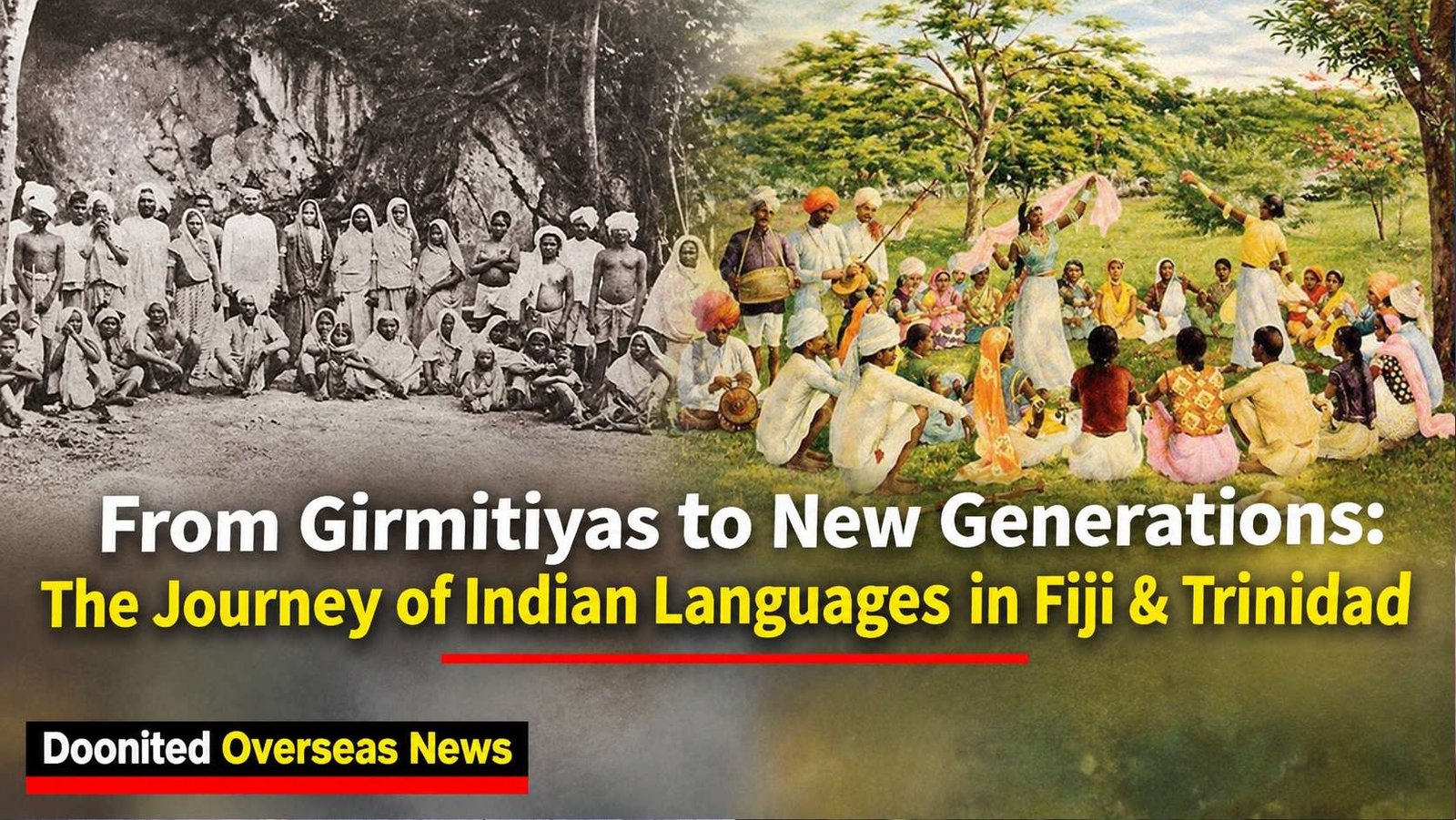
The Language They Carried Across the Oceans: How Girmitiya Descendants Preserved Indian Heritage in Fiji and Trinidad
When Indian indentured labourers left the subcontinent for distant plantations during the nineteenth and early twentieth centuries, they carried more than personal belongings. They carried songs, prayers, stories, dialects and ways of speaking that would become part of the cultural foundations of communities thousands of kilometres from India.
Their descendants are now spread across Fiji, Trinidad and Tobago, Guyana, Suriname, Mauritius, South Africa and other destinations. One of the most remarkable legacies of this migration is linguistic: ancestral Indian languages did not follow a single path. In Fiji, a new everyday language emerged and endured. In Trinidad, Bhojpuri gradually lost ground as a community language, but its influence remained embedded in cultural expression.
The contrast offers an important lesson for the global Indian diaspora: a language can survive by changing, but cultural visibility does not necessarily mean that younger generations still speak it fluently.
The Girmitiya journey: language under colonial indenture
The word Girmitiya developed from the English word “agreement”, referring to the contracts under which Indian workers were recruited for plantation labour. Following the abolition of slavery, European colonial powers expanded indentured migration to meet labour demand.
More than 1.3 million Indians signed indenture contracts between 1834 and 1916, according to research published by Cambridge University Press. They travelled to colonies across the Caribbean, Africa and the Pacific, including Trinidad and Fiji. The system involved exploitation, difficult working conditions and restrictions that shaped the lives of generations.
The workers came from different linguistic backgrounds. Bhojpuri and Awadhi were important among migrants from northern India, but they were not the only languages represented. Other regional languages and dialects also travelled with them.
On plantations, people from different parts of India had to communicate across linguistic boundaries. Their descendants developed new ways of speaking, shaped by local societies, education, religion and contact with other languages.
Fiji: a living language shaped by migration
Fiji Hindi, also known as Fiji Baat, emerged from the interaction of languages and dialects brought by Indian indentured labourers. Its foundations are particularly associated with varieties from eastern Uttar Pradesh and Bihar, including Bhojpuri and Awadhi, alongside influences from other Indian languages and local linguistic environments.
It is not simply Standard Hindi spoken with a different accent. Fiji Hindi has developed its own vocabulary, grammar and patterns of everyday expression. Linguists describe it as a distinct Indo-Aryan vernacular that became a major marker of Indo-Fijian identity.
The language remains widely used in homes and communities. Its significance is also recognised in Fiji’s constitutional framework. The 2013 Constitution provides that conversational and contemporary iTaukei and Fiji Hindi languages shall be taught as compulsory subjects in all primary schools.
There is, however, an important distinction between constitutional provision and classroom practice. Research published in 2026 notes that Standard Hindi is often used in formal education, while Fiji Hindi remains particularly important in informal communication. English continues to dominate many educational, administrative, professional and media settings.
Fiji Hindi therefore enjoys a strong community presence and constitutional recognition, but its long-term development still faces questions about teaching resources, standardisation and social attitudes. Some speakers continue to regard it as less prestigious than Standard Hindi, despite its importance as a living language.
Trinidad: when a language becomes a cultural inheritance
The Indian migration experience in Trinidad followed a different trajectory. According to the National Archives of Trinidad and Tobago, 147,592 Indian indentured labourers arrived between 1845 and 1917. Most came from northern Indian regions, including the North-Western Provinces, Oudh and Bihar, although migrants also came from other parts of India.
Bhojpuri became an important language among early generations. Over time, however, English and Trinidadian English Creole gained ground in public life, education and everyday communication. The transmission of Bhojpuri between generations weakened.
A particularly significant contribution to understanding this change appeared in Language, a journal published by Cambridge University Press. In a study published online on 12 March 2026, researchers Peggy Mohan and Paul Zador examined speech samples from 40 people in rural Caroni, Trinidad, aged between 26 and 95.
Their findings identified a marked separation between older speakers with native-level competence and a younger group whose language abilities differed substantially. The study points to a generational discontinuity rather than a smooth, gradual decline.
This does not mean that every trace of Bhojpuri has disappeared. Its vocabulary, songs, religious expressions and cultural traditions continue to form part of Indo-Trinidadian heritage.
Chutney music: a language’s cultural afterlife
One of the most recognisable expressions of Indian-Caribbean cultural fusion is chutney music. Drawing on Bhojpuri folk traditions, Indian wedding songs and Caribbean musical styles, it developed into a distinctive form of popular expression.
Traditional genres such as birha singing and performances associated with the Ramcharitmanas also travelled across the Caribbean. Research by music scholar Peter Manuel documents how these traditions flourished for decades, even as Bhojpuri declined as a spoken language.
Music can preserve words, rhythms and memories, but it cannot by itself replace everyday language transmission. A community may continue singing ancestral songs while fewer young people understand their full vocabulary or can hold a conversation in the language from which those songs originated.
That distinction is central to the future of heritage preservation.
Reconnecting descendants with their ancestral roots
The effort to preserve Girmitiya history is also receiving renewed attention through archival cooperation. During his May 2026 visit to Trinidad and Tobago, India’s External Affairs Minister S. Jaishankar highlighted an archival cooperation agreement intended to help diaspora members trace their ancestry and reconnect with families in India.
The historical records are particularly important. UNESCO recognises the records of Indian indentured labourers from destinations including Fiji, Guyana, Suriname and Trinidad and Tobago as part of its Memory of the World registers. Such documents can contain the personal details needed to reconstruct family histories.
These initiatives are not language-revival programmes in themselves. But they can strengthen the connection between descendants, ancestral places and the histories of the communities from which their forebears came.
Preservation must reach the next generation
Fiji and Trinidad demonstrate two different outcomes of the same broad historical experience. Fiji Hindi became a living language that adapted to a new society. Trinidad Bhojpuri lost much of its everyday spoken base but continues to influence cultural identity and artistic expression.
Neither outcome should be treated as a simple success or failure. Languages change through migration, education, social mobility and contact with other communities. The challenge is to ensure that adaptation does not become involuntary loss.
For younger generations of Girmitiya descendants, preservation can involve family conversations, heritage-language classes, recordings of elders, digitisation of songs and oral histories, and greater access to authentic learning resources. Universities, cultural organisations and diaspora institutions can also support research and intergenerational learning.
The Girmitiya story is not only about the journey from India to distant plantations. It is also about how communities rebuilt their identities in unfamiliar lands. Their languages remain among the most intimate records of that history—and preserving them means keeping the voices of those journeys accessible to generations yet to come.

World Beyond the News
Why Elephants Stay Close to Their Herd
Elephants live in highly social family groups and use calls, touch and body movements to maintain strong bonds.
Most of the Deep Ocean Remains Difficult to Explore
Extreme pressure, darkness and distance make deep-ocean exploration one of Earth’s greatest scientific challenges.
Spacecraft Can Travel Without Traditional Roads
Spacecraft use carefully calculated trajectories and gravity assists to travel enormous distances through space.
Why Movie Trailers Are Released in Stages
Major films often use teaser trailers, full trailers and final promotional spots to build awareness over time.