
US Green Card Rules Change September 18: What Indian Applicants Need to Know About the New Public-Charge Test
For thousands of Indians pursuing permanent residence in the United States, September 18, 2026 is an important date to remember.
The U.S. Department of Homeland Security is scheduled to implement a new public-charge rule that gives immigration officers broader discretion to examine an applicant’s overall circumstances when deciding whether the person is likely to become a public charge.
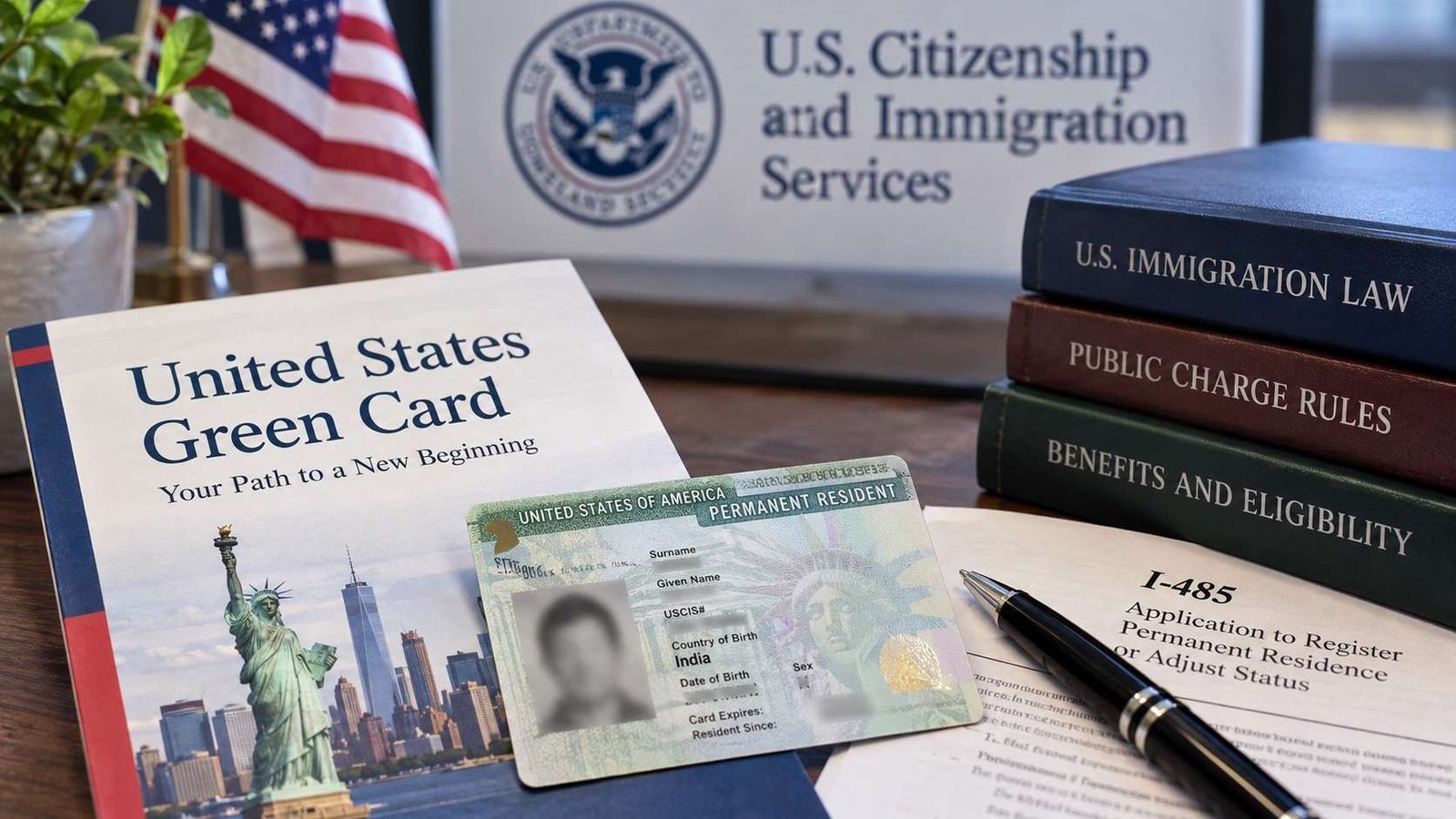
At the same time, U.S. Citizenship and Immigration Services (USCIS) is introducing a new edition of Form I-485, the principal application used by people inside the United States seeking adjustment of status to permanent residence.
And there is no comfortable paperwork grace period.
USCIS says that applications submitted on or after September 18 must use the 09/18/26 edition of Form I-485. Older editions submitted on or after that date will not be accepted.
For Indian applicants—particularly those navigating the long employment-based green-card process—the change deserves careful attention.
But it also deserves careful reporting.
A headline suggesting that “using government benefits means your Green Card will be rejected” would be inaccurate.
The new framework is broader and more discretionary than the 2022 rules, but the Federal Register explicitly states that receipt of means-tested public benefits alone is not outcome-determinative. Officers are required to consider the relevant circumstances of the individual case.
What is changing on September 18?
The change originates in a DHS final rule published in the Federal Register on July 20.
DHS is rescinding the 2022 public-charge regulation and returning to a framework that gives immigration officers broader discretion to consider relevant evidence when determining whether someone is likely to become a public charge. The rule is scheduled to become effective September 18.
The previous 2022 framework specified a narrower set of benefits and circumstances that could be considered.
The new framework removes many of those regulatory restrictions.
That means the officer’s assessment can become more comprehensive.
Think of it less as a single checkbox and more as an immigration officer examining the applicant’s financial and personal picture as a whole.

What does “totality of the circumstances” mean?
This phrase is at the centre of the new system.
Federal immigration law already identifies several factors that must be considered in a public-charge determination.
These include:
- Age
- Health
- Family status
- Assets and financial resources
- Education and skills
Employment history, employment prospects and other relevant evidence can also form part of the assessment.
This is important for Indian applicants because many employment-based immigrants have a substantial employment history, professional qualifications and continuing employment.
But the same principle applies in family-based cases and other categories subject to the public-charge ground of inadmissibility.
The assessment is individual.
There is no published rule saying that being Indian, holding an H-1B, having a particular profession or having used one specific benefit automatically determines the outcome.
Public benefits: what is different?
This is the part generating the most concern.
Under the 2022 framework, several commonly used non-cash benefits—including programs such as SNAP and housing assistance—were excluded from public-charge consideration.
The new rule removes those regulatory exclusions and expands the universe of means-tested benefits that may be relevant to the assessment. DHS itself acknowledges that the change could lead some immigrants to reconsider applying for Medicaid, CHIP, food assistance, housing assistance and other means-tested programmes.
That does not mean every person who has ever received one of these benefits will automatically be refused a Green Card.
The Federal Register makes the distinction clear: the benefit receipt is evidence that can be considered within the totality of the circumstances, rather than an automatic rejection trigger.
That distinction is critical.
What about benefits received before September 18?
The final rule contains a specific transition provision.
DHS states that applications for adjustment of status postmarked or electronically submitted on or after September 18, 2026 will be governed by the new rule.
But receipt of means-tested public benefits before September 18 will be considered consistently with the 2022 Final Rule.
So the date matters.
This is one reason applicants should keep accurate records rather than trying to reconstruct their benefits history from memory.
Immigration paperwork is not an ideal place for the famous Indian solution of:
“I think I have that document somewhere.”
Somewhere is not a filing system.
The Form I-485 change is just as important
There is another practical issue that could affect applicants immediately.
USCIS is publishing a revised Form I-485 dated September 18, 2026.
The agency has stated that the older 01/20/25 edition will no longer be accepted for applications postmarked or electronically submitted on or after September 18.
This is a technical change, but technically wrong immigration paperwork can have very non-technical consequences.
An applicant who prepares an otherwise complete package but uses the wrong edition could face rejection rather than having the application smoothly enter processing.
Therefore, anyone preparing an I-485 filing around the transition date should verify the edition directly with USCIS or their qualified immigration lawyer before submission.

What does this mean for Indian employment-based applicants?
Indian professionals are particularly relevant to this story because of the country’s large employment-based Green Card population and long-running visa backlogs.
Many Indian applicants are professionals working in technology, engineering, medicine, finance, research and other skilled fields.
A stable job and continuing income can be relevant evidence in a public-charge assessment.
But it would be wrong to say that “H-1B holders are automatically safe.”
The new framework is not an H-1B test.
It is a public-charge determination concerning the applicant’s overall circumstances.
Likewise, it would be wrong to suggest that an applicant is automatically in danger merely because they have dependents or medical expenses.
Those factors are considered alongside the rest of the evidence.
The central issue is the overall picture.
What does NOT change?
The September 18 public-charge rule should not be confused with a general rewrite of America’s entire immigration system.
It does not mean that every Indian living in America must suddenly submit a new financial assessment.
It is relevant to people subject to the public-charge ground of inadmissibility, including certain applicants for adjustment of status and immigrant visas.
Nor does it turn existing Green Card holders into public-charge applicants simply because they possess a Green Card.
Similarly, this is not a general change to routine H-1B extensions and petitions.
The focus is the public-charge inadmissibility determination.
There is also a legal battle
This story has another important chapter.
A coalition of states and local governments has already filed a federal lawsuit challenging the new rule. Reuters reports that the plaintiffs argue the rule could improperly expand immigration officials’ discretion and create uncertainty around legally available public benefits. The administration has defended the policy as an effort to ensure that immigrants are self-sufficient and that taxpayer-funded benefits do not encourage immigration.
That means September 18 should not necessarily be treated as the final word.
A court could issue an injunction or otherwise affect implementation.
As of September 17, 2026, however, the rule remains scheduled to take effect on September 18.
For applicants, this creates an awkward but familiar immigration reality:
The rulebook can change while the paperwork is sitting on the desk.
The DOONITED Editorial View
There is a legitimate policy question behind the new rule.
A government can reasonably require people seeking permanent residence to demonstrate that they are capable of supporting themselves and their families.
The difficult question is how that principle should be applied.
A broad discretionary test can potentially allow officers to examine a more complete financial picture.
But discretion also creates the need for clear standards, consistent application and understandable guidance.
That is especially important in immigration systems where a family’s financial circumstances can be complicated.
For example, receiving a benefit during a temporary period of difficulty does not necessarily describe someone’s long-term financial prospects.
Conversely, a strong current salary does not by itself answer every question about a household’s circumstances.
That is why the “totality of the circumstances” approach matters.
It asks immigration officers to look at the whole picture.
The challenge is making sure that the whole picture is assessed consistently.

What Indian Green Card applicants should do
The most useful response is preparation—not panic.
1. Check the Form I-485 edition
If filing on or after September 18, verify that the form is the 09/18/26 edition. USCIS says the older edition will not be accepted.
2. Maintain financial records
Keep organised records relating to income, employment, assets, debts, tax filings and other relevant financial information.
3. Understand your benefits history
Do not assume that every government programme is treated identically.
The new rule expands the range of benefits that can potentially be considered, but benefit receipt alone does not determine the outcome.
4. Do not hide information
Immigration applications require accurate answers.
Attempting to solve an immigration problem by providing incomplete or misleading information can create a problem substantially larger than the original issue.
5. Check for court developments
Because litigation is already underway, applicants should verify the status of the rule immediately before filing.
6. Seek qualified advice when the case is complicated
People with unusual financial circumstances, complex family situations, significant medical issues or complicated benefits histories should consider obtaining advice from a qualified U.S. immigration attorney.
The bigger lesson for Indian families
For many Indians, the American Green Card journey can last years.
Employment-based backlogs, changing visa policies, employer changes, family circumstances and evolving immigration rules can all affect the journey.
The September 18 change adds another layer.
But it also reinforces an important principle:
Immigration applications are evidence-based legal processes, not internet rumours.
A WhatsApp message saying “SNAP means automatic rejection” is not a substitute for the Federal Register.
Neither is a social-media post saying “Indian H-1B holders are exempt.”
The actual rule is considerably more nuanced.
The Bottom Line
From September 18, 2026, the United States is scheduled to move to a broader public-charge assessment for covered immigration applicants, while USCIS introduces a new edition of Form I-485.
The new framework gives officers greater discretion to consider public benefits and the applicant’s overall circumstances.
But no single benefit, financial factor or personal characteristic automatically decides every case.
For Indian applicants, the practical message is therefore straightforward:
Use the correct form. Keep accurate records. Understand the new rules. Follow court developments. And get case-specific legal advice when necessary.
The Green Card process was never famous for being simple.
September 18 does not make it simpler.
It does, however, make careful preparation more important than ever.

World Beyond the News
Dolphins Use Individual Signature Whistles
Bottlenose dolphins develop distinctive whistles that function somewhat like individual acoustic identifiers.
The Pacific Is Earth’s Largest Ocean
The Pacific Ocean covers more area than any other ocean basin and stretches between Asia, Australia and the Americas.
Artificial Intelligence Learns Statistical Patterns
Modern machine-learning systems identify patterns in large datasets and use those patterns to generate predictions or outputs.
Why Some Stories Spread So Quickly
Emotion, novelty, visual appeal and easy sharing can make a story travel rapidly across social platforms.