
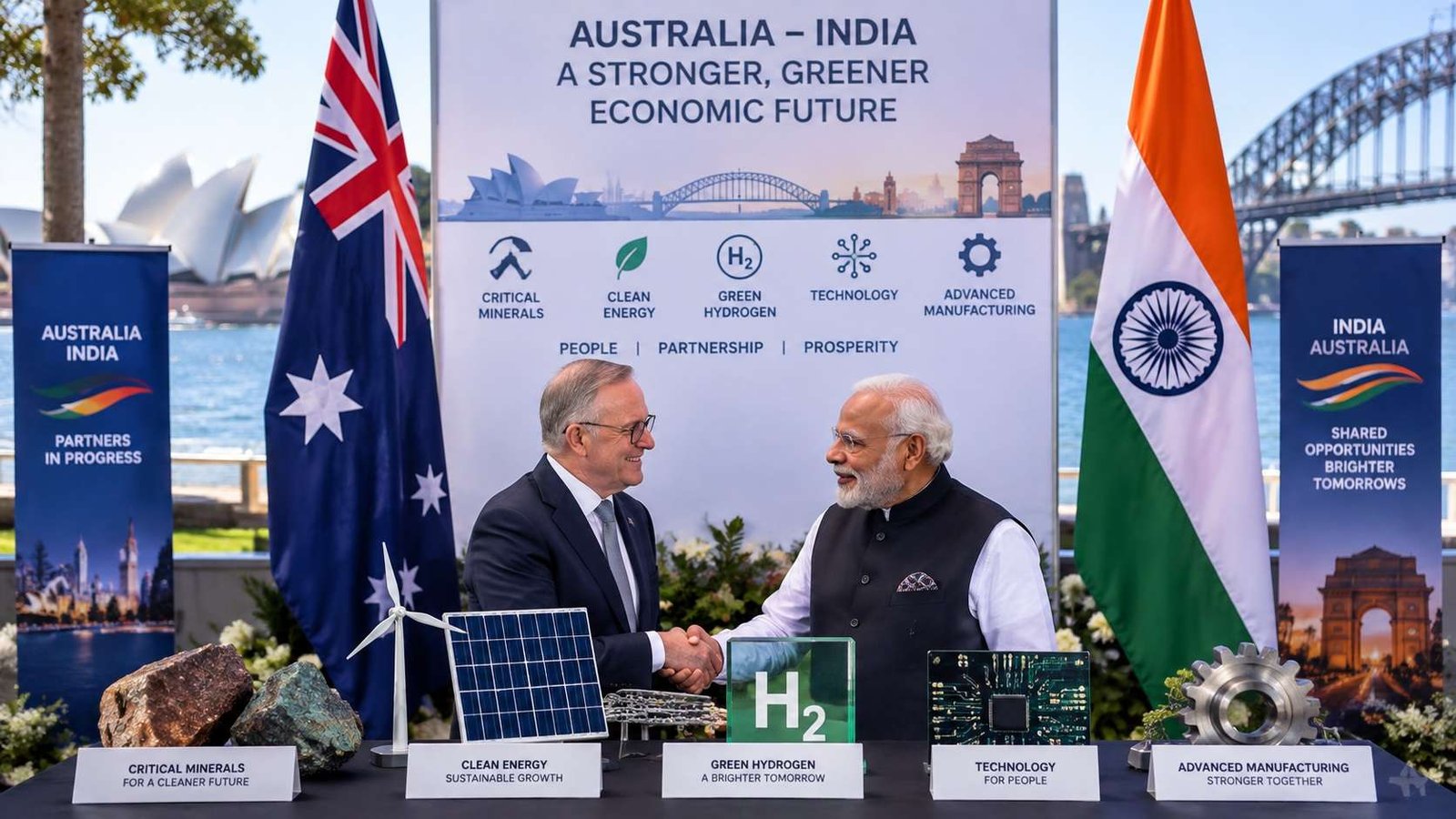
From Ore to AI: How India and Australia Are Building a New Economic Corridor
For decades, the India–Australia economic relationship was easy to describe.
Australia supplied resources. India supplied services, students, professionals and a rapidly expanding consumer market.
That description is now becoming too small.
A more complicated economic corridor is taking shape—one that connects Australian minerals and energy resources with Indian manufacturing, technology, clean-energy ambitions and research.
The transformation is being supported by the Australia–India Economic Cooperation and Trade Agreement (ECTA), which entered into force on 29 December 2022, while negotiations continue for a more comprehensive Comprehensive Economic Cooperation Agreement (CECA). Australian government data puts two-way trade in goods and services at A$50.2 billion in calendar 2025, while DFAT’s FY2024–25 measure puts it at A$54.4 billion.
The interesting part is not simply that trade is growing.
It is what the two countries increasingly want to trade and build together.
ECTA Was the Beginning, Not the Finish Line
ECTA was designed as an initial step toward a broader trade relationship.
Under the agreement, more than 90 per cent of Australian goods exports by value to India will have tariffs eliminated or reduced, while Australian government guidance says more than 85 per cent of Australian goods exports by value to India were already tariff-free from the agreement’s entry into force, with additional reductions scheduled over time. India also received tariff-free access for its imports into Australia under ECTA.
That does not mean every Australian product suddenly became duty-free.
Tariff schedules contain product-specific commitments, staging periods and conditions. Businesses still have to comply with rules of origin and customs procedures.
That is the less glamorous side of a trade agreement—but often the side that determines whether a theoretical market opportunity becomes an actual commercial transaction.
ECTA has nevertheless created a platform on which businesses can plan longer-term investment and supply arrangements.
And the next layer is already being negotiated.
Australia and India are continuing negotiations for CECA, intended to build upon ECTA and broaden economic cooperation.
Critical Minerals: From Australian Ground to Indian Industry
Perhaps nowhere is the new relationship more visible than in critical minerals.
Australia has major mineral resources and established mining capabilities. India, meanwhile, wants secure access to the raw materials required for electric mobility, renewable energy, electronics, advanced manufacturing and other strategic industries.
That creates an obvious economic complement.
The two countries have already established the Australia–India Critical Minerals Investment Partnership.
In 2023, the Australian and Indian governments announced that five potential projects—two lithium and three cobalt projects—had been identified for detailed due diligence under the partnership. Australia said the objective was to develop supply chains involving critical minerals processed in Australia that could support India’s manufacturing and electric-vehicle ambitions.
The relationship has also expanded into research.
The Australia–India Strategic Research Fund supports collaboration between scientists and research institutions, with critical-minerals processing among its priority areas. The programme has operated for two decades and has supported collaborative research across a range of strategic fields.
This is important because simply digging a mineral out of the ground is only the beginning of a modern critical-minerals supply chain.
Processing, refining, technology, logistics and recycling determine where much of the economic value ultimately sits.
For India, the strategic objective is therefore not merely to buy Australian minerals.
It is to develop more resilient supply chains that can feed Indian manufacturing and technology ecosystems.
Green Hydrogen Could Become the Next Bridge
The minerals story is being accompanied by another emerging connection: clean energy.
India and Australia launched an elevated India–Australia Renewable Energy Partnership in November 2024.
The partnership covers solar photovoltaic technology, solar supply chains, green hydrogen, energy storage, circular economy opportunities, renewable-energy investment and skills development.
A joint Green Hydrogen Taskforce has also examined practical areas for cooperation, including technology, supply chains, workforce development and knowledge sharing.
The taskforce submitted its recommendations in 2025, and both governments are now considering implementation.
Australia has an abundance of renewable-energy potential and resources.
India has a huge industrial base, rapidly expanding energy demand and ambitious plans to develop clean-energy manufacturing.
Put the two together and the commercial conversation moves beyond simply:
“Who sells what to whom?”
It becomes:
“Who develops the technology, who manufactures it, who finances it and who builds the supply chain?”
That is a much bigger economic question.
Green Steel: Where the Relationship Gets Really Interesting
Steel may become one of the most important tests of this emerging partnership.
Australia is a major supplier of iron ore, while India has a huge and expanding steel industry.
The challenge is that the next generation of steelmaking needs to reduce its carbon intensity.
That creates potential space for cooperation around hydrogen, renewable energy, iron ore quality, processing technology and low-emissions production.
The wider India–Australia clean-energy relationship already includes green hydrogen cooperation, while Australia’s climate and resources agencies identify clean-energy supply chains and industrial decarbonisation as areas for international partnership.
The commercial logic is straightforward.
Australia has resources.
India has industrial scale.
Both need technologies capable of making heavy industry cleaner.
The difficult part will be economics.
Green steel is not simply a technology challenge. It is also a cost, infrastructure, energy and market challenge.
A laboratory breakthrough does not automatically become a competitive tonne of steel.
That is where long-term cooperation—and investment—will matter.
The IT Relationship Is Evolving Too
The old India–Australia technology story was largely about Indian IT companies supplying software development, consulting and back-office expertise to Australian businesses.
That remains important.
But the opportunity is becoming broader.
Australia’s own India economic strategy identifies areas including technology, education, energy, resources and innovation as opportunities for deeper engagement. Government-supported research programmes are simultaneously connecting Indian and Australian institutions in fields ranging from critical minerals to quantum technologies and biotechnology.
That creates room for a different model.
Indian engineering teams can participate in product development.
Australian mining companies can bring real-world operational problems.
Indian technology companies can develop software, analytics and automation.
Universities and research institutions can work across borders.
The result can be more valuable than the traditional outsourcing model because intellectual property, research and commercialisation increasingly become part of the relationship.
The back office, in other words, may gradually become the co-development office.
Why This Matters to India
For India, the significance goes beyond bilateral trade statistics.
Critical minerals matter to electric vehicles, batteries, renewable-energy equipment and electronics.
Clean hydrogen matters to industrial decarbonisation.
Advanced technology matters to manufacturing productivity.
Research partnerships matter to the ability to convert scientific knowledge into commercial products.
And secure supply chains matter because geopolitical disruptions have demonstrated how vulnerable concentrated global production can become.
Australia can provide resources, research capability, technology and investment.
India brings scale, manufacturing capacity, engineering talent and a huge domestic market.
The economic proposition is therefore increasingly complementary.
But There Are No Easy Wins
It would be misleading to present this as a friction-free economic success story.
Mining projects take years.
Critical-mineral processing is technically difficult.
Green hydrogen remains expensive in many applications.
Green steel requires large investments in infrastructure and energy.
Trade agreements reduce tariffs; they do not eliminate logistics costs, regulatory differences, financing problems or commercial risk.
And CECA negotiations themselves demonstrate that the two countries still have substantial issues to work through before the relationship reaches its full potential.
That is why headlines about a “new economic corridor” should be treated as a description of direction, not a claim that the corridor is already complete.
The New Australia–India Equation
The emerging relationship can be understood through a simple chain:
Australian resources → Indian manufacturing → joint technology → clean-energy transition → regional supply-chain resilience.
That is considerably more ambitious than the old commodities-for-services model.
And it may also prove more durable.
The two economies do not need to become identical to benefit from each other.
They need to become more complementary.
Australia does not need to become India’s manufacturing centre.
India does not need to become Australia’s mining industry.
The opportunity lies in connecting Australian resources and capabilities with India’s enormous industrial and technological scale.
That is where the real economic value could emerge.
DOONITED EDITORIAL PERSPECTIVE
The most revealing feature of the Australia–India relationship is not the size of the trade number. It is the changing nature of the bargain.
The first phase was largely about exchanging goods and services.
The next phase is increasingly about building supply chains.
That distinction matters.
If India merely imports Australian lithium, iron ore or other minerals, the economic relationship remains largely transactional. If Australian resources are connected with Indian processing, manufacturing, research and technology, a much larger share of the value chain can potentially be created across both economies.
That will require patience, capital and serious industrial policy rather than diplomatic slogans.
The funny thing about economic corridors is that they are rarely built by speeches.
They are built by factories, laboratories, ports, engineers, investors—and an extraordinary amount of paperwork.
The Learning Point
For Indian businesses, the Australia opportunity should not be viewed only through the lens of exports.
The bigger opportunities may lie in joint ventures, technology partnerships, mineral processing, clean-energy projects, research, engineering services, mining technology and advanced manufacturing.
ECTA has lowered some tariff barriers. The next challenge is turning that access into productive investment and deeper value chains.
That is where the Australia–India economic story is likely to be decided.

World Beyond the News
Dolphins Use Individual Signature Whistles
Bottlenose dolphins develop distinctive whistles that function somewhat like individual acoustic identifiers.
The Pacific Is Earth’s Largest Ocean
The Pacific Ocean covers more area than any other ocean basin and stretches between Asia, Australia and the Americas.
Artificial Intelligence Learns Statistical Patterns
Modern machine-learning systems identify patterns in large datasets and use those patterns to generate predictions or outputs.
Why Some Stories Spread So Quickly
Emotion, novelty, visual appeal and easy sharing can make a story travel rapidly across social platforms.