
Rati Sahi Levesque: The Indian-Origin Leader Turning Luxury Resale Into a Global Business
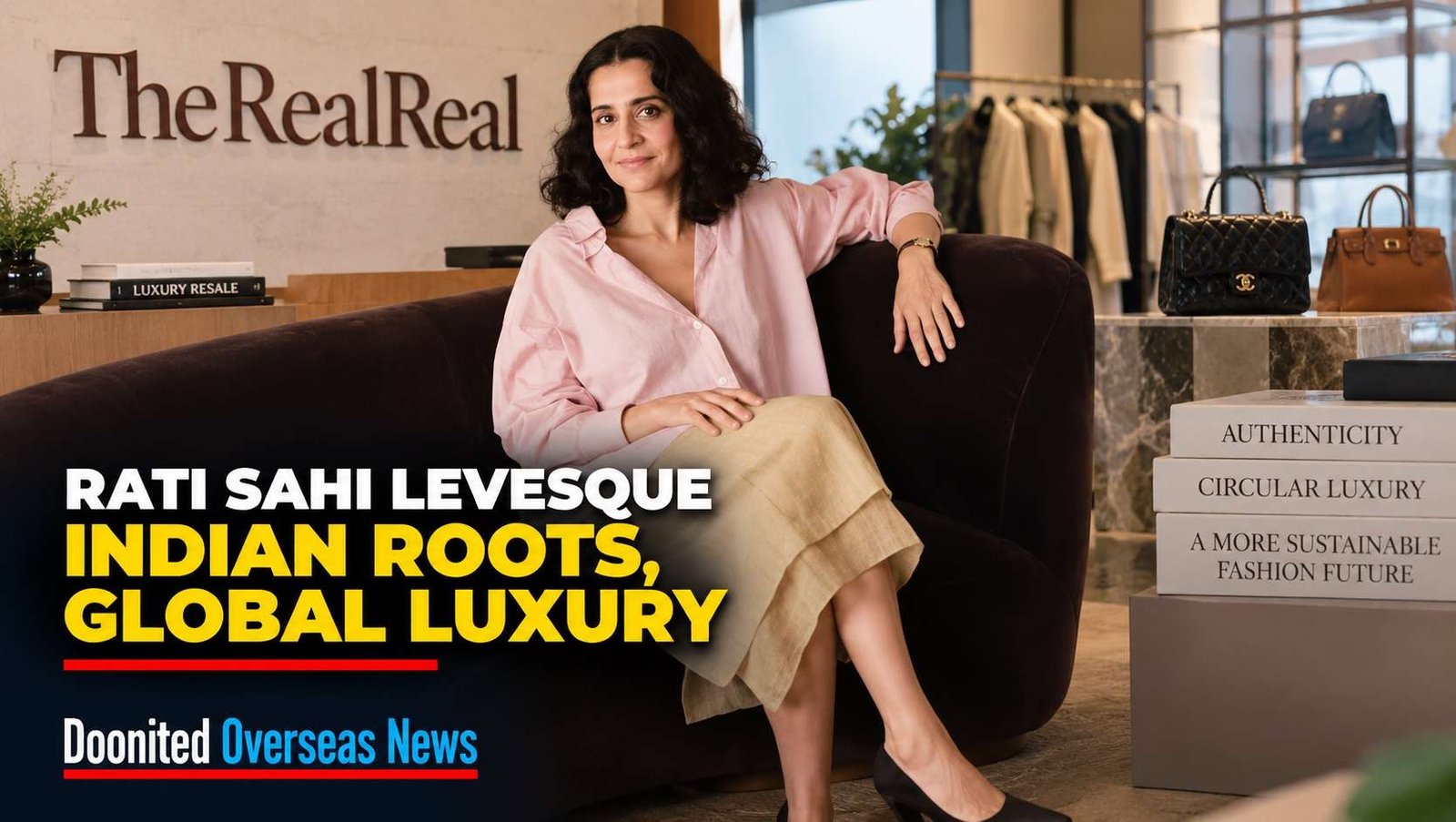
From a San Francisco family business to becoming the first employee and now CEO of The RealReal, Rati Sahi Levesque represents a different kind of Indian-diaspora success story—one built not simply around technology, but around changing how the world thinks about luxury, ownership and resale.
For years, the story of Indian-origin success in America has been closely associated with technology, medicine, finance and engineering. Rati Sahi Levesque’s career offers a different template: fashion, e-commerce, luxury and the emerging circular economy.
In September 2026, TIME named Levesque to its TIME100 Next 2026, placing her among the rising figures it sees as shaping the next generation. Her recognition is particularly interesting for the Indian diaspora because her influence has been built inside a distinctly American consumer business—while her journey began with a family business and an entrepreneurial instinct in San Francisco. TIME
Today, Levesque is President and CEO of The RealReal, the publicly traded luxury-resale marketplace. She has held the CEO role since October 2024, after years of progressively broader responsibility inside the company. The RealReal
But the more revealing part of her story is how she got there.
From a San Francisco family business to fashion entrepreneurship
Levesque was born and raised in San Francisco and grew up in a family that operated a restaurant in the city’s Nob Hill neighbourhood, according to a recent profile of Indian-origin TIME100 Next honourees. She studied Business Management Economics at the University of California, Santa Cruz and subsequently worked in the financial sector.
Her next move was less conventional.
She launched Anica, a fashion boutique in San Francisco’s Russian Hill neighbourhood. The store combined physical retail with an online presence and developed a following around avant-garde and luxury consignment pieces. Earlier interviews described how the business eventually generated about half of its sales through e-commerce—a useful early indication of where retail was heading. Rank & Style
That experience gave Levesque something that would later prove unusually valuable: an understanding of the relationship between luxury products, consumers and resale—not from a theoretical perspective, but from actually handling the merchandise and customers.
Then came The RealReal.
The first employee who helped build the company
Levesque joined founder Julie Wainwright in 2011 as The RealReal’s first employee. The company was attempting to create a digital marketplace for authenticated luxury resale at a time when online secondhand shopping had not yet become mainstream.
Her role expanded as the business grew.
She became Chief Merchant, taking responsibility for merchandising and sales strategy, warehouse operations and the company’s engineering team. Later, as President and COO, she oversaw revenue channels, operations, authentication and the physical retail footprint, while also contributing to merchandising, editorial and creative direction.
That progression matters.
Levesque was not simply brought into an established company as an outside executive. She accumulated institutional knowledge as the company itself evolved—from startup to major e-commerce marketplace and eventually a Nasdaq-listed business.
TIME’s tribute, written by PVH CEO Stefan Larsson, specifically highlighted this ability to evolve with the company through its early years, IPO and expansion into a billion-dollar business.
The resale market is no longer a niche
The business Levesque now leads is considerably larger than the consignment-store model that existed when she began.
The RealReal reported that its 2025 gross merchandise value surpassed $2 billion, while adjusted EBITDA was positive in every quarter for the first time.
Its 2026 performance has continued to show momentum. In the second quarter, GMV reached $617 million, up 22% year over year, while revenue rose 17% to $193 million. The company said it was raising its full-year outlook.
The scale of the consumer community is even more striking.
The company’s 2026 Resale Report said its community had reached 44 million members and that more than 50 million items had been sold across its 15-year history.
This changes the significance of luxury resale.
It is no longer simply about finding a discounted designer handbag or selling clothes that someone no longer wants. It increasingly represents an alternative economic model in which luxury products retain value, circulate between owners and remain part of the consumer economy for longer.
From “secondhand” to circular luxury
Levesque has repeatedly positioned resale as something larger than discount shopping.
The RealReal’s San Francisco flagship, reopened in 2026, was explicitly presented around ideas of circular luxury, sustainability and the extended life of luxury products. The RealReal
That distinction is important.
Traditional luxury depends heavily on newness: new collections, new seasons and new products. Resale introduces a different proposition. A luxury handbag, watch, piece of jewellery or designer garment can have multiple owners without necessarily losing its cultural or financial value.
The RealReal’s own research found that 47% of consumers were considering resale value when purchasing in the primary luxury market, according to the company’s 2025 results announcement.
If that behaviour continues to grow, resale could influence the original luxury market rather than merely exist alongside it.
The question becomes not only, “What does this product cost today?” but also, “What might it be worth tomorrow?”
That is a profound change in consumer psychology.
Levesque’s TIME100 Next recognition is significant beyond the fashion industry because it expands the picture of where Indian-origin leadership is making an impact.
Her career does not follow the familiar Silicon Valley route of founding a software company or becoming an executive at a technology giant. Instead, she combined retail experience, finance, fashion, digital commerce and operations and used those capabilities to help build an entirely different kind of technology-enabled global business.
For younger Indian-origin professionals overseas, that may be the more useful lesson.
The diaspora’s influence increasingly extends across sectors where technology is an enabler rather than the product itself: fashion, healthcare, finance, entertainment, food, sustainability, logistics and consumer services.
Levesque’s career demonstrates the value of combining domain expertise with digital thinking.
She understood luxury merchandise before scaling a technology-enabled marketplace around it. That combination is difficult to reproduce through technology alone.
The challenge ahead
The TIME100 Next recognition comes at a moment when The RealReal has significant momentum—but also faces the fundamental challenges of the resale business.
Authentication must remain credible. Buyers need confidence that products are genuine. Sellers need attractive economics. Luxury brands themselves must decide how much they want to embrace secondary-market activity. And the company must continue growing while maintaining margins and customer trust.
There is also a broader question about sustainability.
Resale can extend the useful life of products, but it does not automatically solve fashion’s environmental problems. If resale simply encourages consumers to buy more products, its sustainability benefit becomes more complicated.
The RealReal therefore has to prove that circularity can be more than a compelling marketing narrative.
A different definition of global Indian success
Rati Sahi Levesque’s story is ultimately not just about luxury fashion.
It is about building influence from accumulated experience.
She started with a family business environment, moved through finance, experimented with independent retail, entered a young technology-driven company as its first employee and eventually became the CEO of a multibillion-dollar luxury-resale marketplace.
That trajectory offers an important diaspora lesson: global Indian success does not have to follow a single formula.
The next generation of Indian-origin leaders may emerge not only from laboratories and software companies, but from the intersection of culture, commerce, sustainability, design and technology.
Levesque’s TIME100 Next recognition is therefore best understood not simply as an award for a fashion executive. It is recognition of a leader who helped turn resale from a peripheral shopping habit into an increasingly important part of the luxury economy—and who grew alongside that transformation.
For the Indian diaspora, that is a story worth watching.


World Beyond the News
Octopuses Can Change Their Appearance
Octopuses can rapidly alter their skin colour and texture to communicate, camouflage themselves and respond to danger.
Some Cities Exist Across Two Continents
A small number of cities are geographically associated with two continents, creating unusual cultural and geographic identities.
Earth’s Climate Is Measured in Many Ways
Scientists track temperature, atmospheric gases, sea level, ice cover and other indicators rather than relying on a single climate number.
Streaming Changed How Audiences Discover Shows
Recommendation systems and global streaming releases allow audiences to discover programmes far beyond their original markets.