
US Student Visa Rule Blocked at the Last Moment: What the Court’s Decision Means for Indian Students
For thousands of Indian students dreaming of an American degree—and for parents watching every immigration announcement with the intensity usually reserved for cricket scores—there was a major development on September 14.
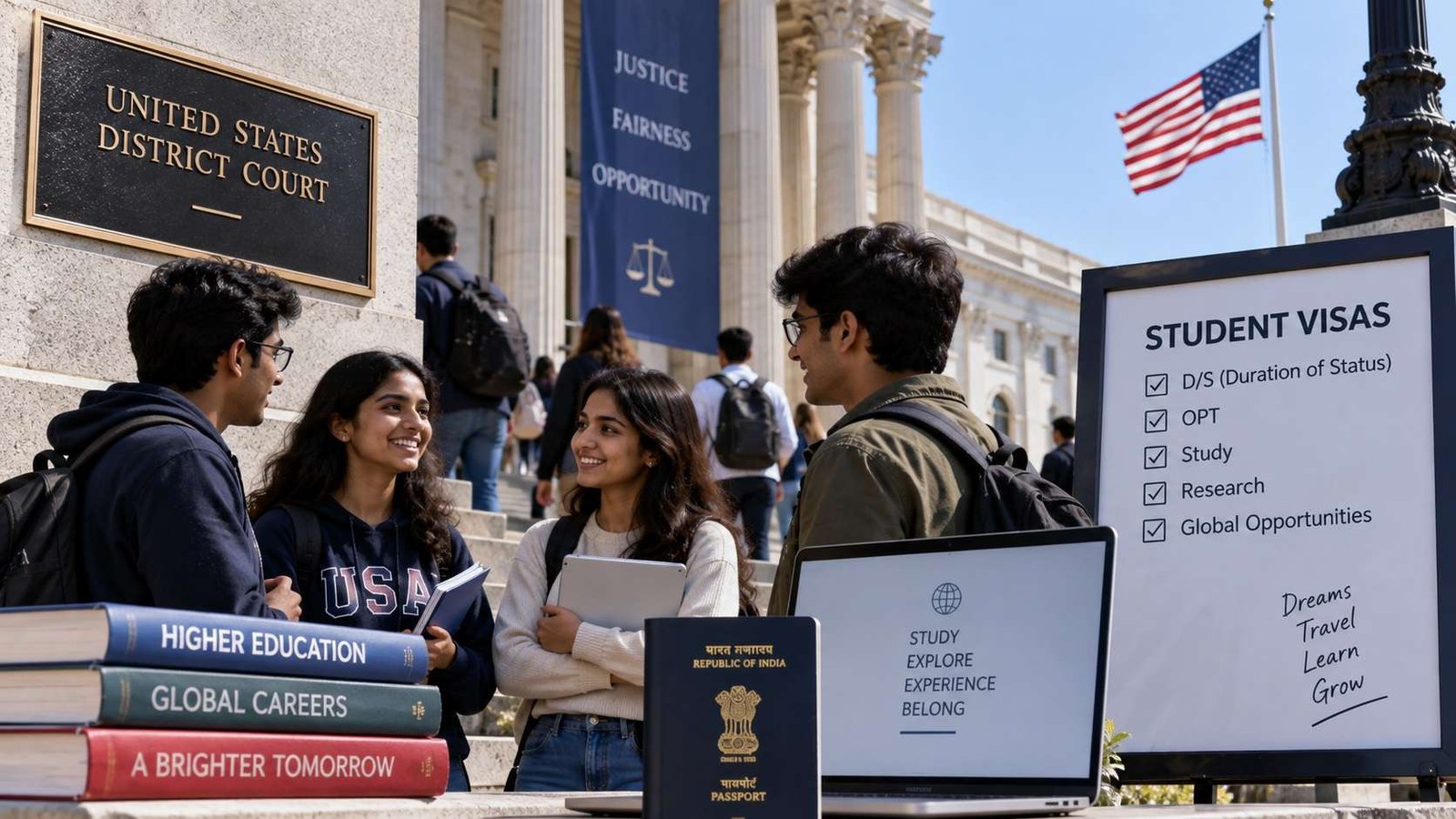
Just one day before a controversial new U.S. immigration rule was scheduled to take effect, a federal judge in Boston temporarily blocked the Department of Homeland Security’s plan to replace the long-standing “Duration of Status” system for international students and exchange visitors with fixed admission periods.
The ruling means the planned September 15 change does not take effect for now.
For Indian students already in America under F-1 status, that is significant relief.
But it is important not to misunderstand the headline.
The judge has paused the rule; he has not permanently struck it down.
The legal battle is still alive.
What was supposed to change on September 15?
The Department of Homeland Security published the final regulation in July, replacing the nearly 50-year-old Duration of Status (D/S) framework with a fixed admission system. The rule was scheduled to become effective on September 15, 2026.
Under the proposed system, F-1 students would generally have been admitted for the length of their academic programme, but for no more than four years.
A student whose programme required additional time could have needed to seek an extension from U.S. Citizenship and Immigration Services rather than simply continuing under D/S.
The rule also included a reduction in the F-1 post-study departure grace period from 60 days to 30 days.
For students in long academic programmes, particularly doctoral and research programmes, the change could have created considerably more administrative complexity.
A four-year bachelor’s degree fits neatly into a four-year box.
A PhD, however, has never been famous for respecting calendars.
Why Indian students are watching closely
India is now the largest source of international students in the United States.
According to the latest Open Doors data, 363,019 Indian students were studying in the U.S. in the 2024/25 academic year, a 10% increase from the previous year.
That makes changes to American student-visa policy particularly relevant to Indian families.
For many students, the American academic journey does not end exactly where the original programme calendar says it should.
Research projects can take longer.
Doctoral dissertations can run beyond expected timelines.
Laboratory work can be delayed.
Medical or specialised programmes can have complicated academic schedules.
And after graduation, students may seek authorised practical training such as Optional Practical Training (OPT).
The flexibility of D/S has therefore been an important part of the existing system.
What did the judge actually do?
U.S. District Judge F. Dennis Saylor IV issued preliminary relief on September 14, preventing the government from implementing the new rule while the legal challenge proceeds. NAFSA, one of the organisations involved in the lawsuit, confirmed that the existing Duration of Status framework remains in place nationwide as a result.
Reuters reports that Saylor found the government’s justification for replacing the long-standing framework inadequate, describing the rationale as “exceptionally weak.” The judge also questioned whether DHS had adequately considered less restrictive alternatives.
The important legal distinction is this:
The court has not issued a final judgment permanently eliminating the DHS regulation.
Harvard’s International Office likewise cautioned students that the injunction is temporary and that the government could appeal. The underlying case could therefore continue for some time.
For students, that means today’s relief should not be confused with a permanent guarantee about what the rules will look like several months from now.
What does this mean for Indian students right now?
1. The D/S system remains in place for now
Students currently covered by Duration of Status continue under the existing framework while the court order remains effective.
Harvard has specifically advised its international students and scholars that their D/S designation remains intact and that the blocked rule currently has no impact on their visa status.
2. The four-year cap is not taking effect today
The September 15 implementation of the fixed admission period has been halted.
Students therefore do not suddenly acquire a four-year admission deadline simply because September 15 has arrived.
3. The 30-day grace-period change is also paused
The proposed rule would have reduced the F-1 post-completion grace period from 60 days to 30 days. Because implementation has been blocked, that change does not currently replace the existing framework.
4. OPT is not suddenly cancelled
The court action does not eliminate F-1 OPT.
However, students should not interpret this as meaning that every future OPT-related immigration requirement is permanently settled. The rules could change depending on the outcome of the litigation.
5. International travel still deserves caution
This is perhaps the most important practical point.
Harvard’s current guidance specifically warns students to consider the consequences of international travel in relation to the evolving D/S rule.
Columbia University had similarly advised students about the consequences that international travel could have under the proposed fixed-admission system.
Because the legal situation has now changed, students should check their university’s latest international-student guidance before travelling, rather than relying on an article, social-media post or WhatsApp message—even this one.
Immigration advice is one area where forwarding a five-day-old screenshot is not a particularly sophisticated legal strategy.
Why universities fought the rule
The dispute is not simply about paperwork.
American universities and international-education organisations argued that fixed admission periods could create additional administrative burdens for institutions and students, particularly those pursuing longer research programmes.
The judge’s ruling also recognised potential academic and economic consequences. Reuters reported that universities and higher-education advocates warned that restrictions could disrupt research and reduce international enrolment.
The broader American higher-education system has a substantial dependence on international talent.
Open Doors reports that international students contributed significantly to U.S. higher education and the wider economy, while more than half of international students across academic levels were studying in STEM fields in 2024/25.
Indian students are a major part of that ecosystem.
The DOONITED Editorial View
The most interesting question here is not whether the government or the universities have the better slogan.
It is whether immigration policy can become more effective without becoming unnecessarily complicated.
There is a legitimate policy argument for stronger monitoring of international students. Governments have a responsibility to ensure that student visas are actually being used for genuine education and that immigration rules are respected.
But administrative control and academic flexibility do not have to be enemies.
A system can demand compliance without creating unnecessary uncertainty for legitimate students who are progressing through demanding academic programmes.
That is particularly important for research.
A government can reasonably ask a student:
“Are you genuinely studying and maintaining your status?”
That is a very different question from:
“Why did your PhD take five years instead of four?”
Science, unfortunately, has never signed an agreement to finish experiments before an immigration deadline.
The court’s intervention therefore raises a broader policy lesson: immigration reform should be measured not only by how much control it creates, but also by whether the administrative burden is proportionate to the problem it is intended to solve.
What Indian students should do now
The immediate message is neither “panic” nor “everything is permanently solved.”
It is simpler:
Stay calm, stay compliant and stay informed.
Indian students should:
- Maintain their required academic status.
- Keep their I-20, passport, visa and I-94 records accessible and accurate.
- Follow instructions from their university’s Designated School Official/international office.
- Check university guidance before international travel.
- Avoid making immigration decisions based solely on social-media posts.
- Monitor the court case because the government’s next legal move could change the situation again.
Harvard has already indicated that the government can appeal and that the legal process may continue.
The bigger lesson for Indian families
The latest court decision provides breathing space, but it also exposes a reality that every Indian student considering the United States should understand.
Getting an F-1 visa is not the end of the immigration story.
Visa rules, admission rules, I-94 requirements, SEVIS compliance, OPT regulations and court decisions can all affect a student’s journey.
That makes professional and institutional guidance more important than ever.
For now, however, the immediate threat of the September 15 four-year rule has been stopped.
The clock that was supposed to start ticking today has, at least temporarily, been switched off.
But nobody should throw away the calendar yet.
The court case is still running—and the next chapter could matter just as much as this one.

World Beyond the News
Birds Can Navigate Using Earth’s Magnetic Field
Several bird species can sense Earth’s magnetic field, helping them navigate during long-distance migration.
Fermentation Is a Global Food Tradition
People across continents have used fermentation for centuries to preserve food and create distinctive flavours.
Modern Batteries Store Energy Chemically
Rechargeable batteries repeatedly move ions between electrodes, allowing electrical energy to be stored and released.
Why Songs Become Global Hits
Streaming platforms, short-form video, playlists and international collaborations can rapidly carry music across borders.