

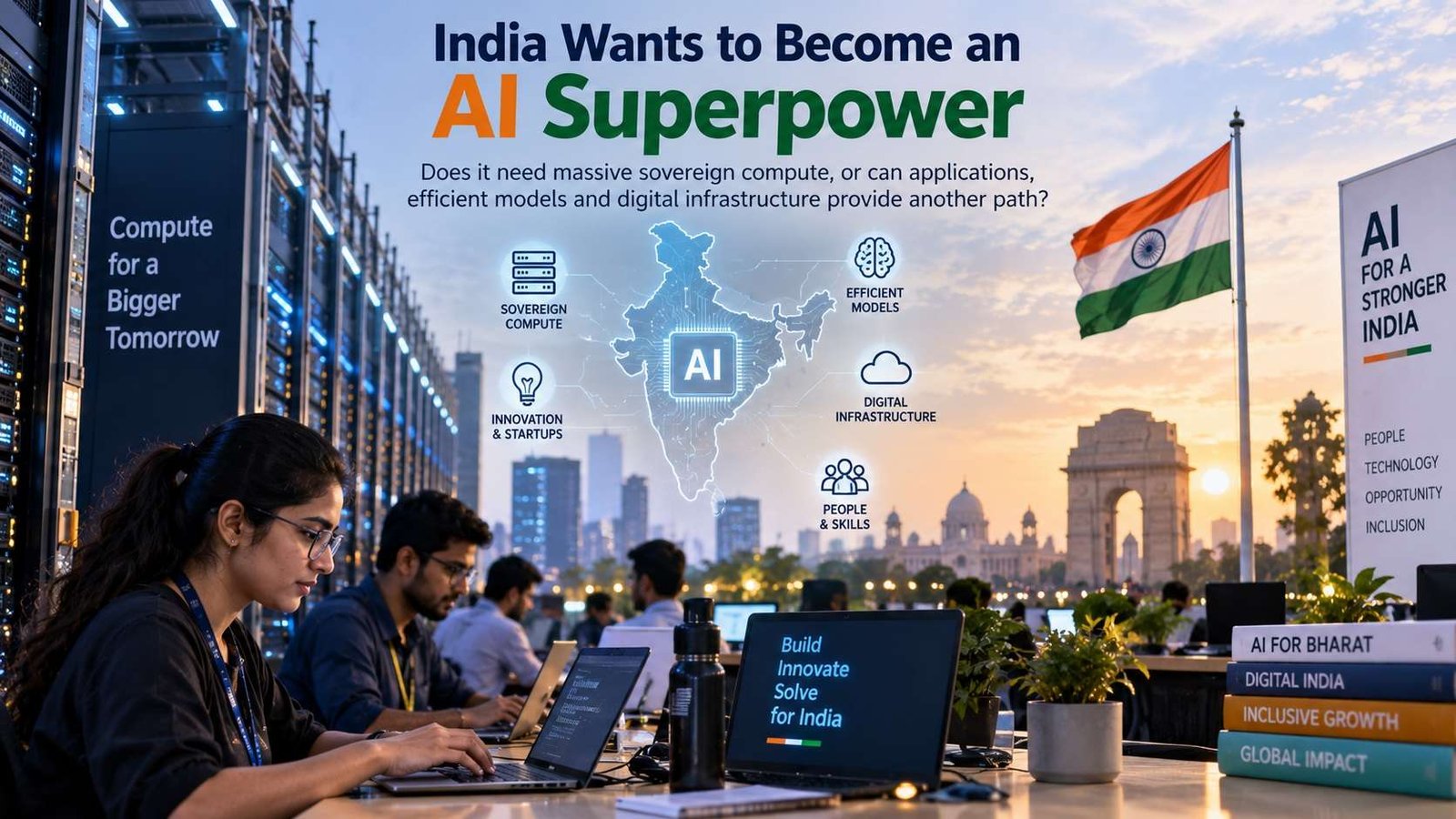
Does India Really Need Billions of Dollars of AI Compute to Become a Superpower?
India wants to become a major artificial-intelligence power. But there is a difficult question behind that ambition: does a country need to own enormous amounts of computing infrastructure to be a genuine AI superpower?
The answer is not as simple as “yes.”
Frontier AI requires extraordinary amounts of computing power. Training and operating the most capable models involves advanced processors, large data centres, enormous electricity requirements and sophisticated networking infrastructure. Countries and companies controlling these resources therefore possess an important strategic advantage.
But AI is much larger than frontier-model training.
India’s opportunity may lie not only in building enormous computing clusters, but also in deciding where sovereign infrastructure is essential, where collaboration is sensible and where Indian companies can create global value without owning every layer of the technology stack.
That distinction could determine India’s AI strategy over the next decade.
The compute problem is real
Artificial intelligence ultimately runs on physical infrastructure.
Behind every large language model are semiconductor accelerators, servers, networking equipment, cooling systems, electricity and data-centre capacity.
The most advanced AI systems require huge computational resources. Access to cutting-edge chips has also become a strategic issue because advanced semiconductor exports are increasingly affected by geopolitical considerations.
For India, this creates a vulnerability.
If an Indian company depends entirely on foreign cloud providers or overseas foundation models, it can potentially face higher costs, changing commercial terms, availability constraints or restrictions arising from international technology policy.
That does not mean foreign technology is inherently undesirable.
It means complete dependence can become a strategic weakness when the technology becomes economically or nationally critical.
But does sovereignty mean owning everything?
This is where the debate becomes more nuanced.
A country does not necessarily need to manufacture every semiconductor, design every processor, operate every cloud platform and train the world’s largest model to become a major AI economy.
Consider India’s existing technology strengths.
Indian companies have built enormous global businesses in software services, engineering, cloud implementation and enterprise technology without owning every underlying technology they use.
AI could follow a similar path—but with a crucial difference.
The strategic value of AI is likely to extend beyond software applications into compute, data, models and infrastructure. India therefore needs enough domestic capability to ensure that critical applications and national priorities are not completely dependent on external systems.
The question is how much is enough?
India’s sovereign AI push
India has already recognised the importance of domestic AI capacity.
The IndiaAI Mission was approved with an overall budget of ₹10,371.92 crore and includes pillars covering compute capacity, innovation, datasets, applications, skills and startup financing. The government’s stated objective is to build an AI ecosystem that supports both capability and access. (indiaai.gov.in)
The IndiaAI Compute Capacity initiative has also sought to make high-end computing resources available to researchers, startups and other users.
That is strategically significant.
India does not necessarily have to give every startup its own giant AI cluster. A shared national computing ecosystem can allow thousands of researchers and companies to access infrastructure without each organisation having to build a data centre.
That is a much more economically rational model.
The ₹1 lakh crore question
India’s proposed Research, Development and Innovation (RDI) Fund is another important piece of the puzzle.
The government announced a ₹1 lakh crore financing mechanism aimed at encouraging private-sector research and development in strategic and deep-technology areas.
But it would be misleading to describe the entire amount as an AI-compute fund.
The RDI initiative is broader, covering deep technology and research across multiple sectors.
That distinction matters.
India needs investment in AI, but it also needs investment in semiconductors, quantum technologies, biotechnology, advanced materials, defence technology, energy systems and other strategic fields.
Putting the entire RDI pool behind AI would not necessarily be sensible.
The better question is how much capital should be directed toward AI infrastructure that has genuine strategic and economic value.
India has another weapon: efficiency
There is a tendency in the AI race to measure success by the number of GPUs.
That can be misleading.
The world does need frontier-scale models, but not every useful AI application requires a frontier-scale model.
Smaller language models, model distillation, quantisation, specialised models and efficient inference can dramatically reduce computing requirements for particular tasks.
This could suit India unusually well.
India has a vast population, dozens of major languages and millions of businesses that need affordable technology.
A highly efficient AI model capable of performing a specific task at a fraction of the computing cost could be more commercially valuable in many Indian applications than a gigantic general-purpose model.
The strategic opportunity may therefore be:
Don’t always try to build the biggest model. Build the model that solves the problem efficiently.
That is not technological surrender.
It is a different definition of technological competitiveness.
India’s digital public infrastructure could become an advantage
India also possesses something that cannot simply be measured in GPUs: digital public infrastructure.
UPI demonstrated how government-backed infrastructure can create a common platform on which private companies build consumer services.
India’s AI strategy could potentially apply a similar philosophy to language and AI services.
Initiatives such as BHASHINI are designed to improve access to digital services across Indian languages and reduce language barriers in the digital ecosystem. (bhashini.gov.in)
This is particularly important because India’s AI opportunity is not limited to affluent English-speaking users.
An AI system that works effectively across Indian languages, accents and contexts could unlock enormous economic value.
That could become one of India’s distinctive contributions to global AI.
The application layer is not second-class AI
There is another misconception worth challenging.
Building applications on top of foundation models is sometimes dismissed as “not real AI.”
That is economically shortsighted.
The application layer is where AI interacts with hospitals, banks, manufacturers, retailers, schools, governments and consumers.
A company that develops an AI system capable of dramatically reducing the cost of processing insurance claims, improving factory maintenance or helping small businesses manage accounts can create enormous economic value without training the world’s largest language model.
India already has a large technology-services ecosystem capable of deploying software globally.
AI could turn that capability into a much larger export opportunity.
The country could become a global leader in AI implementation, integration and domain-specific systems.
But there is a line India should not cross
None of this means sovereign compute is unnecessary.
It would be strategically risky for India to depend entirely on foreign infrastructure for sensitive government, defence, scientific and critical-sector AI workloads.
There should be domestic capacity for strategically important workloads.
There should also be domestic expertise in chips, data centres, networking, model development and AI safety.
Otherwise, India risks becoming an enormous consumer and implementer of AI without possessing sufficient control over the underlying technology.
That is the real danger.
Not failing to build the world’s largest AI cluster.
Failing to build enough domestic capability to make meaningful strategic choices.
DOONITED EDITORIAL VIEW
India should resist two extremes.
The first is technological complacency:
“We have software engineers, therefore we are automatically an AI superpower.”
That is not enough.
The second is infrastructure maximalism:
“Unless India owns tens of thousands of the world’s most advanced GPUs, it cannot become an AI power.”
That is also too simplistic.
A serious AI strategy should pursue sovereign capability where it matters, global partnerships where they make economic sense, and efficiency everywhere possible.
India needs domestic compute.
It needs semiconductor capability.
It needs strong models trained for Indian languages and contexts.
It needs world-class AI researchers.
But it also needs something less glamorous and potentially more valuable: millions of businesses and public institutions successfully using AI.
The United States and China may dominate frontier-model development today, but India’s route to influence does not have to be an exact copy of theirs.
India’s advantage could be scale of adoption.
If hundreds of millions of people and millions of businesses use affordable Indian AI systems across multiple languages and industries, the resulting ecosystem could become globally significant.
The real AI superpower test
Perhaps the better definition of an AI superpower is not:
“Who owns the most GPUs?”
It is:
“Who can turn computing power, talent, data and infrastructure into the greatest economic and strategic capability?”
Compute is the foundation.
But foundations are useful because something is built on them.
India’s challenge is therefore to build enough sovereign infrastructure to avoid strategic dependence while simultaneously becoming exceptionally good at efficient AI, applications, languages and mass adoption.
The country does not have to choose between hardware and software.
It needs both.
The winning formula may ultimately be less about owning every component of the AI stack—and more about ensuring that India has enough capability across the stack to never be powerless at any critical layer.

World Beyond the News
Why Elephants Stay Close to Their Herd
Elephants live in highly social family groups and use calls, touch and body movements to maintain strong bonds.
Most of the Deep Ocean Remains Difficult to Explore
Extreme pressure, darkness and distance make deep-ocean exploration one of Earth’s greatest scientific challenges.
Spacecraft Can Travel Without Traditional Roads
Spacecraft use carefully calculated trajectories and gravity assists to travel enormous distances through space.
Why Movie Trailers Are Released in Stages
Major films often use teaser trailers, full trailers and final promotional spots to build awareness over time.