
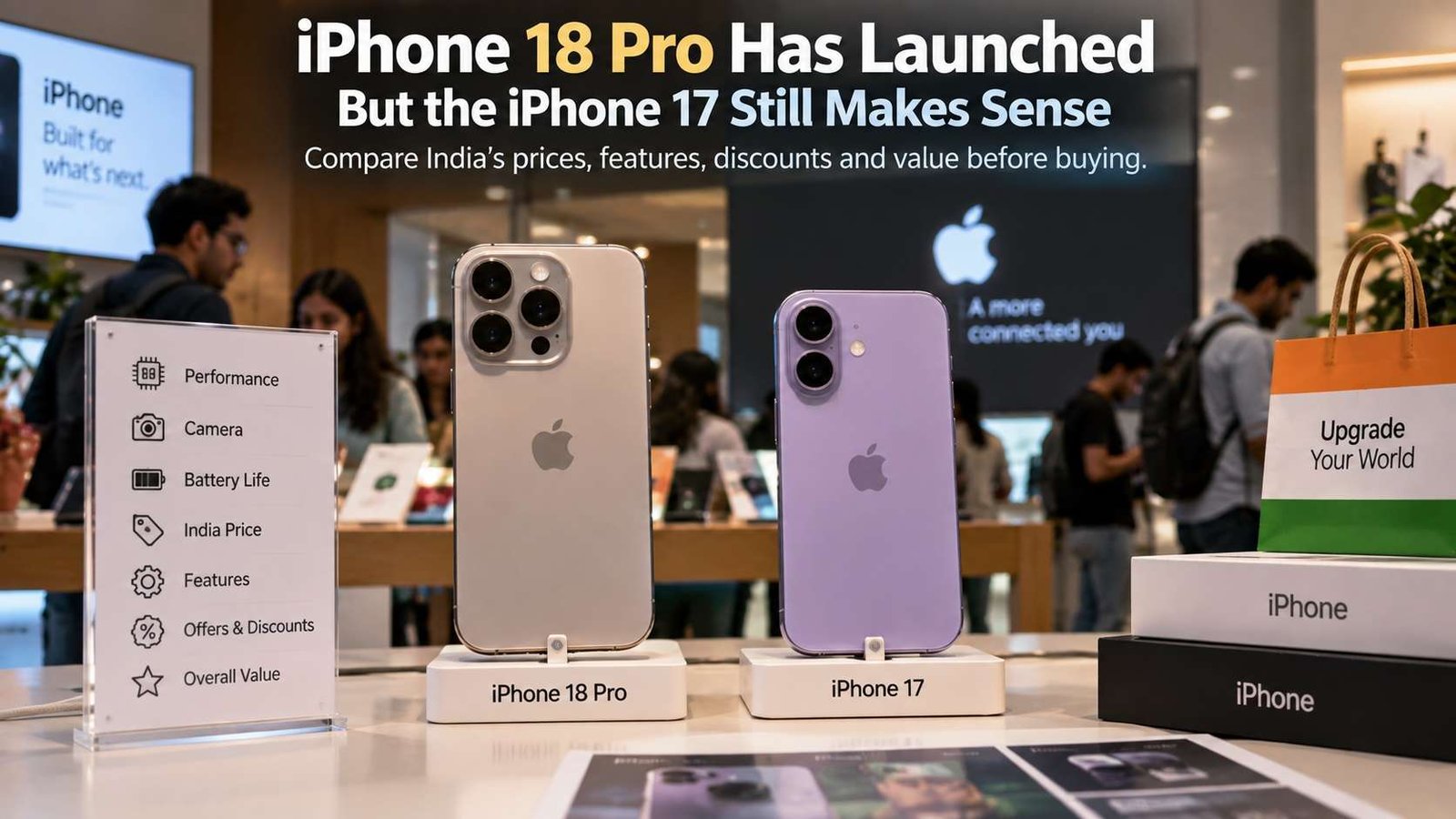
iPhone 17 After the iPhone 18 Launch: Is the Older iPhone Now the Smarter Buy in India?
The iPhone 18 generation has arrived—but if you are an Indian consumer looking for an iPhone today, the most interesting question may not be “Which new iPhone should I buy?”
It may be:
“Do I actually need the new one?”
Apple’s September 2026 launch changed the company’s usual iPhone cycle. The iPhone 18 Pro and iPhone 18 Pro Max have arrived, alongside Apple’s new foldable iPhone Duo, while the standard iPhone 18 is being held for a later launch expected in spring 2027.
That creates an unusual situation for buyers.
The latest Pro models offer Apple’s newest technology, but they also come with premium pricing. Meanwhile, the iPhone 17 remains a current model with a 6.3-inch ProMotion display, A19 chip, 48MP dual-camera system and Apple Intelligence support.
So, in September 2026, should Indian buyers look backward before looking forward?
The iPhone 18 launch created an unusual gap
For years, Apple’s September launch effectively gave consumers a simple choice: buy the new iPhone or take advantage of lower prices on the previous generation.
This year is different.
Apple has split the iPhone launch cycle. The standard iPhone 18 is not part of the September 2026 lineup and is expected in spring 2027, according to current reporting.
For someone who wants a regular, non-Pro iPhone today, that matters.
The iPhone 17 is therefore not an obsolete product suddenly pushed out of Apple’s catalogue. It remains officially sold by Apple in India.
There is, however, an unexpected twist.
The iPhone 17 actually became more expensive
Consumers expecting a dramatic Apple clearance sale received an unpleasant surprise.
Following the September launch, Apple increased the India price of the iPhone 17. Gadgets 360 reported that the starting price moved from ₹82,900 to ₹99,900, while Reuters described India’s price increases as among the steepest in markets where Apple adjusted prices in 2026.
Apple’s own Indian store currently lists the iPhone 17 from ₹99,900.
That changes the conventional “old phone equals cheap phone” story.
The iPhone 17 isn’t automatically a bargain simply because a newer generation has arrived.
The deal has to come from the retailer, bank offer, exchange programme or other discount—not necessarily from Apple’s official price.
And that distinction is extremely important for Indian shoppers.
What does the iPhone 17 still offer?
Quite a lot.
The iPhone 17 has a 6.3-inch Super Retina XDR OLED display with ProMotion up to 120Hz, Always-On capability and up to 3,000 nits peak outdoor brightness. It uses Apple’s A19 chip and includes a 48MP Dual Fusion rear-camera system.
It also supports Apple Intelligence and runs Apple’s current iOS 27 software.
For most everyday users, that is hardly a technological museum piece.
Web browsing, photography, social media, video, gaming, messaging and ordinary productivity are already well within the capabilities of the device.
The more interesting question is therefore not whether the iPhone 17 is “old.”
It is whether the additional capabilities of the new Pro generation are worth the additional money for a particular buyer.
And the new iPhone 18 Pro?
This is where the equation becomes more complicated.
Apple’s new Pro generation introduces the A20 Pro platform and further camera and display-related improvements, while the iPhone Duo brings an entirely new foldable form factor.
Those are genuine hardware changes—not cosmetic renaming.
For photography enthusiasts, heavy mobile gamers, professionals who need the highest available performance, or consumers who simply want Apple’s latest technology, the new generation may make sense.
But the average smartphone buyer should ask a less glamorous question:
Which of these improvements will I actually notice every day?
That question can save a surprising amount of money.
The Indian price equation is where things get interesting
The iPhone 17 Pro Max remains a premium device. Croma currently lists the 512GB model at ₹1,63,490 after a displayed ₹6,410 reduction from ₹1,69,900, with additional bank offers shown separately.
Croma is also advertising selected Apple-product benefits through its Tata Neu HDFC Bank Card programme, with potential savings of up to 10 percent in NeuCoins for eligible customers during the stated offer period.
These offers illustrate an important point:
The advertised price is not always the final effective price.
Consumers should compare:
- official Apple price;
- retailer price;
- bank cashback;
- exchange value;
- exchange bonus;
- reward points;
- EMI cost;
- storage capacity;
- and whether the offer is actually available in their location.
A ₹5,000 headline discount can become much less impressive if it requires an expensive financing arrangement or an unrealistic exchange valuation.
Conversely, a modest-looking bank or exchange offer can become significant when several benefits legitimately stack.
So should you buy the iPhone 17?
For many people, yes—but only at the right price.
The iPhone 17 has an unusually strong argument because its core experience remains modern: a 120Hz display, A19 processor, capable cameras, Apple Intelligence and current software support.
But buying it at Apple’s new ₹99,900 official starting price simply because it is “cheaper than the Pro models” isn’t necessarily a smart financial decision.
The better strategy is to look for a genuine effective discount from a reputable retailer.
If the final price difference between an iPhone 17 and a newer model is relatively small, the newer device becomes easier to justify.
If the difference is substantial, the iPhone 17 becomes much more attractive.
In other words, there is no universal winner.
The winner is the price-to-usefulness ratio.
The biggest mistake buyers can make
There is a temptation after every Apple launch to treat last year’s phone as yesterday’s technology.
That is excellent news for Apple’s marketing department.
It is not necessarily excellent news for your bank account.
A smartphone is not a car whose mechanical platform suddenly becomes obsolete when a new model arrives. Much of the experience is software, ecosystem, camera capability, display quality and processing performance.
The iPhone 17 already has a 120Hz ProMotion display—an important upgrade that was once restricted to Apple’s Pro models.
So if your current phone works well and your primary reason for upgrading is simply that a new iPhone exists, waiting may be the most economical option of all.
Yes, that is slightly less exciting.
Your wallet probably won’t complain.
DOONITED EDITORIAL VIEW
The most interesting story after Apple’s 2026 launch isn’t really about iPhone 17 versus iPhone 18.
It is about how consumers define value.
Apple has created a more complicated product ladder: premium Pro models now arrive first, the standard generation follows later, and India’s retail pricing can differ substantially from what shoppers expect after a new launch.
That makes comparison shopping more important than ever.
Our view is straightforward:
Don’t buy the iPhone 17 because it is old. Don’t buy the iPhone 18 Pro because it is new. Buy whichever phone delivers the features you actually need at a price you can justify.
And if you are already happy with your current iPhone, there is an even more radical option:
Keep it.
No launch event can make a perfectly functional phone stop working at midnight.
The takeaway
The iPhone 18 launch has made the iPhone 17 more interesting, not necessarily less relevant.
But Indian consumers should be careful with the word “discount.”
Apple’s official iPhone 17 price has increased, while retailer and payment offers can change the effective cost.
So before buying, compare the final payable price, not the size of the promotional banner.
Because in 2026, the smartest iPhone buyer may not be the person carrying the newest iPhone.
It may be the person who knows exactly why they bought theirs—and how much they really paid for it.

World Beyond the News
Why Elephants Stay Close to Their Herd
Elephants live in highly social family groups and use calls, touch and body movements to maintain strong bonds.
Most of the Deep Ocean Remains Difficult to Explore
Extreme pressure, darkness and distance make deep-ocean exploration one of Earth’s greatest scientific challenges.
Spacecraft Can Travel Without Traditional Roads
Spacecraft use carefully calculated trajectories and gravity assists to travel enormous distances through space.
Why Movie Trailers Are Released in Stages
Major films often use teaser trailers, full trailers and final promotional spots to build awareness over time.