

Beyond Remittances: How India’s Global Diaspora Could Become an Economic Superpower for Viksit Bharat
For years, the economic story of Indians living abroad has been told mainly through one impressive number: remittances.
Money earned in Dubai, London, New York, Toronto, Singapore and elsewhere travels back to India, paying for education, homes, healthcare, family expenses and investments.
But there is a much bigger story developing.
It is increasingly a source of capital, professional expertise, technology, international networks and global credibility.
And that could make the diaspora an important partner in India’s ambition to become a developed nation by 2047.
$730 billion is an impressive number—but it needs context
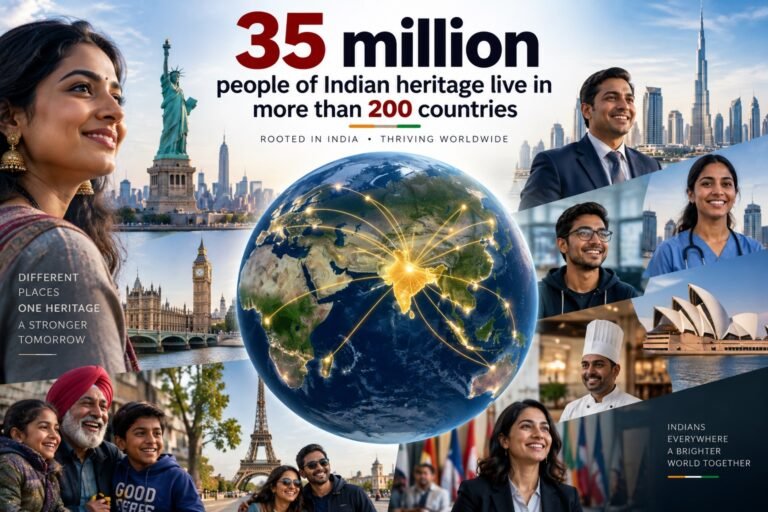
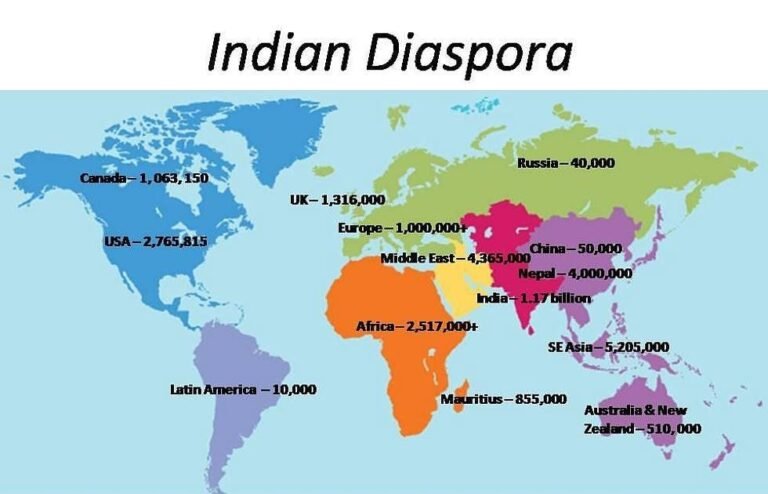
A 2026 report by Indiaspora estimates that more than 35 million people of Indian heritage live across more than 200 countries. It estimates that the diaspora earns more than $730 billion annually from formal employment.
That figure should not be misunderstood as $730 billion flowing into India.
It is an estimate of the income earned by the diaspora in the countries where they live and work.
The more interesting question is therefore not, “How much money do Indians abroad earn?”
It is:
How much of that economic power can become productive engagement with India?
That distinction matters.
A software engineer in California, a doctor in London, an entrepreneur in Singapore or an investor in Dubai may have considerably more to offer India than a conventional remittance transfer.
They can bring connections to markets, universities, investors, technologies and institutions that are difficult to create from scratch.
In other words, the diaspora’s real balance sheet may be much larger than the remittance figure suggests.
India remains the world’s remittance champion
India’s remittance story is already extraordinary.
The Economic Survey 2025–26 says India remained the world’s largest recipient of remittances, with inflows of $135.4 billion in FY2024–25, equivalent to roughly 3.5% of GDP. It also notes that remittances have helped strengthen India’s external account and finance a substantial portion of the merchandise trade deficit.
Indiaspora’s 2026 report uses a $138 billion figure for India’s remittances.
So which number is correct?
Both can be useful—provided they are labelled properly.
The $135.4 billion figure is the Indian government’s FY2024–25 figure, while the $138 billion figure is used in the Indiaspora report for its assessment of the diaspora’s economic contribution.
This is precisely why responsible journalism should not turn every impressive number into a competition.
The bigger point survives either way: India receives more remittances than any other country in the world.
The geography of remittances is changing
There is another important development.
India’s remittance flows are becoming increasingly diversified.
The Economic Survey notes that the share coming from advanced economies has increased, reflecting the growing contribution of skilled and professional workers.
This matters because India’s overseas population is not simply a low-wage labour story anymore.
Indian professionals are deeply embedded in technology, medicine, finance, academia, engineering, management and entrepreneurship.
That creates a different kind of economic relationship.
A worker sending money home helps a family.
A successful professional who invests in an Indian startup, mentors an Indian entrepreneur, establishes an R&D partnership, connects an Indian company to an overseas customer or funds a university collaboration can potentially influence an entire ecosystem.
That is where the conversation about India’s diaspora becomes much more interesting.
From remittance to investment
The next opportunity is to make it easier for diaspora wealth to become productive investment.
Imagine an Indian-origin technology executive in California who wants to invest in an AI company in Bengaluru.
Or a doctor in Britain who wants to support medical research in India.
Or an entrepreneur in Singapore who wants to help an Indian manufacturer enter Southeast Asian markets.
The money is useful.
But the knowledge and network accompanying the money may be even more valuable.
Indiaspora’s 2026 report describes diaspora contribution through three broad dimensions: capital, capability and credibility. Its survey also found strong interest among diaspora members in contributing through business, philanthropy, academia and government. At the same time, respondents identified administrative friction, legal complexity and limited visibility into opportunities as obstacles.
That is an important warning.
India cannot simply say, “Our diaspora loves India; therefore everything will happen automatically.”
It won’t.
Good intentions do not fill investment forms, resolve regulatory uncertainty or navigate bureaucratic procedures.
Sometimes even patriotic enthusiasm needs a reasonably well-designed online portal.
The 2047 opportunity
India’s developed-nation ambition gives the diaspora relationship a much larger horizon.
India will need enormous expansion in infrastructure, manufacturing, technology, research, education, healthcare, financial services and global trade.
The diaspora already occupies positions inside many of those international ecosystems.
This creates a potential bridge.
India can provide scale, talent, entrepreneurial energy and a large domestic market.
The diaspora can provide international networks, specialised expertise, capital and access to mature global markets.
The combination could be powerful.
But there is an important condition:
The relationship must become two-way.
India should not view overseas Indians merely as a source of foreign exchange.
And diaspora members should not be treated merely as honorary ambassadors who are invited to conferences and handed a shawl.
The relationship needs practical mechanisms for investment, research collaboration, mentoring, technology transfer, philanthropy and market access.
The hidden value: credibility
There is another asset that is difficult to measure in dollars.
Credibility.
Indian-origin executives, academics, scientists, doctors, entrepreneurs and public figures increasingly operate inside major international institutions.
Their success can influence how India is perceived abroad.
That does not mean every successful person of Indian origin automatically represents India’s interests. They are citizens, professionals and individuals with their own identities and responsibilities.
But their presence creates something valuable: familiarity.
A country becomes easier to understand when its people are already working inside the world’s major universities, corporations, hospitals, laboratories and financial centres.
This is soft power—but soft power with a professional address.
Remittances should not become an excuse for complacency
There is also a danger in celebrating the remittance story too comfortably.
Remittances are enormously valuable, but they can also reflect the fact that people had to leave India to find higher-paying opportunities.
The long-term objective should therefore not be to maximise migration simply because migrants send money home.
It should be to create an India where people can choose to build global careers from India as well as abroad.
That means stronger universities, better research infrastructure, globally competitive companies, deeper capital markets, easier business processes and more opportunities for high-skilled professionals.
The best diaspora policy is ultimately not about asking Indians abroad to compensate for India’s weaknesses.
It is about giving them compelling reasons to participate in India’s strengths.
DOONITED Editorial Perspective
The most interesting figure in the diaspora story may not be $138 billion.
It may be the much harder-to-measure combination of capital + knowledge + networks + credibility.
Money can cross a border with a bank transfer.
Knowledge can create an industry.
A professional network can open a market.
A research collaboration can produce technology.
And credibility can change how the world sees a country.
India’s diaspora therefore should not be viewed simply as India’s “extended wallet”.
It can become an extended economic and intellectual network.
For Viksit Bharat @2047, that distinction could prove decisive.
The challenge for India is to build the bridges.
The challenge for the diaspora is to walk across them.
And the opportunity is to make sure that the relationship produces something much larger than another remittance record.
The future may not simply be about Indians sending money home. It could be about Indians around the world helping build what India becomes next.
Reader takeaway: India’s diaspora already provides enormous financial support through remittances. The larger opportunity is to convert its global expertise, investment capacity, business networks and institutional influence into long-term partnerships with India.

World Beyond the News
Birds Can Navigate Using Earth’s Magnetic Field
Several bird species can sense Earth’s magnetic field, helping them navigate during long-distance migration.
Fermentation Is a Global Food Tradition
People across continents have used fermentation for centuries to preserve food and create distinctive flavours.
Modern Batteries Store Energy Chemically
Rechargeable batteries repeatedly move ions between electrodes, allowing electrical energy to be stored and released.
Why Songs Become Global Hits
Streaming platforms, short-form video, playlists and international collaborations can rapidly carry music across borders.