

How Indian Communities Are Bringing Ganpati Bappa to Britain
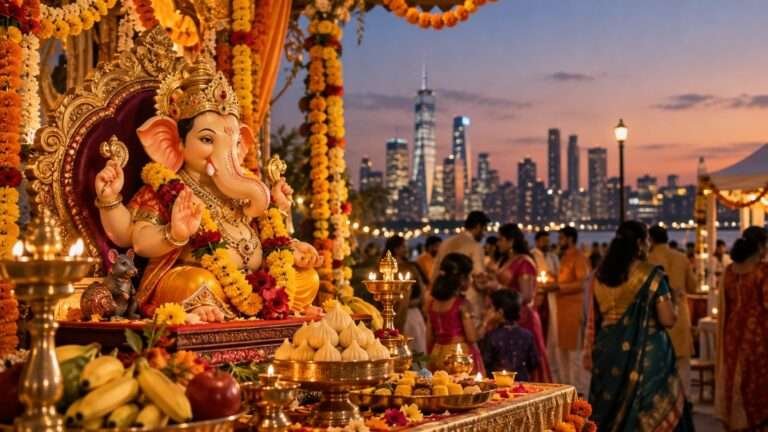
On Monday, 14 September 2026, something very familiar to millions of Indians will begin happening thousands of kilometres away from Mumbai, Pune, Nagpur and other Indian cities.
Homes will welcome Ganesha.
Community halls will fill with prayers.
Temples will organise darshans.
Modaks will appear.
And somewhere, inevitably, someone will discover that a perfectly respectable British kitchen is suddenly being asked to produce enough food for an entire neighbourhood.
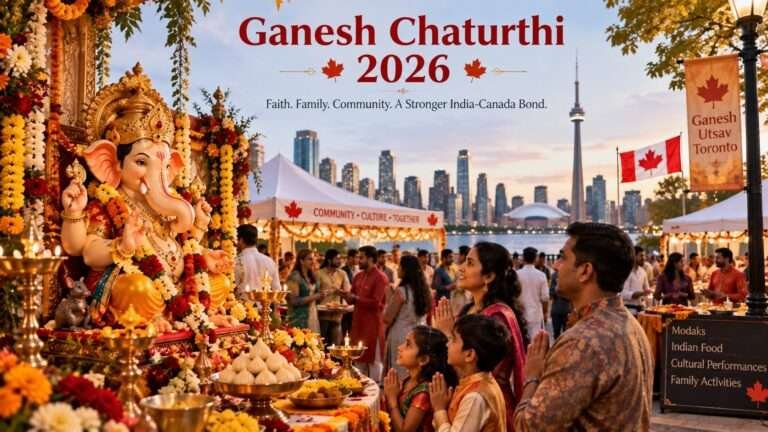
Ganesh Chaturthi has become part of Britain’s multicultural calendar.
In 2026, Hindu communities across the UK will celebrate the festival from September 14, with the ten-day observance concluding around Anant Chaturdashi on September 25. Leicester’s local Hindu calendar, for example, confirms September 14 as Ganesh Chaturthi and September 25 as the main visarjan date.
But Ganeshotsav in Britain is not simply an Indian festival transplanted overseas.
It is evolving into something distinctly British-Indian.
Ganpati arrives in Britain
Ganesh Chaturthi commemorates the birth of Lord Ganesha, revered in Hindu tradition as the deity associated with wisdom, prosperity and the removal of obstacles.
In India, the festival can transform entire neighbourhoods.
In Britain, the scale is naturally different.
But the emotion is familiar.
Indian families and community organisations in cities including London, Leicester, Birmingham and Manchester organise prayers, cultural programmes, darshans and community gatherings during the festival. Remitly’s 2026 overview identifies these cities among the principal centres of British Hindu celebrations.
For first-generation immigrants, such celebrations can reconnect them with memories of home.
For their children, they can provide something equally important:
a living connection with a culture they may otherwise experience mainly through family stories, food and social media.
That is one reason diaspora festivals matter.
They are not simply religious events.
They are cultural classrooms.
London is not Mumbai and that is perfectly fine
One of the interesting features of the British Ganesh festival is how communities adapt.
Mumbai can accommodate enormous public celebrations.
British cities operate under very different rules governing public events, traffic, waterways, noise, safety and public spaces.
That means the British version of Ganeshotsav tends to rely more heavily on temples, community organisations, halls, private homes and organised venues.
The result can be smaller than a major Mumbai procession.
But smaller does not mean less meaningful.
A family gathering around a Ganpati murti in a London home can carry the same emotional significance as a much larger celebration.
And there is perhaps a useful lesson here:
A festival’s cultural power is not measured in decibels.
The British calendar continues as normal
There is sometimes confusion about whether Ganesh Chaturthi is an official holiday in Britain.
It is not.
The official 2026 bank-holiday calendar for England and Wales does not list September 14 as a bank holiday.
So British workplaces, schools and businesses generally continue operating normally.
For Hindu families, this creates a familiar balancing act:
work during the day, Ganpati celebrations when time allows.
It is a very modern diaspora experience.
Tradition has to share the calendar with meetings, school runs, commuting and—because this is Britain—probably a weather forecast that cannot make up its mind.
The visarjan question is different in Britain
Perhaps the most visible difference concerns Ganesh Visarjan.
In Maharashtra, the image of devotees carrying Ganesha towards a river, lake or sea is deeply associated with the festival.
In Britain, however, communities must consider environmental regulations and permissions governing activities involving waterways.
The Environment Agency says organisers planning events on its rivers and canals should contact the relevant waterway office in advance and make appropriate arrangements for safety. More generally, activities that can pollute water or affect water resources may require environmental permissions.
That does not mean the British Ganesh festival has to abandon visarjan.
It means communities need to organise it differently.
The use of eco-friendly clay murtis, controlled immersion arrangements and designated facilities can allow the spiritual symbolism to continue while respecting British environmental requirements.
That adaptation is actually quite significant.
The ritual remains.
The method changes.
Can tradition adapt without losing its meaning?
This is one of the most interesting questions raised by Ganesh Chaturthi abroad.
Religious traditions have always adapted to geography.
A festival celebrated beside the Arabian Sea will naturally look different from one celebrated in Birmingham.
The important question is whether adaptation destroys meaning—or protects it.
In many cases, the British experience suggests the latter.
If a clay Ganesha is immersed through an approved arrangement rather than directly into a natural river, the environmental method is different.
But the underlying spiritual idea of return, renewal and letting go can remain.
Tradition, after all, has survived considerably bigger changes than a different postcode.
Food becomes cultural diplomacy
There is another powerful part of the British Ganesh festival that deserves more attention.
Food.
Modak is traditionally associated with Ganesha.
But community celebrations also bring together a huge range of regional Indian cuisine.
Maharashtrian families may prepare ukadiche modak, puran poli and other festive foods.
Other Indian communities bring their own traditions.
And British-born children encounter these foods alongside their friends and neighbours.
Food becomes an informal form of cultural diplomacy.
You do not need a foreign-policy conference to explain India when someone has just handed you a plate of freshly prepared modaks.
A festival that speaks to the next generation
Perhaps the most important audience for Ganesh Chaturthi in Britain is not the first generation.
It is the second and third.
Young British Indians live between multiple cultural worlds.
They are British.
They may have Indian parents or grandparents.
They may speak English more comfortably than an Indian language.
They may know London better than Mumbai.
And yet, through Ganesh Chaturthi, they can participate in something that connects generations.
They learn prayers.
They hear stories.
They help decorate.
They meet other young people from similar backgrounds.
They discover that heritage is not something sitting quietly inside an old family album.
It can be celebrated.
Ganesh Chaturthi is also becoming a public expression of Indian identity
The growing visibility of Indian festivals in Britain reflects the wider evolution of the Indian diaspora.
Indian-origin communities are increasingly established across professional, cultural and civic life.
Ganesh Chaturthi therefore exists within a broader landscape that includes Diwali celebrations, Holi events, Navratri, Vaisakhi and numerous regional Indian cultural festivals.
The significance goes beyond religion.
These festivals demonstrate how immigrant communities can preserve distinctive traditions while participating fully in the societies where they live.
That is one of the strengths of multicultural Britain.
But cultural celebration needs responsibility
Celebrations in public spaces require consideration for neighbours, traffic, waste, noise and environmental protection.
That is not a burden unique to Hindu festivals.
It is a normal requirement for any large community event.
The strongest celebrations are therefore likely to be those that combine enthusiasm with good organisation.
A beautiful festival should leave behind memories—not litter.
And a religious celebration should ideally demonstrate the values it represents.
That makes the environmental question around visarjan particularly relevant.
If Ganesha is associated with wisdom, then perhaps an environmentally responsible visarjan is a rather appropriate expression of that wisdom.
DOONITED Editorial Perspective
Ganesh Chaturthi in Britain tells a much larger story than the dates on a calendar.
It shows how a diaspora carries culture across borders without freezing it in time.
The Ganpati celebration that takes place in Leicester or London in 2026 may not look exactly like one in Pune or Mumbai.
It doesn’t have to.
Culture survives not because every detail remains unchanged, but because each generation finds a way to make it meaningful again.
For British Indians, Ganesh Chaturthi can therefore be simultaneously Indian and British.
The prayers may be ancient.
The venue may be modern.
The food may come from Maharashtra.
The children may speak with unmistakably British accents.
The immersion may have to follow British environmental rules.
And yet the central sentiment remains remarkably simple:
Welcome Ganesha. Celebrate together. Learn. Give thanks. And eventually, learn to let go.
That is perhaps why Ganesh Chaturthi travels so well.
It does not need India to remain alive.
It needs people who remember why it matters.
And in Britain in 2026, those people are increasingly making Ganpati Bappa part of the country’s multicultural story.

World Beyond the News
Octopuses Can Change Their Appearance
Octopuses can rapidly alter their skin colour and texture to communicate, camouflage themselves and respond to danger.
Some Cities Exist Across Two Continents
A small number of cities are geographically associated with two continents, creating unusual cultural and geographic identities.
Earth’s Climate Is Measured in Many Ways
Scientists track temperature, atmospheric gases, sea level, ice cover and other indicators rather than relying on a single climate number.
Streaming Changed How Audiences Discover Shows
Recommendation systems and global streaming releases allow audiences to discover programmes far beyond their original markets.