
Indian Culture in America: How a Community Is Preserving Its Roots While Shaping American Life
Walk through parts of New Jersey, Texas, California, Illinois or New York and it is possible to encounter an India that exists thousands of kilometres from the subcontinent.
There may be an Indian grocery store, a temple or gurdwara, a restaurant serving regional cuisine, a Bharatanatyam class, a Hindi-speaking family or a community preparing for Diwali.
But Indian culture in the United States is no longer simply an immigrant culture preserved behind closed doors.
It has increasingly become part of the wider American cultural landscape.
The scale of the community helps explain why.
The U.S. Census Bureau’s 2024 American Community Survey counted approximately 5.56 million people of Asian Indian origin, alone or in combination with another race in the United States.
The community is large, but its cultural identity is anything but uniform.
One community, many Indias
Indian Americans do not represent a single language, religion or regional tradition.
Pew Research Center data shows that among Indians aged five and older, Hindi, Telugu, Gujarati and Tamil are among the leading languages spoken at home. At the same time, 84% are proficient in English.
Religion is similarly diverse.
About 48% of Indian Americans identify as Hindu, while 15% identify as Christian, 8% as Muslim, 15% as religiously unaffiliated and 11% with another faith, according to Pew’s survey data.
This diversity is important because “Indian culture” in America is not one tradition transplanted intact from India.
It is a combination of Punjabi, Gujarati, Tamil, Telugu, Bengali, Marathi, Malayali, Hindi-speaking and many other traditions interacting with American life.

Festivals are becoming public culture
Perhaps nowhere is that transformation more visible than in festivals.
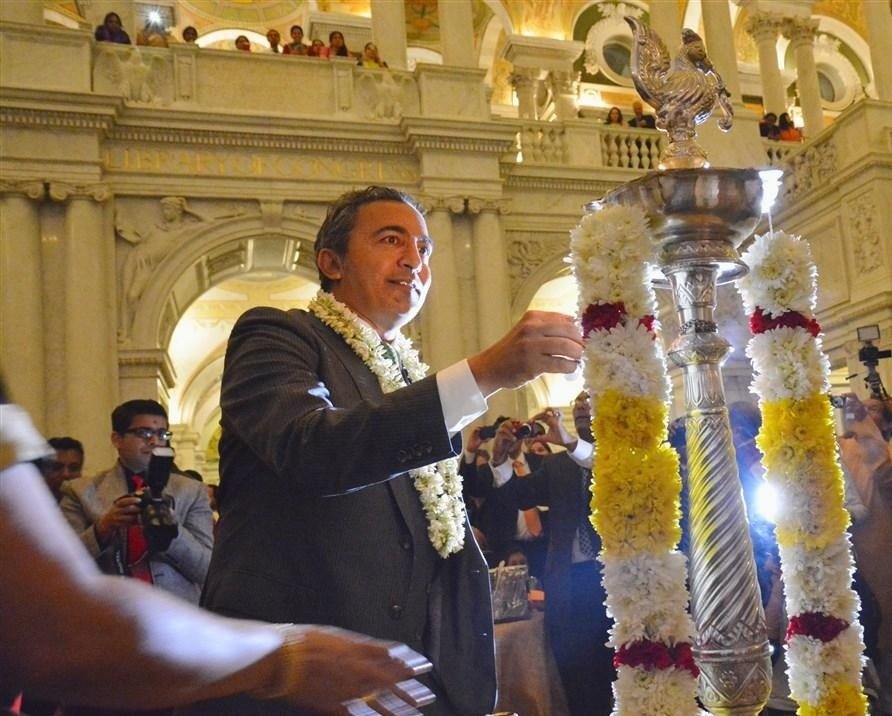
Diwali celebrations are now held not only in homes and community centres but also at universities, workplaces and public institutions.
Pew found that 63% of Indian Americans surveyed in the 2020 Indian American Attitudes Survey said they celebrated Diwali, while 41% reported celebrating Holi.
The public recognition of Diwali provides another indication of this cultural transition.
New York City made Diwali an official public-school holiday in 2023, following years of advocacy by community leaders.
California also moved to recognise Diwali as a state holiday, with Governor Gavin Newsom signing the relevant legislation in October 2025.
These developments do not mean that American society has become Indian.
They demonstrate something subtler: Indian traditions have become visible enough to be accommodated within public American life.
Food may be the most powerful cultural bridge
Food perhaps travels even more easily than language or religion.
Indian restaurants and grocery stores have become familiar parts of many American communities. For Indian families, these businesses provide access to ingredients and flavours associated with home.
For Americans who did not grow up with Indian food, they provide an introduction to the cuisine.
And Indian food itself is evolving.
A restaurant may serve traditional Gujarati thali alongside contemporary dishes. A family may prepare rotis at home while children prefer pizza at school. A festival may combine an Indian religious tradition with an American community setting.
This is not necessarily cultural dilution.
It is how living cultures adapt.
The second generation faces a different question
For immigrants who arrived from India, preserving culture can mean maintaining language, food, religious practice, family customs and relationships with relatives back home.
For their American-born children, the question is different.
They do not necessarily have to choose between “Indian” and “American.”
Pew found that Indian Americans describe their identities in several ways: 41% most often described themselves as Indian, 21% as Indian American, 10% as American, 15% as Asian or Asian American and 9% as South Asian.
That suggests an important reality.
Identity can have layers.
Someone can grow up speaking English at school, speaking Gujarati or Telugu with grandparents, eating Indian food at home, participating in an American workplace and celebrating both American and Indian holidays.
None of these identities necessarily cancels the others.

But cultural preservation is not automatic
There is also a less comfortable side to the story.
Pew found that one in five Indian Americans said they had hidden part of their heritage, such as cultural or religious practices, from people who were not Asian.
That finding reminds us that cultural confidence cannot be measured only by the number of festivals taking place.
Language can disappear between generations.
Young people may understand a heritage language without speaking it fluently. Traditional practices may become occasional rather than routine. Some families may struggle to balance expectations surrounding marriage, career, family hierarchy and individual choice.
These are not uniquely Indian problems. They are common questions faced by immigrant communities.
The challenge is finding a balance between preserving heritage and allowing the next generation to define what that heritage means to them.
Indian culture is also influencing America
The cultural exchange does not move in only one direction.
Indian Americans have contributed to American business, medicine, technology, academia, entertainment, public service and community life.
The community’s educational profile is particularly notable: Pew reports that 77% of Indian Americans aged 25 and older have at least a bachelor’s degree, including 45% with an advanced degree.
But cultural contribution cannot be measured only through professional achievement.
It is also visible in music, dance, cuisine, yoga, fashion, festivals, entrepreneurship and neighbourhood life.
India is not simply being preserved inside America.
It is participating in the continuing evolution of American society.
The DOONITED perspective
The most interesting story about Indian culture in the United States is not that Indians have managed to remain Indian.
It is that Indian identity has proved capable of adapting without necessarily disappearing.
The first generation may preserve traditions because they remember India.
The second generation may preserve some traditions because they choose them.
The third generation may reinterpret them completely.
That is how culture survives.
A language may become less fluent but remain emotionally important. A festival may move from a family living room to a city-wide celebration. Indian food may become mainstream while still retaining regional identities. A young American may feel equally comfortable at a Diwali celebration and an American Thanksgiving dinner.
That is not cultural confusion.
It is cultural evolution.
For India, the diaspora also represents a powerful bridge between two societies. The strongest cultural connection is not created by insisting that people remain exactly as they were when they left India.
It is created when heritage remains meaningful while people build their own lives in a new country.
Indian culture in America is therefore not a museum exhibit from the old country.
It is a living culture—changing, adapting and, in many places, becoming unmistakably part of the American story.

World Beyond the News
Bees Communicate Where Food Is
Honeybees use movement patterns known as waggle dances to communicate information about food locations.
Street Food Reflects Local History
Many famous street foods developed from migration, trade, local ingredients and the everyday needs of working communities.
A Day on Venus Is Extremely Long
Venus rotates so slowly that one rotation relative to distant stars takes longer than its trip around the Sun.
Human Achievement Continues to Push Limits
Athletes, engineers, scientists and explorers regularly establish new benchmarks in speed, endurance, scale and precision.