
How Open-Source Analysts Separate Battlefield Facts from Digital Fiction
In modern warfare, the battlefield is no longer limited to deserts, mountains, oceans and airspace.
There is another battlefield that can be just as consequential:
the smartphone screen.
A missile strike can take place thousands of kilometres away. Within minutes, a video can appear on social media claiming that an airbase has been destroyed, a fighter has been shot down or a senior military officer has admitted defeat.
Sometimes the video is genuine.
Sometimes it is old footage.
Sometimes it shows a completely different country.
And increasingly, sometimes the person speaking in the video never said those words at all.
This is where open-source intelligence, or OSINT, has become an important tool for journalists, researchers, investigators and ordinary internet users trying to establish what actually happened.
The first rule: don’t believe the picture simply because it looks convincing
A photograph or video is evidence.
It is not automatically proof.
Professional OSINT analysts therefore ask a deceptively simple question:
What independent evidence supports this claim?
A dramatic explosion may show an actual explosion.
It does not necessarily prove when it happened, where it happened or what caused it.
That distinction is fundamental.
A good investigation separates the original visual material from the story attached to it.
Satellite imagery can test battlefield claims

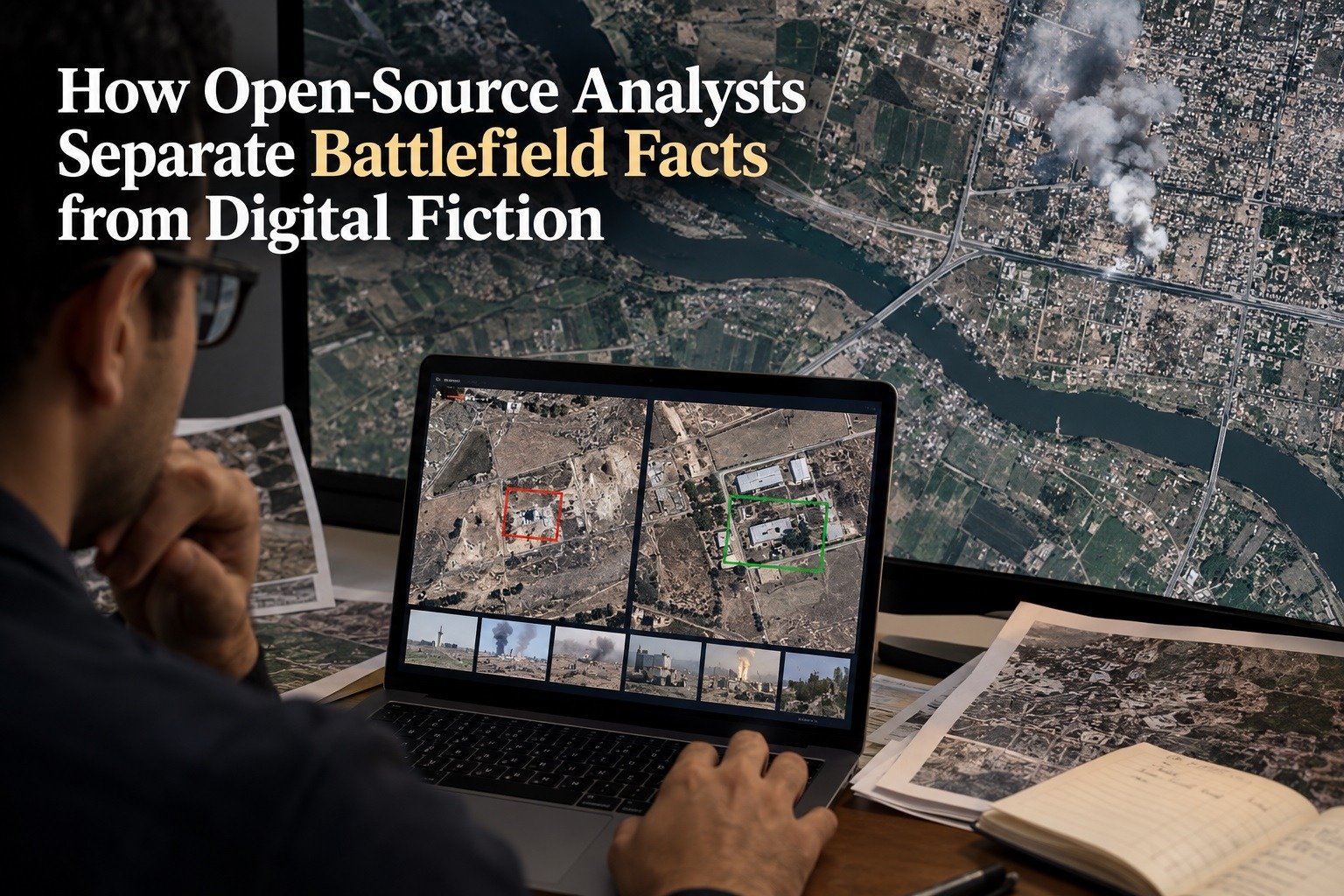
If an online account claims that a particular military airbase has suffered major damage, analysts can compare imagery from before and after the alleged event.
They look for things such as:
- new impact craters,
- damaged buildings,
- aircraft shelters,
- destroyed runways or taxiways,
- burn marks,
- displaced equipment,
- changes in aircraft numbers,
- construction or repair activity.
Commercial satellite imagery can therefore provide an independent physical reference point.
But there is an important limitation.
Satellite imagery does not automatically tell investigators who caused the damage.
A crater can establish that something happened.
It may not establish exactly what weapon produced it.
Likewise, the absence of visible damage does not necessarily prove that a military claim is false. Imagery may have the wrong date, resolution or viewing angle, or the relevant facility may be obscured.
Good OSINT therefore treats satellite imagery as one layer of evidence—not a magical battlefield truth machine.
The clock can expose a fake
Time is one of the simplest ways to catch recycled footage.
A video claimed to show an event “today” might actually have been recorded years earlier.
Investigators can examine:
weather, vegetation, shadows, buildings, road markings, aircraft configuration and even construction progress.
Suppose a video supposedly recorded during a September operation shows trees, buildings or infrastructure that did not exist at that location on the claimed date.
The timestamp has a problem.
The same applies to weather.
If an alleged battlefield video shows heavy rain while reliable meteorological records indicate clear conditions at that location, the claim deserves further investigation.
This is not glamorous detective work.
It is mostly comparison.
But sometimes boring verification beats exciting misinformation.

Metadata helps—but it is not a fingerprint of truth
Digital files can contain metadata such as creation dates, device information and editing information.
Analysts may examine these details when available.
But metadata should be treated cautiously.
Social-media platforms frequently strip or alter metadata when files are uploaded.
A missing timestamp does not make a video fake.
Likewise, a convincing timestamp does not prove that the footage is authentic.
The stronger approach is to combine metadata with visual and contextual evidence.
Reverse-image searches can uncover recycled propaganda
Another highly useful technique is reverse-image searching.
Investigators can take a frame from a suspicious video and search for earlier appearances of the same image.
Video can also be broken into individual frames so that distinctive scenes can be searched separately.
This can reveal that an apparently new battlefield photograph actually appeared online five years earlier.
The trick works because misinformation often has an unexpected weakness:
the internet remembers.
Old photographs, television broadcasts and social-media posts can remain searchable long after their original context has been forgotten.
The PIB Fact Check Unit itself says it uses technological tools including reverse-image search and video analysis to determine whether viral images or videos have been reused in misleading contexts.

AI has made the problem harder
Deepfakes have changed the nature of verification.
A fabricated video may now contain a realistic-looking face, synchronised speech and an apparently authentic military setting.
Audio can also be synthetically generated or manipulated.
Investigators can look for inconsistencies in:
- lip movement,
- facial motion,
- lighting,
- reflections,
- image edges,
- compression patterns,
- voice characteristics,
- background sound,
- unnatural pauses or transitions.
But here too, caution matters.
There is no single visual or audio anomaly that universally proves a deepfake.
AI detection tools can produce false positives and false negatives.
The strongest conclusion usually comes from several independent pieces of evidence pointing in the same direction.
Military claims require an unusually high evidence threshold
This is particularly important during armed conflict.
A claim that an aircraft has been destroyed can influence public opinion.
A claim that an airbase has been wiped out can affect markets and diplomatic narratives.
A fabricated statement from a defence official can potentially create panic.
That means OSINT analysts should resist the temptation to publish first and verify later.
A responsible investigation asks:
What do we know?
What do we think we know?
What remains unverified?
And perhaps the most important question:
What evidence would prove us wrong?
That last question is often missing from social media.
PIB Fact Check has become an important official verification channel
India’s PIB Fact Check Unit was established in November 2019 to address misinformation concerning the Government of India.
Its remit is narrower than the phrase “fact checker” might suggest.
The unit specifically handles claims relating to the Union Government, its ministries, departments, public-sector entities and other Central Government organisations. It does not claim jurisdiction over every statement circulating online.
Its stated process involves receiving complaints or identifying claims, assessing whether they fall within its mandate, checking authoritative government sources and, where necessary, using technological tools and consulting the relevant government organisation before publishing a fact check.
In April 2026, PIB reported that the unit had published 2,913 fact-checks, including claims involving deepfakes, AI-generated videos, misleading videos, fake notifications, letters and websites.
During Operation Sindoor, the government said the FCU actively addressed misinformation and hostile narratives and that more than 1,400 URLs were subjected to blocking directions.
In May 2026, for example, the government debunked a digitally altered video falsely depicting Defence Secretary Rajesh Kumar Singh making a claim about Pakistan and India’s systems. PIB identified it as an AI-generated deepfake.
These examples demonstrate the problem.
They do not mean every military claim should automatically be accepted or rejected because PIB has—or has not—commented on it.
Independent OSINT and official fact-checking serve different purposes
This distinction is important.
An official fact-checking unit has access to government sources and can verify claims concerning government institutions.
Independent OSINT investigators can examine satellite imagery, historical archives, commercial imagery, geolocation clues, flight data, photographs and other publicly available evidence.
The two approaches can complement one another.
Neither should be treated as infallible.
An official statement can establish what a government says happened.
Independent evidence can sometimes establish what the available physical evidence appears to show.
Journalism’s job is to tell readers which is which.
The danger of confirmation bias
There is one final problem that technology cannot solve.
People believe information that confirms what they already want to believe.
An Indian account may eagerly share a video showing enormous losses on the other side.
A Pakistani account may eagerly share a video showing spectacular Indian losses.
A partisan account may interpret every satellite photograph according to its preferred narrative.
The same image can become “proof” of two completely opposite stories.
That is why good OSINT requires discipline.
The analyst must investigate claims even when the answer is inconvenient.
Otherwise OSINT becomes just another word for internet tribalism.
DOONITED Editorial Perspective
The most powerful OSINT tool is not satellite imagery.
It is not reverse-image search.
It is not artificial-intelligence detection.
It is intellectual honesty.
Technology can tell us that a photograph existed before the alleged event.
Satellite imagery can show whether a building appears damaged.
Audio analysis can reveal suspicious characteristics.
Reverse searches can uncover the original source.
But none of these tools automatically tells us the complete truth.
The responsible investigator builds a chain of evidence.
And the responsible reader learns to wait before pressing “share.”
That may sound almost embarrassingly old-fashioned in the age of instant information.
But during a military crisis, five minutes of verification can be more valuable than five million views.
The battlefield may belong to soldiers.
The information battlefield belongs to everyone.
And in that battlefield, the most useful weapon is often not a louder voice.
It is a better question:
“How do we know this is true?”

World Beyond the News
Birds Can Navigate Using Earth’s Magnetic Field
Several bird species can sense Earth’s magnetic field, helping them navigate during long-distance migration.
Fermentation Is a Global Food Tradition
People across continents have used fermentation for centuries to preserve food and create distinctive flavours.
Modern Batteries Store Energy Chemically
Rechargeable batteries repeatedly move ions between electrodes, allowing electrical energy to be stored and released.
Why Songs Become Global Hits
Streaming platforms, short-form video, playlists and international collaborations can rapidly carry music across borders.