
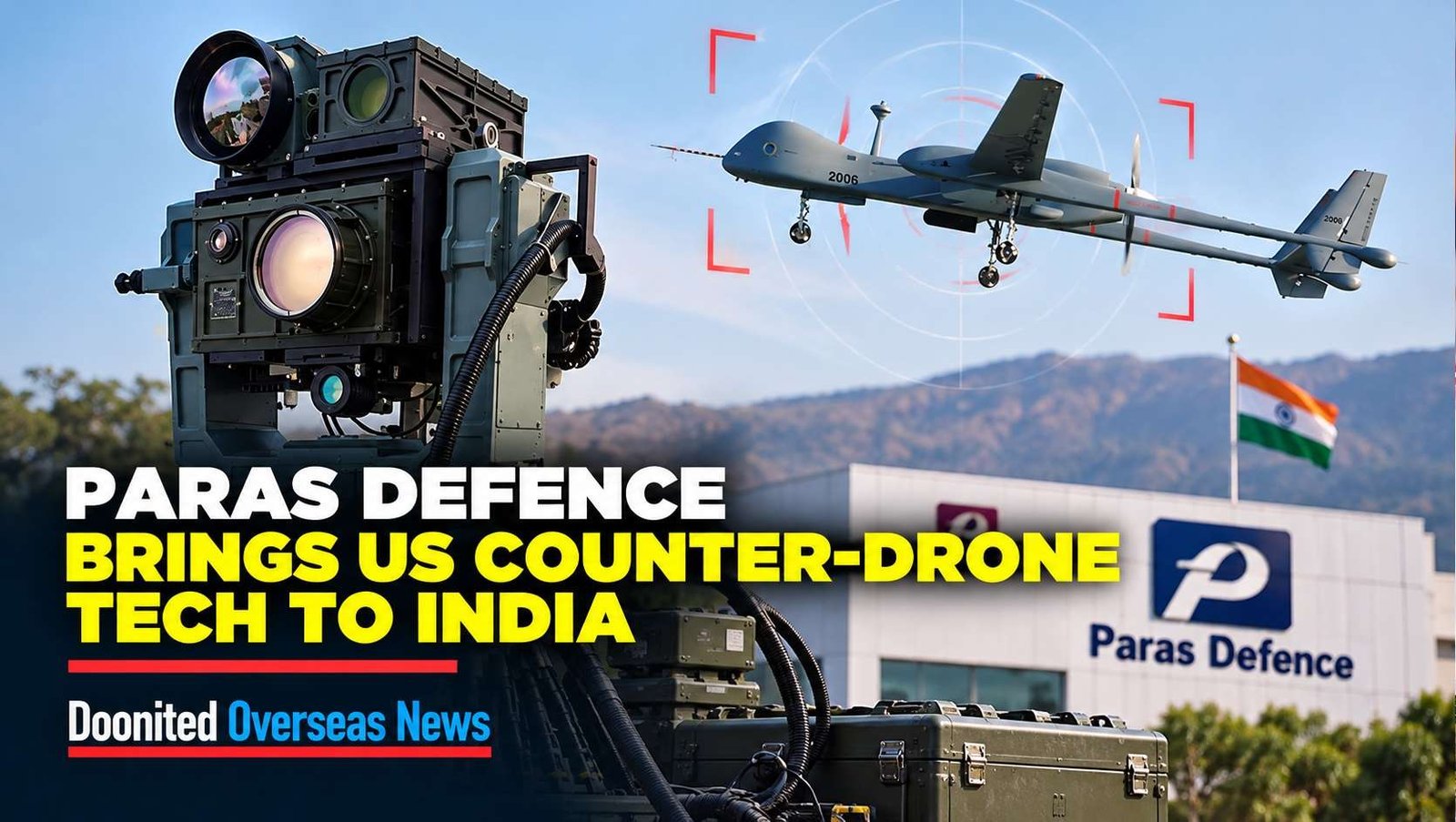
Paras Defence–Powerus Deal: India’s Counter-Drone Ambitions Meet a New Geopolitical Test
Paras Defence and Space Technologies has secured an exclusive Indian manufacturing and commercialisation licence for the US-developed Guardian-1 counter-drone interceptor. But the agreement is not an Indian military procurement order—and Powerus’s subsequent defence engagement with Pakistan has raised questions about supplier relationships, technology security and the risks of cross-border defence partnerships.
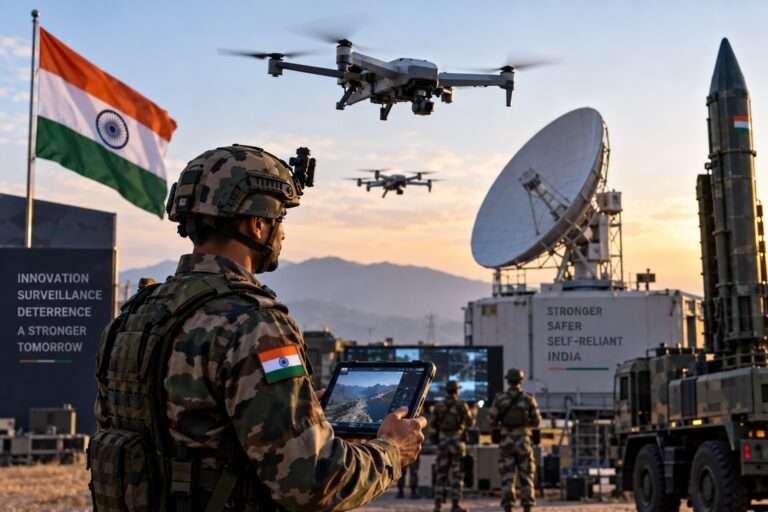
India’s defence industry is increasingly looking beyond the traditional model of importing finished equipment. Partnerships that give Indian companies access to foreign technology, manufacturing rights and domestic commercialisation opportunities offer another route: bringing products into local production while building the capacity to serve India’s own security requirements.
The licensing agreement between Paras Defence and Space Technologies Limited and Tandem Defence LLC, a subsidiary of US-based Autonomous Power Corporation, which operates as Powerus, illustrates both the opportunity and the complexity of this approach.
Signed on June 30, 2026, the agreement grants Paras Defence an exclusive licence to manufacture and commercialise the Guardian-1 counter-drone interceptor in India. The company announced the arrangement as a technology-licensing agreement, not as a confirmed order from the Indian armed forces.
The agreement therefore represents a potential entry point into India’s counter-unmanned aerial systems market—not proof of future sales.
What the licence allows—and what it does not
According to the reported agreement terms, Paras Defence receives an exclusive, non-transferable and non-sublicensable licence to use the specified intellectual property within India for manufacturing and domestic commercialisation. The initial term is 12 months, with renewal subject to mutual consent. The commercial arrangement includes an initial licence fee and a share of net profits from Indian sales.
These conditions have practical implications.
Exclusivity can give Paras a defined position in the Indian market for the licensed technology, while the restrictions on transfer and sublicensing limit its ability to pass the rights to other manufacturers. The short initial term also makes renewal and commercial execution important considerations. Whether the arrangement becomes a durable business will depend on production readiness, customer interest and the parties’ willingness to continue the licence.
The Guardian-1 is described as a battery-powered, kinetic counter-drone interceptor intended to engage hostile unmanned aerial systems. Unlike electronic countermeasures, which can disrupt or interfere with a drone’s communications or navigation, a kinetic interceptor seeks to physically neutralise the target.
The commercial attraction is straightforward: military and security agencies need ways to address small, relatively inexpensive aerial threats without relying on costly defensive measures for every engagement. But no single system is suitable for every threat. Operational performance, detection and tracking integration, reliability, environmental testing, safety, lifecycle costs and the ability to operate alongside other defensive systems all matter.
Paras Defence’s licence provides a basis for pursuing this market. It does not, on its own, establish the product’s suitability for any particular Indian operational environment.
Why local manufacturing matters
India has been encouraging greater domestic participation in defence production through initiatives such as Make in India and the broader push for indigenous design, development and manufacturing.
A licence for foreign-developed technology can contribute to that objective by creating opportunities for local production, supplier development and engineering work. It may also help a domestic company develop experience in a category of equipment where demand is growing.
However, manufacturing in India is not automatically the same as owning the underlying technology. The distinction matters for strategic autonomy. The licence’s territorial limits and restrictions on transfer mean Paras’s rights remain governed by the agreement. The publicly reported terms do not establish that the company has acquired ownership of the Guardian-1 intellectual property or unrestricted rights to modify, export or sublicense it.
For Indian defence planners and industry observers, the next questions are therefore practical: how much of the production process will take place locally, which components will remain dependent on overseas suppliers, what technical support is available, and whether the arrangement can be renewed long enough to support sustained production.
The answers will help determine whether the partnership creates a lasting industrial capability or primarily provides a route to assemble and sell a foreign-developed product in the Indian market.
The Pakistan connection changes the scrutiny
The agreement attracted renewed attention after Powerus announced a separate engagement with Pakistan in September.
On September 17, Powerus said it had received a limited procurement order from Pakistan’s Ministry of Defence for unmanned aerial systems and associated support. It also announced a strategic memorandum of understanding concerning potential wider cooperation in unmanned and autonomous defence technologies. The company said that future programmes under the memorandum would depend on definitive agreements and applicable legal and government approvals.
That distinction is important. It would be inaccurate to treat the two agreements as proof that the same interceptor has been supplied to both countries or that technology licensed to Paras has been transferred to Pakistan.
Nevertheless, the overlap raises a legitimate strategic question: how should Indian companies assess commercial partnerships with foreign defence suppliers that also pursue business in countries with which India has serious security tensions?
The issue is not unique to this transaction. Defence companies often operate internationally, while governments maintain separate export-control and procurement rules. But when a technology is intended for military use, a supplier’s broader commercial relationships can become relevant to due diligence, supply-chain assurance, intellectual-property protection and long-term support.
Paras has said its objective from the outset was to contribute to India’s defence preparedness, according to reporting by The Times of India. That statement explains the company’s stated purpose, but the longer-term implications will depend on contractual safeguards, product provenance, the security of technical information and compliance with applicable regulations.
What should happen before an Indian military order?
For any counter-drone system, the gap between a commercial agreement and operational deployment can be substantial.
The product must demonstrate that it can perform reliably in the conditions for which it is intended. Military users may assess integration with detection and command systems, performance against different classes of aerial threats, safety, maintainability, training requirements and the cost of operating the system over its service life.
Procurement must also follow the applicable acquisition procedures and approvals. An intellectual-property licence does not substitute for these requirements, and the existence of a licence does not guarantee that a product will be selected over competing systems.
The 12-month initial licence term is another factor to watch. If the parties do not renew it, the commercial prospects could be affected, depending on the contract’s detailed provisions. Conversely, a renewal would preserve the licensing relationship but would still not establish that the Indian military has ordered the system.
For investors, defence-industry suppliers and potential customers, the meaningful milestones will be evidence of manufacturing readiness, disclosed commercial orders, successful evaluations where publicly confirmed, and clarity about the licence’s continuation.
The wider lesson for India’s defence partnerships
The Paras–Powerus agreement illustrates a wider challenge facing India as it seeks to expand domestic defence manufacturing while using international technology.
Foreign partnerships can accelerate access to new capabilities, but they also create dependencies. A company may manufacture equipment locally without controlling all the intellectual property, components or future technical updates. A supplier’s international activities can also complicate the strategic calculations surrounding a deal.
The answer is not necessarily to reject foreign technology. It is to examine the terms carefully, establish clear security and support arrangements, understand the limits of local manufacturing rights, and assess whether the partnership contributes to a sustainable domestic capability.
For overseas Indians working in defence engineering, aerospace, electronics, cybersecurity and international manufacturing, this is also a wider business issue. India’s growing defence industry may create opportunities in engineering, supplier development and technical services. But the sector is governed by export controls, confidentiality obligations and other restrictions that can limit how information and technology move across borders.
The bottom line: Paras Defence has obtained a commercial route to manufacture and market Guardian-1 in India. That is a meaningful industrial development, but it remains an early step. The test will be whether the agreement leads to a viable domestic production capability, meets the relevant security and procurement requirements, and can withstand the scrutiny created by Powerus’s separate engagement with Pakistan.

World Beyond the News
Birds Can Navigate Using Earth’s Magnetic Field
Several bird species can sense Earth’s magnetic field, helping them navigate during long-distance migration.
Fermentation Is a Global Food Tradition
People across continents have used fermentation for centuries to preserve food and create distinctive flavours.
Modern Batteries Store Energy Chemically
Rechargeable batteries repeatedly move ions between electrodes, allowing electrical energy to be stored and released.
Why Songs Become Global Hits
Streaming platforms, short-form video, playlists and international collaborations can rapidly carry music across borders.