
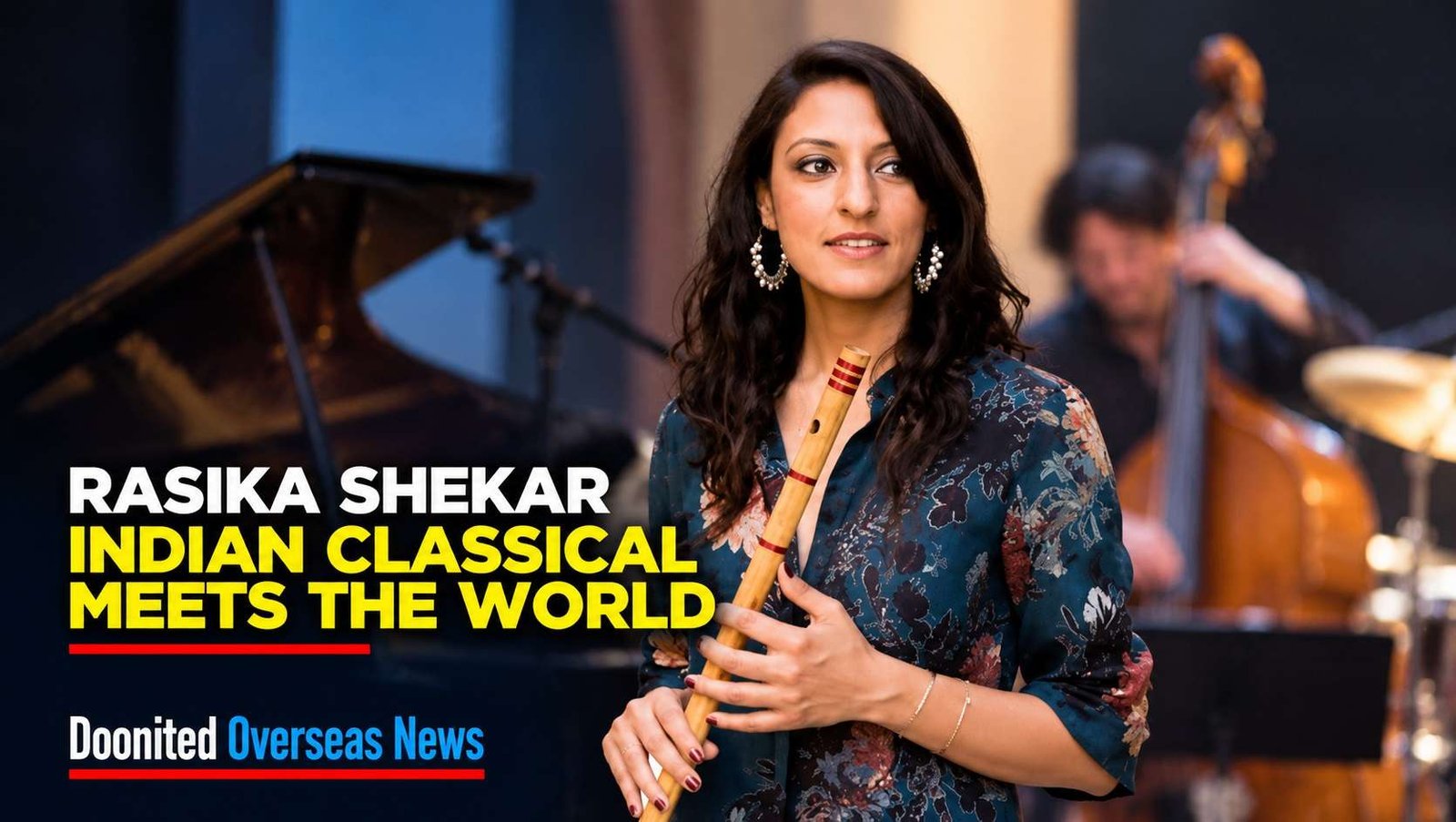
Rasika Shekar: The Indo-American Musician Turning the Bansuri Into a Global Sound
Born in Dubai, raised in New Jersey and shaped by Indian classical traditions, Rasika Shekar has built an international career across Carnatic music, jazz, contemporary performance, Bollywood and global fusion—showing how diaspora artists can carry tradition forward without keeping it frozen in time.
The Indian bamboo flute is an ancient instrument. But for Rasika Shekar, the bansuri is not a museum piece.
It is a language.
Born in Dubai, raised in New Jersey and now working between the United States and India, Shekar has built a career around the idea that Indian classical music does not have to remain inside a single cultural or musical boundary. Her performances and compositions bring Carnatic and Hindustani traditions into conversation with jazz, flamenco, contemporary music and other global influences.
That makes her story particularly relevant to the Indian diaspora.
She is not simply exporting Indian music to Western audiences. She represents a generation born or raised outside India that has absorbed Indian traditions alongside the musical vocabulary of the wider world—and is now creating something that belongs naturally to both.
As an Indian-origin flautist, vocalist and composer whose work has taken her across continents and into collaborations with artists including John McLaughlin, A.R. Rahman, Amit Trivedi and Shankar Mahadevan.
Dubai, New Jersey and an unusual musical education
Shekar was born in Dubai on April 4, 1989, into a family with strong connections to Indian classical music. Her aunt Vaishali Shankar and grandmother Gowri Ramakrishnan were important early influences, while she subsequently trained in Carnatic and Hindustani traditions under several teachers.
When her family moved to New Jersey when she was around 12, the geographical change might have been expected to pull her away from Indian classical culture.
Instead, the opposite happened.
Shekar has described discovering a strong Carnatic music community in the United States, which encouraged her to go deeper into a tradition that was already part of her family background. At the same time, living near New York exposed her to jazz clubs, contemporary musicians and a much wider international musical environment.
That combination became central to her artistic identity.
It also provides an interesting lesson about diaspora culture: migration does not necessarily dilute inherited traditions. Sometimes distance creates the motivation to understand them more deeply.
The engineer who chose music
Shekar initially followed a path that would be familiar to many Indian-origin families.
She studied chemical engineering at Rutgers University. Berklee College of Music’s profile notes that while studying engineering she continued developing as a musician, played in a band and became increasingly interested in jazz and live performance. Berklee
Music eventually became more than an extracurricular pursuit.
During her university years she began performing more extensively and received an opportunity to work with legendary Pakistani ghazal singer Ustad Ghulam Ali. What began as an opening performance developed into touring and eventually performing vocals with him.
That experience helped shift the trajectory of her career.
She later moved between the United States and India, deepening her study of Indian classical music while becoming increasingly involved in India’s professional music industry.
From Bollywood to the global stage
A major breakthrough came through Shankar-Ehsaan-Loy.
After encountering Shekar’s work, the trio invited her to sing and later tour with them internationally. Her playback work included Dekh Indian Circus, followed by projects including 2 States and Kill Dil. She also became associated with MTV Coke Studio, where her flute playing brought another dimension to her public profile.
But Bollywood was only one part of the journey.
Shekar’s collaborations increasingly crossed genres and geography. Her official biography lists work with John McLaughlin, Shankar Mahadevan, Shankar-Ehsaan-Loy, Ustad Ghulam Ali Khan, A.R. Rahman, Amit Trivedi and Vijay Iyer, among others. Rasika Shekar
Her performance with John McLaughlin at Berklee Valencia was particularly revealing. Jazz critic and broadcaster KCRW highlighted the interplay between McLaughlin and Shekar’s bansuri at the Valencia concert, demonstrating how an instrument deeply associated with Indian music could function naturally inside a contemporary jazz setting. KCRW
Berklee and discovering what the bansuri could become
Shekar’s decision to attend Berklee College of Music’s Valencia campus was another important turning point.
She completed a master’s programme in Contemporary Performance in 2017. Berklee describes how the international environment exposed her to musicians from different countries and encouraged her to expand her musical vocabulary.
For Shekar, the experience was not about abandoning Indian classical music.
It was about discovering what could be done with it.
Her bansuri could remain rooted in Carnatic and Hindustani traditions while also interacting with jazz, Latin influences, flamenco, blues and contemporary composition.
That distinction is important.
Fusion can sometimes become a superficial exercise in combining recognisable cultural sounds. Shekar’s work is more interesting because the cross-cultural element comes from her own biography.
Dubai.
New Jersey.
India.
Spain.
New York.
The geography itself created a musical vocabulary.
The Grammy connection
One of Shekar’s notable international credits is Divine Tides, the album created by British musician Stewart Copeland and Indian composer Ricky Kej.
Shekar contributed to the project as both vocalist and flautist, according to her official biography. The album won a Grammy Award in 2023.
The significance goes beyond the award.
Divine Tides brought musicians and musical traditions from different parts of the world together around a contemporary environmental and global theme. Shekar’s participation placed the Indian bamboo flute and Indian vocal traditions within a genuinely international production rather than a project marketed solely as “Indian music.”
That is an important distinction for diaspora artists.
The goal is not simply to make global audiences consume a version of Indian culture.
It is to participate in the creation of global culture itself.
Representation without being “exotic”
Perhaps the most revealing part of Shekar’s recent thinking concerns the challenge of being an Indian musician working internationally.
In her 2026 interview with The Global Indian, she discussed how Indian musicians abroad could sometimes be “exoticized.” Her response was not to reject Indian identity, but to avoid creating music merely to fit—or deliberately break—a category.
That is a significant cultural argument.
Diaspora artists often face two opposing expectations.
One expects them to preserve an idealised version of their ancestral culture. The other expects them to demonstrate that they have completely assimilated into the dominant culture.
Shekar’s work occupies a third space.
She can play Carnatic music without treating it as a boundary. She can perform jazz without abandoning her Indian musical vocabulary. She can work in Bollywood, international fusion and contemporary music without needing to explain why she belongs in each environment.
Her identity becomes an artistic resource rather than a category imposed on the artist.
Indian classical music as a global vocabulary
This matters because Indian classical music is increasingly participating in global musical conversations.
The bansuri has obvious historical and cultural associations with India, but instruments do not have to remain confined to the genres in which they originated.
Shekar’s career demonstrates how traditional technique can become the foundation for experimentation.
Her education in engineering may even provide an accidental metaphor.
Engineering is about understanding structures and then figuring out what those structures can do. Music, in her career, follows a similar principle: learn the grammar deeply enough that experimentation does not require abandoning the grammar.
Her official biography describes her as a flautist, vocalist, composer and producer rather than simply a performer. She also won the Indian Independent Music Award for Best Instrumental Song in 2022 for her composition Departure. Rasika Shekar
That progression—from performer to composer—is important.
It suggests that her long-term contribution may not be measured only by the famous musicians she has performed alongside, but by the musical language she develops herself.
Why her story matters to the global Indian community
For Indian-origin families raising children abroad, Shekar’s career carries an especially useful message.
Cultural preservation does not have to mean cultural isolation.
A young Indian-American musician can learn Carnatic music, study engineering, discover jazz in New York, attend Berklee in Spain, work in Mumbai and eventually perform for audiences around the world.
The result does not have to be half-Indian and half-Western.
It can be something new.
That may be one of the most important forms of cultural diplomacy available to the diaspora. A concert can introduce Indian musical ideas to people who may never have visited India, never studied an Indian language and never attended a traditional Indian classical performance.
And unlike a formal cultural presentation, music does not require translation.
A bansuri phrase can communicate before an audience knows what raga it belongs to.
Beyond algorithms and short-form culture
Shekar’s recent reflections also touch on a broader question confronting musicians everywhere.
Digital platforms reward short clips, immediate reactions and algorithm-friendly content. But her recent conversation suggests she remains interested in music that demands attention rather than merely capturing it.
That philosophy could become increasingly valuable.
Global Indian musicians have an enormous opportunity to use streaming platforms and social media to reach audiences that previous generations could never access. But technology can also flatten cultural distinctions when every artist is encouraged to create the same short-form content.
Shekar’s career offers another model: use global technology to distribute music, but retain enough artistic depth for the music to remain distinctive.
Her international journey—from Dubai and New Jersey to India, Spain and stages around the world—makes her more than an Indo-American performer.
She is part of a generation defining what Indian music can sound like when its practitioners grow up with more than one cultural vocabulary.
The bansuri remains Indian.
The musical conversation no longer has to be.

World Beyond the News
Bees Communicate Where Food Is
Honeybees use movement patterns known as waggle dances to communicate information about food locations.
Street Food Reflects Local History
Many famous street foods developed from migration, trade, local ingredients and the everyday needs of working communities.
A Day on Venus Is Extremely Long
Venus rotates so slowly that one rotation relative to distant stars takes longer than its trip around the Sun.
Human Achievement Continues to Push Limits
Athletes, engineers, scientists and explorers regularly establish new benchmarks in speed, endurance, scale and precision.