
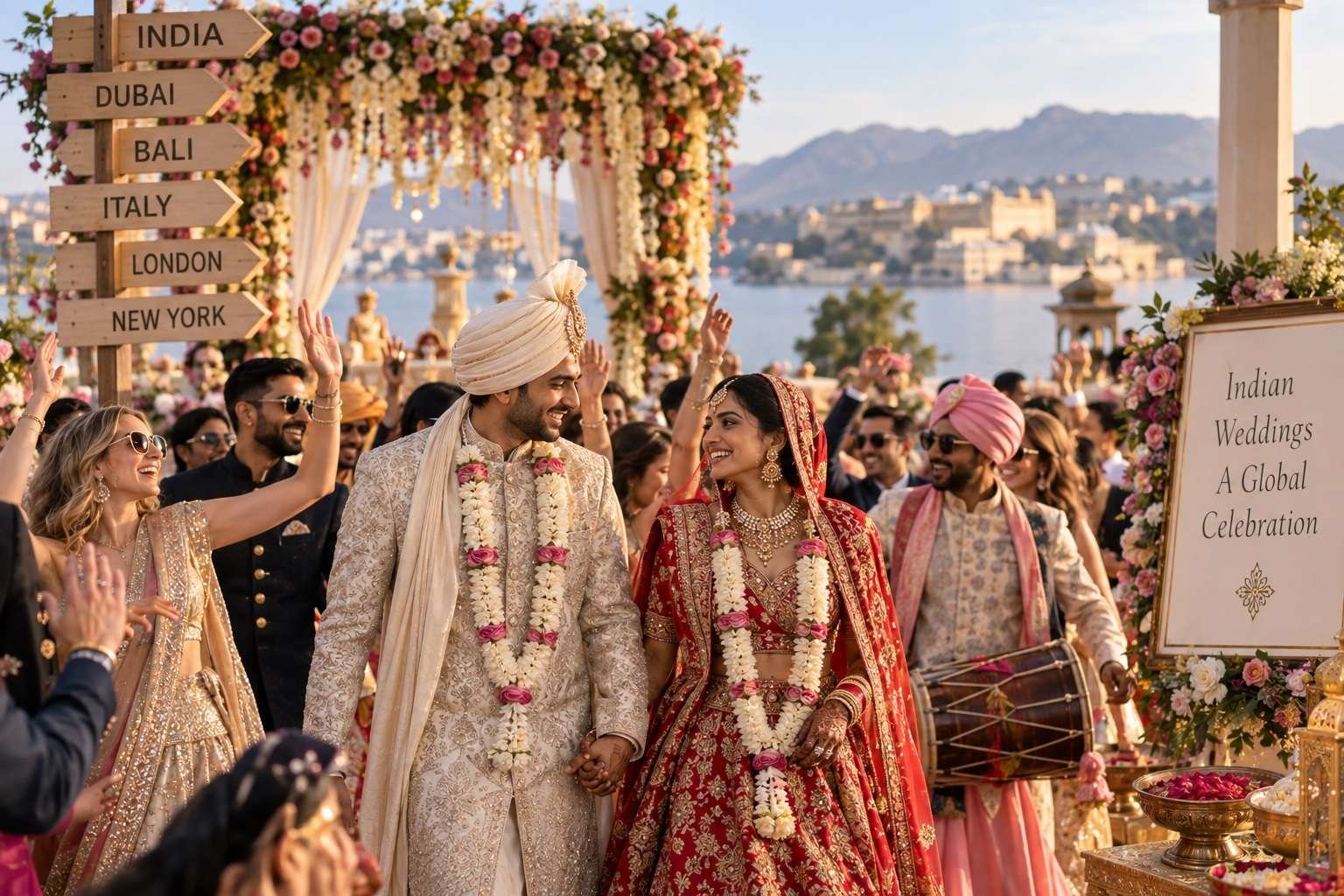
From Jaipur to Dubai: How Indian Weddings Became a Global Celebration Industry
There is a useful way to explain the modern Indian wedding to someone who has never attended one.
It is not simply a wedding.
It is a wedding, fashion show, concert, food festival, family reunion, hospitality operation and destination holiday—sometimes all before the actual wedding ceremony has started.
And increasingly, this distinctly Indian way of celebrating is travelling around the world.
From Muscat and Abu Dhabi to Mauritius, Thailand, Italy, Bali and Türkiye, Indian couples are taking familiar rituals—mehendi, haldi, sangeet, pheras and elaborate receptions—and placing them against international landscapes. The result is an unusual form of cultural globalization: India is exporting not merely clothes or cuisine, but an entire celebration format.
That is the fascinating part.
The Indian wedding has become a global business without becoming culturally anonymous.
First, let’s talk about the money
The frequently quoted $100 billion figure needs some caution.
India’s wedding economy is estimated at around that level, with WeddingWire India’s 2024–25 survey describing the Indian wedding industry as a $100 billion market and reporting an average wedding expenditure of ₹29.6 lakh among its surveyed couples.
India House Foundation similarly describes India’s wedding industry as nearly $100 billion annually.
But that does not mean Indian weddings themselves constitute a $100 billion global export industry.
The broader economic footprint is spread across jewellery, apparel, hospitality, travel, catering, photography, decoration, beauty, transportation, entertainment and event services.
That distinction matters.
Otherwise, one spectacular destination wedding can make journalism sound like the wedding planner’s invoice.

Why does the Indian wedding travel so well?
The answer lies partly in its structure.
A conventional wedding can be built around a principal ceremony and reception.
Indian weddings often contain several events.
There may be a mehendi ceremony, haldi, sangeet, wedding ceremony and reception, with additional family gatherings and excursions.
When the entire wedding moves overseas, the destination effectively receives hundreds of visitors who need rooms, meals, transport, entertainment and activities over several days.
ETTravelWorld notes that these weddings can benefit hotels, resorts and local businesses because guests stay for multiple days and participate in excursions and other tourism activities.
That changes the economics of the event.
It is no longer merely:
“Where shall we get married?”
It becomes:
“Where shall our entire family spend the next four days?”
That is a much larger tourism proposition.
The destination becomes part of the wedding
This is one of the biggest changes.
An Indian wedding in India traditionally draws its character from the destination—perhaps a palace, fort, beach, temple town or family home.
The same principle now works internationally.
Muscat can provide mountains and the Gulf.
Abu Dhabi can combine modern luxury with Arab architectural elements.
Mauritius can turn the Indian Ocean into part of the wedding backdrop.
ET HospitalityWorld describes contemporary Indian destination weddings in places such as Muscat, Abu Dhabi and Mauritius, where local landscapes and hospitality are incorporated into Indian ceremonies and guest experiences.
The destination isn’t merely scenery.
It becomes part of the story.
A mehendi ceremony beside an unfamiliar coastline or a sangeet beneath a foreign skyline gives the wedding something increasingly valuable in the age of Instagram:
a visual identity of its own.

Then comes fashion
Indian weddings are extraordinary consumers of fashion.
The bride’s lehenga is only the beginning.
There may be separate outfits for different functions, coordinated family wardrobes, designer jewellery, groom’s sherwani, bridesmaids’ clothing and carefully planned guest dress codes.
And international guests increasingly participate.
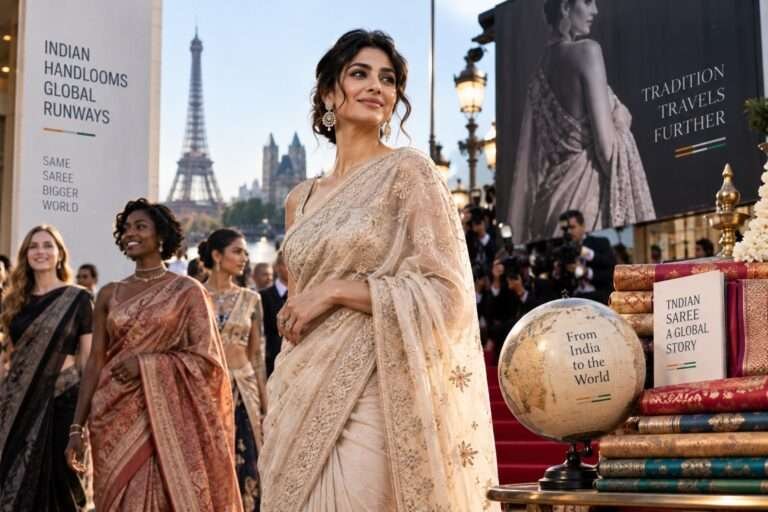
A destination wedding may therefore introduce people who have never worn Indian clothing to lehengas, sherwanis, sarees and embroidered jackets.
This is cultural exposure through celebration rather than formal cultural diplomacy.
Nobody has handed the guest a textbook.
They have handed them a dress code.
And suddenly the guest is learning about India while trying to figure out how many metres of fabric are involved.
The sangeet became a global export
Perhaps nothing illustrates the transformation better than the sangeet.
Traditionally associated with music and celebration before the wedding, the modern sangeet can become a fully produced entertainment event.
Families rehearse choreography.
Professional performers may be hired.
DJs combine Bollywood music with international pop.
Dhol players energise the crowd.
Lighting, staging and audiovisual production can resemble a concert.
Once this format travels abroad, it becomes remarkably adaptable.
ETTravelWorld notes that destination weddings can incorporate Indian music and dance alongside local cultural performances, creating a hybrid entertainment experience.
This is cultural fusion in its most entertaining form.
And unlike a museum exhibition, nobody is complaining about the opening hours.
Food travels with the guests
Indian weddings also export an expectation about food.
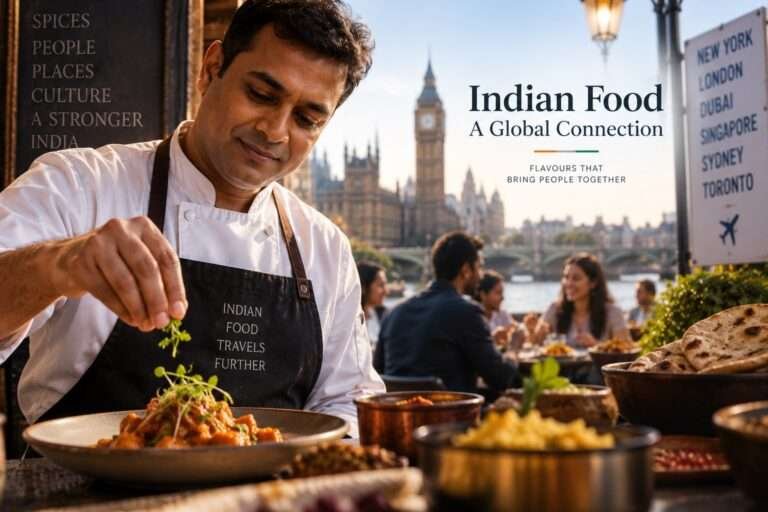
Regional dishes, vegetarian menus, live counters, sweets, chaat, kebabs and elaborate desserts can become central parts of destination events.
But the most interesting development is not simply “Indian food abroad.”
It is culinary adaptation.
ET HospitalityWorld describes destination wedding menus tailored to Indian preferences, including regional tastes, spice levels and vegetarian requirements. It also gives examples of fusion menus combining Indian dishes with local cuisine.
That creates a two-way exchange.
The wedding introduces Indian culinary traditions to the destination while also allowing the destination’s cuisine to enter the Indian celebration.
The result is not necessarily authentic Indian food or authentic local food.
It is something new.
And that is often how cultural exchange actually happens.
The hidden economic story
The most important beneficiaries may not always be the glamorous names attached to the wedding.
A large destination wedding requires hundreds of small logistical decisions.
Florists.
Transport companies.
Photographers.
Make-up artists.
Local performers.
Event technicians.
Caterers.
Security teams.
Hotel employees.
Tour guides.
Decor specialists.
Local artisans.
The wedding becomes an economic ecosystem.
ETTravelWorld specifically points to local vendors, hotels, resorts and artisans benefiting from destination weddings and related guest activities.
This is why wedding tourism can matter to destinations.
A wedding party does not simply arrive, exchange vows and leave.
It consumes an entire destination’s hospitality infrastructure.

But there is a serious downside
The globalisation of Indian weddings also exposes an uncomfortable contradiction.
While wealthy Indian families spend heavily overseas, India itself is trying to attract more weddings domestically.
A 2024 research paper by A. Shaji George estimated that around 5,000 affluent Indian weddings take place abroad annually and argued that this creates substantial economic leakage from India. The paper estimated losses of $10.5–14 billion in economic activity, though those estimates come from the study’s own modelling and should not be treated as official government statistics.
This creates an important policy question:
Why export the wedding when India already possesses the palaces, beaches, mountains, heritage architecture, cuisine and cultural infrastructure required to host it?
The answer is not simply patriotism.
International destinations offer novelty, privacy, international luxury infrastructure and, sometimes, a perception of exclusivity.
India therefore has a competitive problem—not a cultural one.
The country needs to make its own destinations easier, cleaner, more predictable and professionally managed for large international-scale events.
DOONITED Editorial Perspective
The global success of Indian weddings is not really about extravagance.
That is the superficial interpretation.
The deeper story is India’s ability to package culture as an experience.
A sari becomes fashion.
A Bollywood song becomes entertainment.
Indian cuisine becomes hospitality.
A mehendi ceremony becomes an event.
A palace becomes a destination.
And a wedding becomes a multi-day cultural experience capable of generating business across an entire local economy.
That is soft power with a seating chart.
But there is a warning here.
If the international version becomes nothing more than expensive décor, celebrity performers and Instagram content, the cultural value will eventually disappear beneath the production budget.
The strongest Indian weddings abroad are not those that merely spend the most.
They are the ones that carry something recognisably Indian while allowing the destination to contribute something of its own.
That is genuine cultural exchange.
The bigger insight
India has spent decades exporting individual elements of its culture.
Now something different is happening.
India is increasingly exporting experiences.
The wedding is one of the clearest examples.
It brings together clothing, food, music, rituals, hospitality, family, tourism and entertainment into a single package.
That makes the Indian wedding unusually powerful as a form of cultural influence.
The opportunity for India is enormous—but so is the responsibility.
The next stage should not simply be “make Indian weddings bigger.”
It should be:
make them more meaningful, professionally organised, economically inclusive and culturally authentic.
Because the world’s interest in Indian weddings is unlikely to be sustained merely by bigger fireworks.
The real attraction is the culture underneath them.

World Beyond the News
Bees Communicate Where Food Is
Honeybees use movement patterns known as waggle dances to communicate information about food locations.
Street Food Reflects Local History
Many famous street foods developed from migration, trade, local ingredients and the everyday needs of working communities.
A Day on Venus Is Extremely Long
Venus rotates so slowly that one rotation relative to distant stars takes longer than its trip around the Sun.
Human Achievement Continues to Push Limits
Athletes, engineers, scientists and explorers regularly establish new benchmarks in speed, endurance, scale and precision.