
The Ocean Beside India Is Also the Highway Beneath Its Economy
Why the Indian Ocean is central to India’s security, energy and global ambitions
Look at a map of India.
The country’s geography appears almost to point southwards into the sea.
The Arabian Sea lies to the west. The Bay of Bengal stretches to the east. The Indian Ocean opens directly below the peninsula.
That shape is not merely a geographical curiosity.
It is a strategic advantage.
And increasingly, it is also a strategic responsibility.
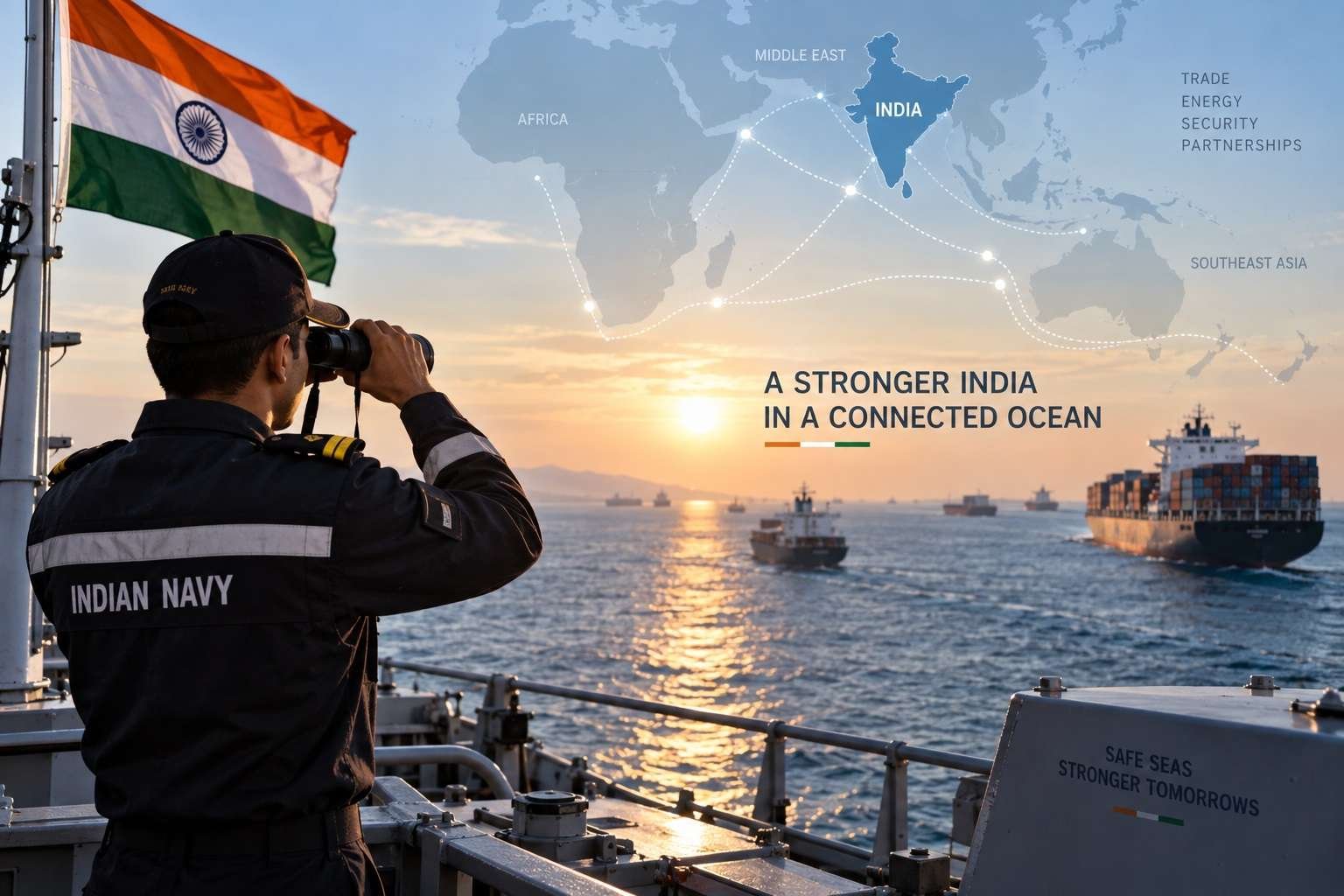
India sits beside one of the world’s most important maritime theatres, connecting the energy-producing Middle East and Africa with the manufacturing and consuming economies of Asia. The Indian Ocean region is estimated to carry around two-thirds of the world’s oil shipments and more than one-third of global bulk cargo traffic.
For India, therefore, the ocean is not “somewhere outside the coastline.”
It is part of the country’s economic infrastructure.

India’s coastline is an economic asset
India has more than 7,500 kilometres of coastline, and its dependence on maritime routes extends across energy, trade, fishing, tourism and commercial shipping. Carnegie’s analysis describes India as the resident naval power in the Indian Ocean and notes that the country relies heavily on the region for commercial shipping, energy imports, trade and other economic activity.
This matters because modern economies do not operate only through highways and airports.
They operate through container ships.
Oil tankers.
Bulk carriers.
LNG vessels.
Undersea cables.
Ports.
And increasingly, offshore infrastructure.
A smartphone assembled in one country may contain components from several others before reaching an Indian consumer.
The same principle applies to energy.
India’s refineries import enormous quantities of crude oil. In 2023, India imported about 4.5 million barrels per day of crude oil and condensate, according to the U.S. Energy Information Administration.
Much of India’s economic security therefore begins at sea.
Chokepoints are where geography becomes geopolitics
The Indian Ocean becomes even more important when we look at its chokepoints.
The Strait of Hormuz connects the Persian Gulf to the Gulf of Oman and Arabian Sea.
The Strait of Malacca connects the Indian Ocean with the Pacific through Southeast Asia.
The Bab el-Mandeb links the Red Sea with the Gulf of Aden.
And the Suez Canal provides the critical connection between the Mediterranean and the Red Sea.
These are narrow passages through which enormous quantities of energy and goods must pass.
The EIA identifies Hormuz and Malacca as the world’s most important strategic oil chokepoints by volume. In 2024, approximately 20.7 million barrels per day of crude oil and petroleum liquids moved through Hormuz, while 22.5 million barrels per day moved through Malacca.
That is why trouble in one relatively narrow stretch of water can have consequences thousands of kilometres away.
A ship does not have to reach Mumbai to affect the Indian economy.
If the cost and time of getting its cargo to Mumbai suddenly increase, Indian businesses can feel the impact.
The ocean has a long memory—and an even longer invoice.
Security is therefore bigger than warships
When people hear “maritime security,” they often imagine naval vessels.
Warships are certainly part of it.
But modern maritime security is much broader.
The Indian Navy’s Information Fusion Centre–Indian Ocean Region identifies threats including piracy and armed robbery, human and contraband trafficking, illegal, unreported and unregulated fishing, irregular migration and maritime terrorism.
There is also the less dramatic but equally important question:
What happens when nobody knows what is happening at sea?
A suspicious vessel.
A fishing boat operating illegally.
A merchant ship in distress.
A trafficking network.
A pirate attack.
A vessel that suddenly changes course.
Detecting such activity requires information.
That is why maritime domain awareness has become such an important part of India’s strategy.

India’s Information Fusion Centre is an important piece of the puzzle
India established the Information Fusion Centre–Indian Ocean Region (IFC-IOR) at Gurugram in December 2018.
Its purpose is regional collaboration and information sharing related to maritime safety and security.
The centre works with partner nations and agencies and maintains maritime-security reporting covering incidents across the Indian Ocean region.
This is strategically significant because oceans do not respect national borders.
A criminal network does not politely stop because one country’s territorial waters end.
A storm certainly does not.
Neither does a distressed merchant vessel.
Maritime security therefore increasingly depends on countries sharing information rather than simply guarding their individual patches of water.
India’s islands make the geography even more interesting
India’s strategic position is not limited to the mainland.
The Andaman and Nicobar Islands sit close to the eastern approaches to the Strait of Malacca, while Lakshadweep sits in the Arabian Sea.
These island territories give India geographical presence far beyond the immediate coastline.
Carnegie identifies India as having one of the largest exclusive economic zones in the Indian Ocean, estimated at about 1.63 million square kilometres in its mapping of the region.
That creates opportunity.
Fishing.
Marine resources.
Tourism.
Shipping.
Scientific research.
Blue-economy development.
But it also creates responsibility.
A large maritime zone cannot be protected effectively simply by drawing a line on a map.
It requires ships, aircraft, surveillance, communications, trained personnel and regional partnerships.
The ocean is also a diplomatic space
There is another reason the Indian Ocean matters to India.
Neighbours.
The region contains major island and littoral states including Sri Lanka, Maldives, Mauritius, Seychelles, Indonesia, Oman, Kenya, Tanzania, Mozambique and others.
For many of these countries, the ocean is not merely a geopolitical theatre.
It is their economy.
Fishing, shipping, tourism, offshore resources and coastal communities are directly dependent on maritime stability.
India’s engagement with these countries therefore cannot be reduced to military strategy.
Search-and-rescue cooperation, disaster response, maritime surveillance, capacity building and economic connectivity can be just as important.
The Indian Ocean is where India’s security policy, foreign policy and development diplomacy increasingly intersect.
And then there is climate change
There is an unfortunate temptation to discuss the Indian Ocean only in military language.
That would be a mistake.
The region is also exposed to climate risks.
Carnegie notes that the Indian Ocean has experienced significant warming and that rising sea levels, tropical cyclones and other climate impacts could create serious vulnerabilities for coastal populations and island states.
For India, this has direct implications.
Ports need resilience.
Coastal cities need protection.
Fishermen need accurate weather information.
Navies and coast guards increasingly have humanitarian roles.
And disaster response can become a major component of regional diplomacy.
A warship carrying relief supplies after a cyclone can sometimes accomplish something that a diplomatic speech cannot.

The uncomfortable truth: strategic geography is not enough
India’s geography gives it an advantage.
But geography does not automatically produce maritime power.
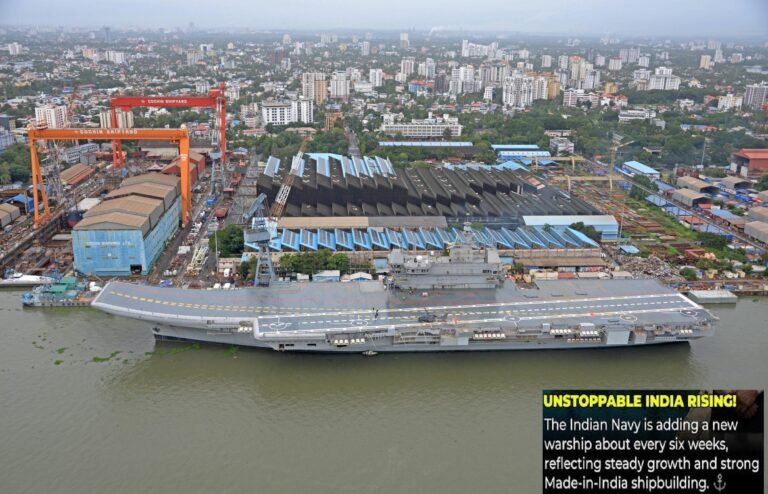
The country still needs efficient ports, competitive shipping, shipbuilding capability, coastal infrastructure, surveillance networks and a strong maritime workforce.
The government’s Sagarmala programme illustrates the economic side of this challenge. Ministry of Ports, Shipping and Waterways material says major-port capacity has expanded substantially and highlights port modernisation and logistics efficiency as part of India’s broader port-led development strategy.
But India’s maritime ambitions should not be judged only by the number of ports or naval platforms.
The real test is whether India can turn its location into reliable economic connectivity while keeping the surrounding maritime environment secure and sustainable.
That is considerably harder.
DOONITED Editorial Perspective
India’s relationship with the Indian Ocean is sometimes discussed as though India has suddenly discovered maritime strategy.
It hasn’t.
Indian civilisation has traded across these waters for centuries.
The difference today is the scale of the stakes.
India is now a major energy importer, manufacturing economy, trading nation and Indo-Pacific power.
That means the sea surrounding India is no longer simply a geographical boundary.
It is an economic lifeline.
The intelligent approach is therefore not to treat the Indian Ocean as a theatre for military competition alone.
India needs to be a security provider, trading power, disaster-response partner, environmental steward and reliable maritime neighbour.
And that requires cooperation as much as capability.
The ocean is too large for one country to police.
It is also too important for any country to ignore.
The bigger insight
There is a useful lesson hidden in India’s geography.
A country’s strategic advantage is not determined simply by where it sits on the map, but by what it is capable of doing with that location.
India cannot move its peninsula.
Fortunately, it does not need to.
It needs to connect its ports to its economy, its navy to maritime awareness, its diplomacy to its neighbours, and its blue-economy ambitions to environmental responsibility.
The Indian Ocean may be India’s geographic inheritance.
Turning that inheritance into lasting economic and strategic strength is the real national project.

World Beyond the News
Bees Communicate Where Food Is
Honeybees use movement patterns known as waggle dances to communicate information about food locations.
Street Food Reflects Local History
Many famous street foods developed from migration, trade, local ingredients and the everyday needs of working communities.
A Day on Venus Is Extremely Long
Venus rotates so slowly that one rotation relative to distant stars takes longer than its trip around the Sun.
Human Achievement Continues to Push Limits
Athletes, engineers, scientists and explorers regularly establish new benchmarks in speed, endurance, scale and precision.