
India’s New Battlefield: When Drones, Satellites and AI Start Working as One
For centuries, military power was largely measured in familiar things.
How many soldiers?
How many tanks?
How many fighter aircraft?
How many ships?
Those numbers still matter.
But another question is becoming increasingly important:
How quickly can a military see, understand and respond to what is happening around it?
That is where India’s defence transformation is becoming particularly interesting.
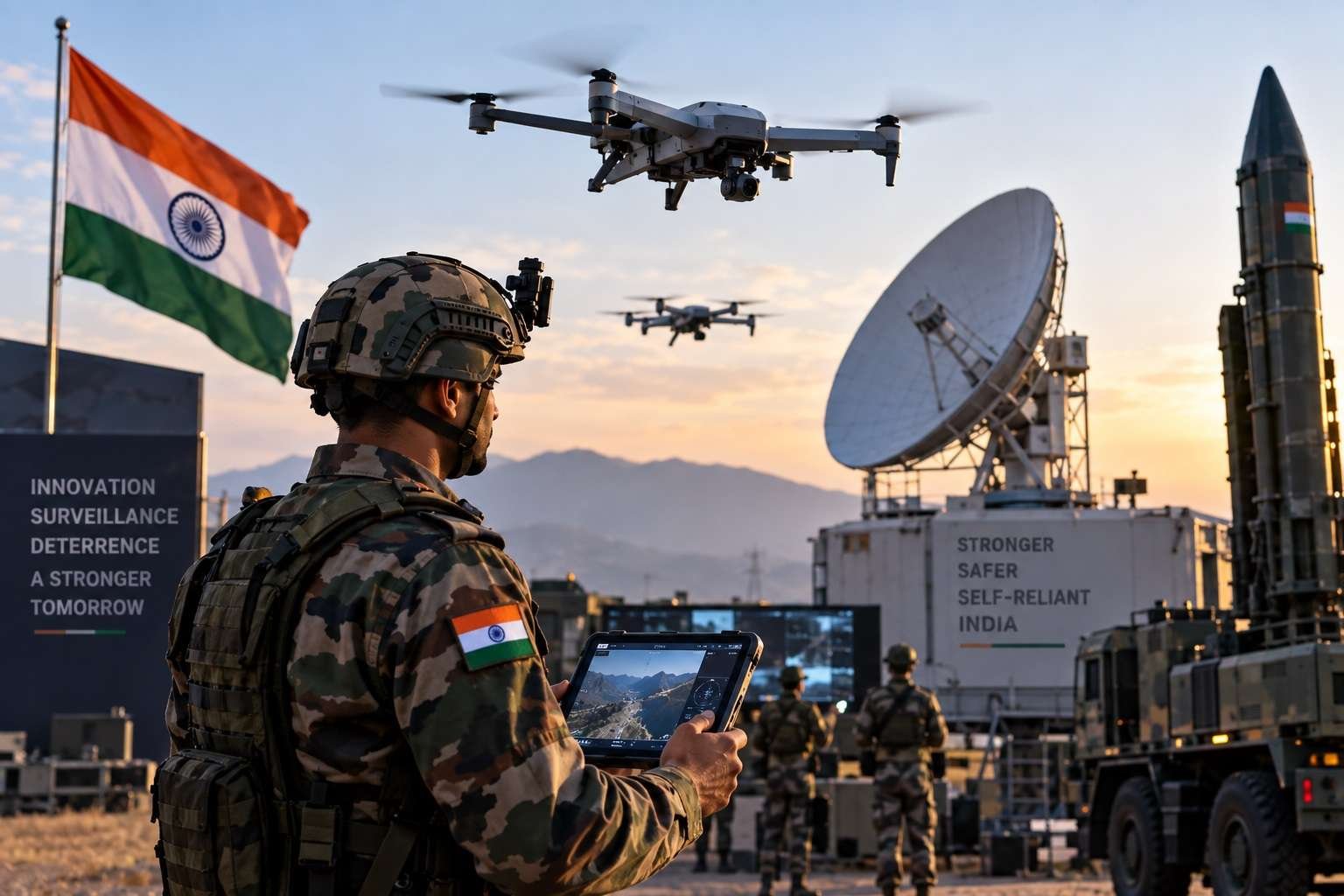
India is building an increasingly networked military architecture involving drones, satellites, sensors, artificial intelligence, electronic systems and increasingly autonomous platforms.
The objective is not simply to replace soldiers with machines.
It is to make the machines, sensors and people work together faster and more intelligently.
That is a very different proposition.
The drone is becoming a military sensor—and sometimes a weapon
The most visible change is in unmanned systems.
India’s armed forces are acquiring and developing drones for surveillance, reconnaissance, targeting and increasingly for precision strike.
The 2024 contract for 31 MQ-9B Sky/Sea Guardian HALE remotely piloted aircraft represented a major step in this direction. The fleet includes 16 Sky Guardians and 15 Sea Guardians for the tri-services.
And India’s maritime requirements are becoming even more apparent.
In August 2026, the Ministry of Defence signed a separate contract to lease two MQ-9B Sea Guardians for 30 months for the Indian Navy. The government says the systems will provide persistent intelligence, surveillance and reconnaissance coverage over large areas of the maritime domain and strengthen India’s maritime-domain awareness across the Indian Ocean Region.
That is significant.
A drone flying for many hours does not simply provide another aircraft.
It provides time.
Time to observe.
Time to identify.
Time to understand.
And potentially time to respond.
India is also learning the swarm lesson
The next development is more radical.
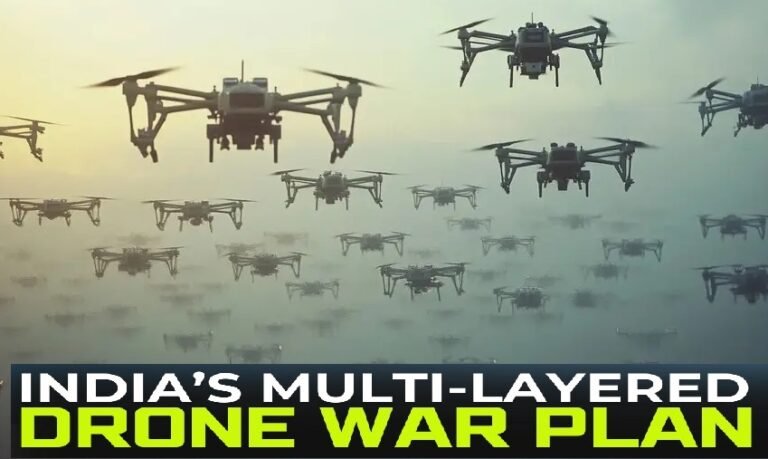
Instead of sending one expensive platform to perform one task, militaries are exploring large numbers of relatively inexpensive autonomous or semi-autonomous systems operating together.
India has demonstrated this concept.
DRDO records work on UAV swarms and AI-based swarm systems, including technology intended for autonomous weapon deployment and assessment.
Indian military demonstrations have included large coordinated drone swarms, while indigenous companies have developed loitering munitions and tactical unmanned systems.
The ALS-50, developed by Tata Advanced Systems, is one example. DRDO material records it as an indigenous loitering munition and notes its delivery to the Indian Air Force.
Another system, Nagastra-1, illustrates the expanding domestic ecosystem. DRDO material describes it as a lightweight, man-portable loitering munition with surveillance capability and autonomous flight modes.
The military logic is straightforward.
If one drone is destroyed, the mission does not necessarily end.
If dozens operate together, an adversary faces a much more complicated problem.
The age of the drone is therefore gradually becoming the age of the drone team.
But autonomy does not mean science fiction
There is an important distinction here.
A drone being capable of autonomous navigation is not the same thing as an AI system independently deciding when to conduct lethal action.
India’s public defence research shows substantial work on autonomous perception, navigation, target identification, human-machine teaming and swarm technologies.
But that should not be confused with a fully autonomous battlefield in which machines independently run wars.
Human control, communications, rules of engagement, identification and reliability remain critical.
In other words:
The robot may become smarter. The commander does not become optional.

Space is becoming part of the battlefield
Drones are only one layer.
The second is above them.
Satellites have become essential to modern military operations because forces need secure communications, positioning, surveillance and intelligence over enormous distances.
India already has military-relevant communication satellites.
ISRO describes GSAT-7 as a communication satellite designed to provide services across a wide oceanic region and India’s landmass.
GSAT-7A, launched in 2018, provides Ku-band communication capability over India.
The next stage is further expansion.
The Indian Army has contracted NSIL for the realisation of GSAT-7B and its ground segment, showing the move toward more dedicated military-space infrastructure.
That is strategically important because modern warfare increasingly depends on connectivity.
A tank without information is less effective.
A drone without communications is limited.
A command centre without reliable data is operating half-blind.
Satellites provide the nervous system.
Earth observation changes what the military can see
India’s Earth-observation programme adds another layer.
ISRO’s Cartosat series provides high-resolution imaging, while radar-imaging satellites such as RISAT have demonstrated India’s ability to operate Earth-observation missions using radar technology.
RISAT-2B, for example, was launched as a radar-imaging Earth-observation satellite.
The significance for defence is obvious.
Clouds cannot simply be allowed to hide strategic developments.
Night cannot automatically stop surveillance.
And a military increasingly wants persistent awareness rather than occasional photographs.
But again, precision matters.
Not every Earth-observation satellite is a dedicated military satellite, and public information does not establish that Indian systems routinely perform every type of automated battlefield analysis suggested in the original reference.
The capability is developing.
That distinction matters.
AI: The real revolution may happen behind the screen
The most transformative technology may not be the drone itself.
It may be the software processing what the drone sees.
DRDO publicly lists work on:
- AI-based image and video analytics;
- satellite-sensor data processing;
- object detection and classification;
- AI-based command-and-control;
- maritime-domain awareness using data analytics and machine learning;
- autonomous navigation;
- autonomous target identification;
- and AI-enabled battlefield management.
This is the beginning of a fundamental change.
A modern military can generate enormous quantities of information.
The problem is no longer simply finding data.
It is deciding which data matters.
A human analyst cannot examine every image, every video feed, every radar track and every maritime signal simultaneously.
AI can help identify patterns and anomalies.
That is where the real advantage may emerge.

From sensor to decision
Imagine a simplified chain.
A satellite detects something.
A drone investigates.
A radar confirms movement.
Another sensor provides additional information.
An AI system helps correlate the data.
A command network distributes the information.
A commander makes the decision.
That is the emerging sensor-to-decision architecture.
The important phrase is not “AI replaces soldiers.”
It is:
AI helps soldiers process complexity faster.
DRDO’s current technology roadmap explicitly includes AI-based command-and-control applications, battlefield management and algorithmic warfare using big data, machine learning and cloud computing.
India’s biggest advantage may be its technology ecosystem
This transformation is also changing who develops defence technology.
It is no longer exclusively a government-laboratory story.
Startups, established private companies, universities and defence public-sector organisations are increasingly part of the ecosystem.
DRDO’s network of Industry Academia Centres of Excellence includes research areas such as advanced UAVs, artificial intelligence, autonomous systems, space systems, information warfare and UAV-swarm wargaming.
This matters because military technology changes faster than traditional procurement cycles.
A five-year procurement process can be painfully slow when the underlying technology changes every twelve months.
The challenge for India is therefore not merely inventing new systems.
It is getting good systems into operational service quickly enough.
The uncomfortable problem: technology is not magic
There is a tendency in defence commentary to assume that every new drone, AI model or satellite automatically creates military superiority.
It doesn’t.
Drones can be jammed.
Satellites can be attacked or disrupted.
AI can make mistakes.
Communications can fail.
Sensors can produce false information.
Adversaries can adapt.
And autonomous systems remain dependent on electricity, software, networks, navigation and logistics.
The future battlefield may therefore be less about having the most advanced individual machine and more about having the most resilient system.
That is a much harder engineering problem.

India’s two-front challenge
India has an unusually demanding strategic geography.
Its northern borders involve difficult mountainous terrain and long distances.
Its western border presents a different security environment.
At sea, India must maintain awareness across a vast Indian Ocean region.
This makes unmanned and space-based systems particularly valuable.
A drone can stay in the air.
A satellite can look across enormous distances.
An AI system can process thousands of inputs.
A human soldier can then concentrate on the decisions that actually require human judgement.
The technology does not eliminate geography.
It helps India manage geography.
DOONITED Editorial Perspective
India’s defence transformation should not be described simply as “robots replacing soldiers.”
That is sensational but wrong.
The more important transition is from platform-centric warfare to network-centric warfare.
The tank matters.
The aircraft matters.
The ship matters.
But increasingly, their effectiveness depends on what they can see, what they can communicate and how quickly commanders can make decisions.
That changes the defence equation.
The country that builds the best aircraft may have an advantage.
But the country that can connect aircraft, satellites, drones, sensors, command centres and human decision-makers into one resilient network may have the greater advantage.
India is trying to build exactly that architecture.
The challenge now is execution.
India has demonstrated that it can develop impressive technology.
The next test is whether it can scale, integrate, secure and continuously upgrade it.
That is where defence technology becomes defence power.
The bigger insight
The battlefield of the future will not necessarily be filled with fewer humans.
It may simply give each human commander more information, more reach and more machines to work with.
That creates a different definition of military strength.
The question will increasingly be:
Who can see first, understand first, decide first—and still function when the network is attacked?
India’s investment in drones, satellites, AI, autonomous systems and domestic defence technology suggests that New Delhi understands this emerging reality.
But technology is only the beginning.
The real achievement will be building a defence ecosystem in which Indian-made sensors, software, satellites, drones and weapons operate together as one dependable system.
That is the strategic transformation worth watching.

World Beyond the News
Bees Communicate Where Food Is
Honeybees use movement patterns known as waggle dances to communicate information about food locations.
Street Food Reflects Local History
Many famous street foods developed from migration, trade, local ingredients and the everyday needs of working communities.
A Day on Venus Is Extremely Long
Venus rotates so slowly that one rotation relative to distant stars takes longer than its trip around the Sun.
Human Achievement Continues to Push Limits
Athletes, engineers, scientists and explorers regularly establish new benchmarks in speed, endurance, scale and precision.