

The Remarkable Story of India’s Population at Home and Around the World
How many Indians are there in the world?
It sounds like a question with a simple answer.
India has roughly 1.48 billion people in 2026. Then there are tens of millions of Indians and people of Indian origin living outside the country.
Put the numbers together and you arrive at something extraordinary: roughly 1.51 billion people when India’s current population estimate is combined with the Government of India’s latest overseas-Indian estimate.
But there is an important catch.
There is no single official number called “the global Indian population” because Indian citizens living abroad and people of Indian ancestry who hold foreign citizenship are not the same demographic category.
And that distinction makes the story much more interesting.
India itself is approaching 1.5 billion
The latest 2026 population estimate based on United Nations data puts India’s population at approximately 1.477 billion. That represents about 17.8% of the world’s population.
In simple terms, almost one out of every six people on Earth lives in India.
That number is astonishing enough without adding anyone else.
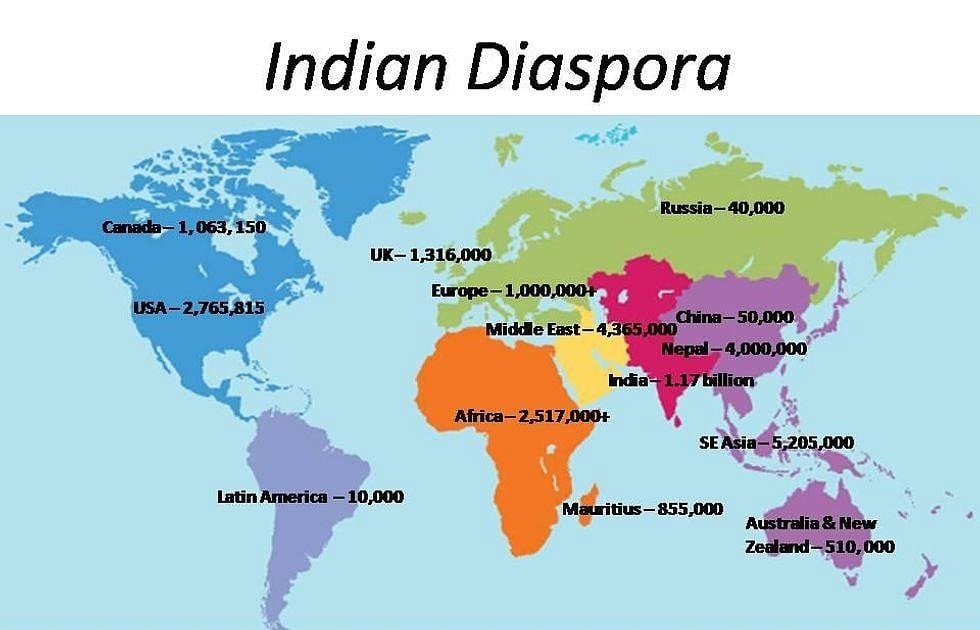
But millions of people with Indian citizenship or Indian ancestry live beyond India’s borders.
The Ministry of External Affairs estimates the overseas Indian community at approximately 35.42 million, based on January 2024 data. This includes around 15.85 million Non-Resident Indians and 19.57 million people of Indian origin, including OCI holders.
So if one simply adds the two populations—India’s estimated 2026 population and the MEA’s overseas-Indian figure—the arithmetic is approximately:
1.477 billion + 35.42 million = 1.512 billion.
But DOONITED’s important footnote is this: 1.512 billion is a calculation, not an official government count of all people of Indian nationality or ancestry worldwide.
That is because the two figures come from different dates and demographic concepts.
Numbers, like relatives at an Indian wedding, need to be introduced properly.
Who exactly are the Indians living abroad?
The term “Indian diaspora” covers a remarkably diverse population.
An NRI is generally an Indian citizen residing outside India.
A person of Indian origin may be a foreign citizen whose family roots go back to India. Overseas Citizens of India are foreign nationals who meet the eligibility requirements of the OCI framework.
The MEA therefore counts the overseas community using categories that go well beyond Indian passport holders.
This explains why the overseas Indian population is much larger than India’s internationally recognised migrant stock alone.
The United Nations has estimated India’s migrant population abroad at around 18 million in its international migration statistics, while the Indian government’s diaspora count is much higher because it includes people of Indian origin and OCI holders. The Parliamentary committee examining diaspora issues specifically noted this difference and also observed that there is no perfectly comprehensive real-time database of the Indian diaspora.
That is an important distinction for anyone quoting “35 million Indians abroad.”
It does not mean 35 million Indian passport holders.

Where does the Indian diaspora live?
The geographical spread is remarkable.
According to MEA data compiled in 2024, the largest overseas Indian populations include:
| Country | Overseas Indians |
|---|---|
| United States | ~5.41 million |
| United Arab Emirates | ~3.57 million |
| Malaysia | ~2.91 million |
| Canada | ~2.88 million |
| Saudi Arabia | ~2.46 million |
| Myanmar | ~2.00 million |
| United Kingdom | ~1.86 million |
| South Africa | ~1.70 million |
| Sri Lanka | ~1.61 million |
| Kuwait | ~996,000 |
These figures combine NRIs with people of Indian origin and therefore should not be interpreted simply as the number of Indian citizens in each country.
The distribution also reveals something fascinating.
The Indian diaspora is not concentrated in one part of the world.
It stretches from North America to the Gulf, from Southeast Asia to Africa, Europe, the Caribbean and the Pacific.
In some places, Indian communities are relatively new, built around professionals, students and migrant workers.
In others, Indian ancestry goes back generations.
The old diaspora and the new diaspora
Not every overseas Indian story began with an IT professional flying to California.
Some communities have been abroad for centuries or generations.
Indian-origin communities in Mauritius, Fiji, South Africa, the Caribbean and parts of Southeast Asia have historical roots connected to colonial-era migration, including the deeply difficult history of indentured labour.
Later waves of migration produced very different communities.
From the second half of the 20th century onward, Indian doctors, engineers, academics, entrepreneurs, technicians and other professionals moved to North America, Europe, Australia and elsewhere.
The Gulf created another major migration story, particularly after the oil boom.
Today these different histories exist simultaneously.
That is why “Indian abroad” is not one social category.
An Indian-origin family in Mauritius whose ancestors arrived generations ago has a very different migration history from an Indian software engineer who moved to Toronto last year.
Both can be part of the wider Indian diaspora.
The economic connection is enormous
The diaspora is not simply a demographic story.
It is also an economic one.
India remains the world’s largest recipient of remittances. The Ministry of External Affairs reported that India received approximately US$120 billion in remittances in 2023, while the Government’s 2024 annual report described the diaspora as more than 35 million strong.
That money supports families, education, housing, healthcare and consumption in India.
But the relationship goes further.
The government identifies the diaspora’s contribution through remittances, investment, trade, knowledge transfer, philanthropy and cultural exchange.
An engineer in California, a doctor in London, a businessman in Dubai and a construction worker in the Gulf may have completely different economic circumstances.
Yet each can create a connection between India and the country where they live.

More than money: India’s global social footprint
The Indian diaspora also gives India something that cannot easily be measured in rupees or dollars.
Visibility.
Indian-origin politicians have reached senior positions in several democracies. Indian-origin scientists and technology leaders occupy influential positions in global companies and research institutions. Indian restaurants, festivals, music, cinema, yoga and religious traditions have become familiar in cities far from India.
The diaspora therefore acts as a cultural bridge.
But there is a danger in describing every successful Indian-origin individual as evidence of India’s national achievement.
A person who becomes successful abroad is simultaneously part of the society where they live.
Their success may reflect Indian family heritage, their host country’s institutions, individual ability, educational opportunities and many other factors.
Claiming every successful person as a trophy for India would oversimplify the diaspora story.
The better description is partnership.
The number alone can be misleading
There is another lesson hidden inside the 1.5-billion figure.
Population size is not the same thing as influence.
India’s enormous population creates a huge domestic market, workforce and talent pool. The diaspora adds another global layer.
But numbers only become an advantage when they are accompanied by education, skills, productivity, entrepreneurship, social stability and opportunity.
The same applies to the diaspora.
Thirty-five million people scattered across more than a hundred countries do not automatically create influence.
Influence emerges through what people actually contribute.
The Indian diaspora is changing too
The old image of the overseas Indian was often the person who left India and eventually became completely disconnected from home.
That model is increasingly outdated.
Cheap communication, digital payments, international travel and social media have made maintaining relationships with India much easier.
A second-generation Indian American can follow Indian news every morning.
A family in Dubai can speak to relatives in India every evening.
An entrepreneur in London can invest in an Indian company without physically moving back.
The boundary between “here” and “there” has therefore become increasingly porous.
The diaspora is no longer simply outside India.
It is connected to India continuously.
The DOONITED perspective
The most interesting fact is not that India has nearly 1.48 billion people or that another 35.42 million overseas Indians live around the world.
It is what happens when those populations are connected.
India’s global story is increasingly being written simultaneously in Mumbai and Melbourne, Delhi and Dubai, Bengaluru and Boston, Chennai and Singapore.
But we should be careful with the headline number.
India does not officially have 1.5 billion “Indians” living across the planet. That figure is a useful derived approximation when India’s 2026 population estimate is combined with the MEA’s 2024 overseas-Indian estimate. It should not be presented as a census figure.
The more meaningful number is perhaps not population at all.
It is connectivity.
India today has a population of extraordinary scale at home and a diaspora of extraordinary reach abroad. The opportunity lies in turning that combination into stronger education, investment, innovation, cultural exchange and human connections.
And there is a little irony in the whole story.
For generations, Indians worried that someone going abroad meant “brain drain.”
Today, the world may be discovering a different phenomenon:
The brain left—but the connection didn’t.

World Beyond the News
Bees Communicate Where Food Is
Honeybees use movement patterns known as waggle dances to communicate information about food locations.
Street Food Reflects Local History
Many famous street foods developed from migration, trade, local ingredients and the everyday needs of working communities.
A Day on Venus Is Extremely Long
Venus rotates so slowly that one rotation relative to distant stars takes longer than its trip around the Sun.
Human Achievement Continues to Push Limits
Athletes, engineers, scientists and explorers regularly establish new benchmarks in speed, endurance, scale and precision.