
When the Gulf Shakes, India Feels It: The Jobs, Money, Oil and Families Behind India’s Gulf Relationship
A conflict thousands of kilometres away can begin with a headline about missiles, oil facilities or shipping routes. In India, its consequences can end somewhere much closer: in a family’s bank account, a petrol bill, a delayed flight—or a WhatsApp group waiting for one reassuring message from a relative abroad.
That is the part of Middle Eastern geopolitics that is often missing from strategic analysis.
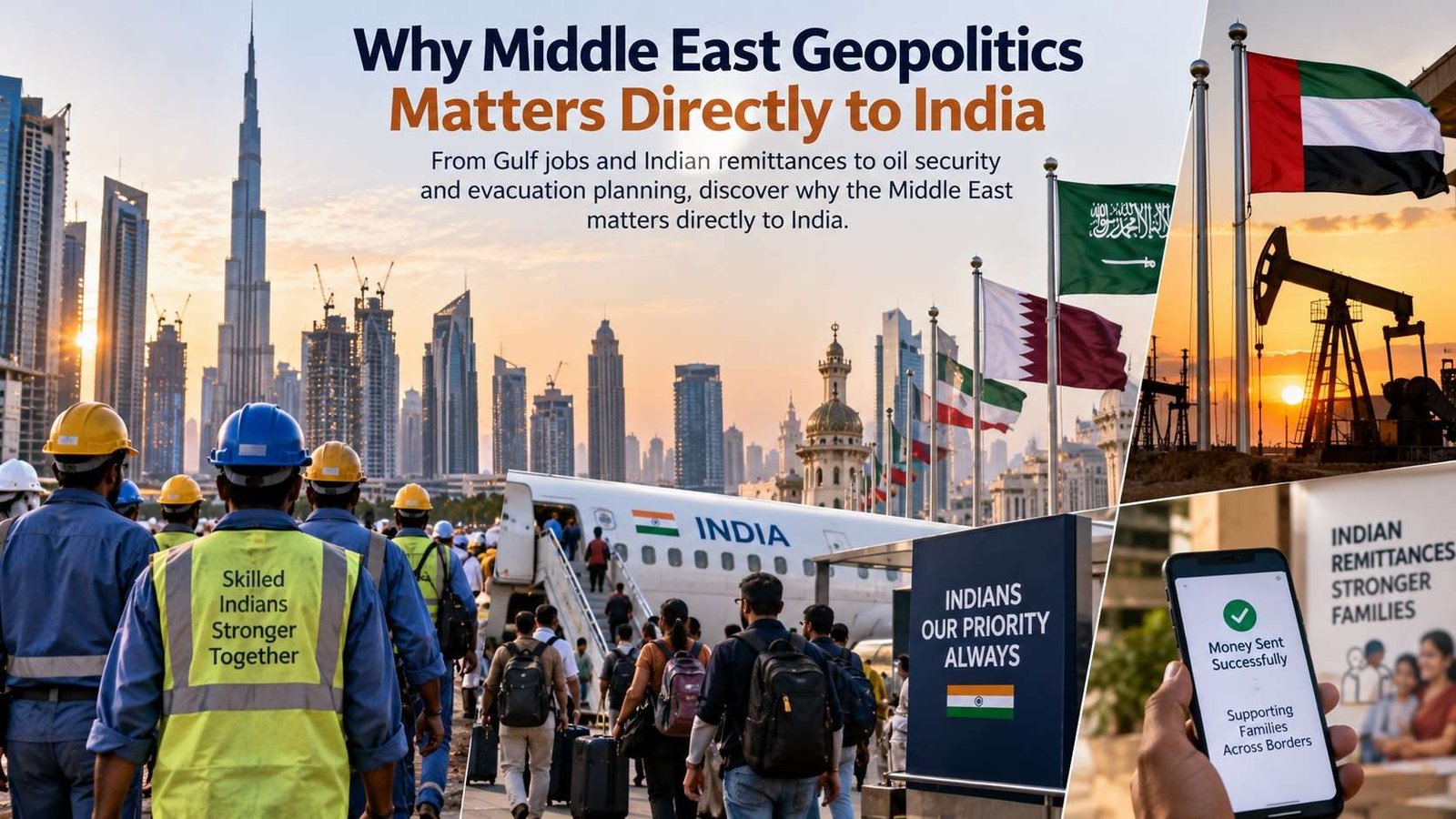
For India, the Gulf is not simply a region of oil producers and geopolitical alliances. It is also a workplace, a source of remittances, an energy supplier, a trading partner and, for millions of families, the place where a son, daughter, husband, wife or parent lives and works.
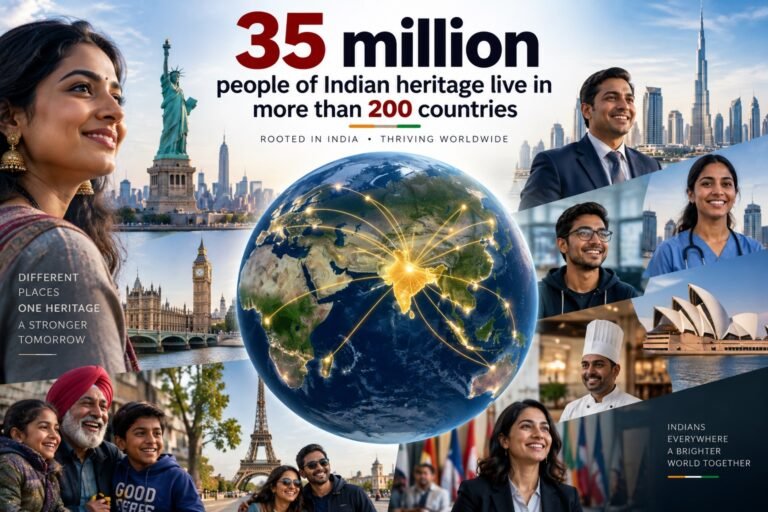
The Ministry of External Affairs’ January 2026 figures put the Indian population across the six Gulf Cooperation Council countries at approximately 9 million. The largest communities are in the UAE and Saudi Arabia, followed by Kuwait, Qatar, Oman and Bahrain.
That makes the India-Gulf relationship unusually personal.
The Gulf begins with jobs
For generations, Indians have travelled to the Gulf in search of employment.
The workforce is diverse.
There are construction workers, drivers, technicians, domestic workers, security personnel and hospitality employees. There are also doctors, engineers, accountants, technology professionals, managers and entrepreneurs.
The economic profile has evolved, but the importance of migrant employment has not disappeared.
For many Indian households, a Gulf salary can finance education, housing, healthcare, family businesses or savings back home.
This creates a relationship that is more complicated than the phrase “Indian diaspora” sometimes suggests.
For a professional working in Dubai, geopolitical instability may mean business uncertainty.
For a construction worker, it may mean concerns about a worksite.
For a family in India, it may simply mean waking up at 3 a.m. to check whether their relative has replied to a message.
The strategic map suddenly becomes personal.
Remittances: the money that travels home
The Gulf’s importance becomes even clearer when viewed through remittances.
World Bank data shows that India received approximately $150.7 billion in personal remittances in 2025, making it the world’s largest recipient.
Remittances are not just an impressive macroeconomic statistic.
They pay for real things.
School fees.
Medical treatment.
Home construction.
Consumer spending.
Savings.
Small businesses.
Debt repayment.
Family emergencies.
The World Bank has estimated that roughly 29% of India’s remittance flows originated in GCC countries, reflecting the continuing importance of Gulf employment to India’s external income flows.
So when the Gulf economy is disrupted, the consequences can travel far beyond the region.
The money doesn’t stay in Dubai, Riyadh or Doha.
It travels home.
Then comes oil
The relationship works in the opposite direction too.
India depends heavily on imported crude oil. Petroleum Planning & Analysis Cell data put India’s crude-oil import dependency at around 88% of consumption in 2024–25.
That makes the stability of major oil-producing regions strategically important.
The Gulf is also connected to one of the world’s most important maritime chokepoints: the Strait of Hormuz.
A prolonged disruption to energy flows through the region can put pressure on crude prices, shipping costs and India’s import bill.
And eventually, the geopolitical crisis can acquire a very ordinary Indian face.
Higher transport costs.
More expensive goods.
Pressure on household budgets.
Greater fiscal pressure.
The missile may be thousands of kilometres away.
The fuel bill isn’t.
The family waiting at home
Statistics cannot capture the emotional geography of migration.
A Gulf worker may be physically distant from India, but their financial and emotional connection to home can remain intense.
During periods of regional tension, families can become informal information centres.
One relative checks the news.
Another checks the airline website.
Someone forwards a message claiming that flights are cancelled.
Another family member responds:
“Don’t panic. Wait for official information.”
That last sentence is increasingly important.
During crises, misinformation can travel faster than aircraft.
For Indians with relatives in affected countries, official advisories from Indian missions and the Ministry of External Affairs should take precedence over forwarded messages and social-media claims.
The MEA maintains country-specific guidance and emergency contacts for Indians in the Gulf.
Evacuation is the state’s ultimate test
India has considerable experience in evacuating citizens from conflict zones.
The 1990 evacuation from Kuwait remains one of the best-known examples. More recently, India has conducted operations including Operation Raahat during the Yemen conflict and Operation Kaveri during the Sudan crisis.
But a major Gulf emergency would present a different scale of challenge.
India’s Gulf population is not a small group that can simply be flown home over a few days.
Millions of people are embedded in cities, workplaces and communities across six countries.
An evacuation on that scale would require coordination between governments, airlines, airports, embassies, employers and families.
And the first objective would not necessarily be evacuation.
It would be prevention.
Keeping people safe where they are is generally preferable to moving millions of people during an active crisis.
That makes diplomatic communication and contingency planning just as important as aircraft.
Why diplomacy matters to ordinary families
India’s Gulf policy is therefore driven by more than trade and strategic partnerships.
New Delhi has substantial relationships with the UAE and Saudi Arabia and important interests involving Qatar, Oman, Kuwait and Bahrain.
Energy security, investment, trade, maritime security and diaspora welfare all overlap.
India’s relationship with the Gulf has also expanded beyond the traditional “labour and oil” model.
Trade and investment have become increasingly important.
The UAE, for example, has become a major economic partner for India, while the two countries have developed arrangements covering trade, investment, payments and strategic cooperation.
That evolution matters because a country with millions of citizens in another region cannot afford a foreign policy built around slogans alone.
It needs working relationships.
The Gulf relationship is changing
The old description of the India-Gulf relationship was relatively straightforward:
India sent workers. The Gulf supplied jobs and energy. Workers sent money home.
That description is now incomplete.
The Gulf economies are diversifying.
Indian professionals are becoming more prominent.
Indian companies are investing and expanding.
Trade is growing.
Technology and digital payments are creating new connections.
Energy cooperation is becoming more sophisticated.
India is also looking at long-term connectivity and trade corridors linking India with the Gulf and Europe.
The relationship is therefore becoming more institutional and strategic.
A crisis does not necessarily destroy that relationship.
In some circumstances, it can demonstrate why the relationship matters.
But India also has vulnerabilities
There is a temptation to describe India’s Gulf relationship only as a strategic success story.
That would be incomplete.
India remains highly dependent on imported oil.
Millions of Indians remain exposed to economic and security conditions in the Gulf.
Remittances are valuable, but dependence on overseas employment also highlights the need to create more high-quality employment opportunities within India.
And migrant workers do not all have equal bargaining power.
Highly skilled professionals and low-wage contract workers experience the Gulf very differently.
A sophisticated India-Gulf strategy therefore has to include migrant protection, not merely investment figures and diplomatic meetings.
That means fair employment practices, accessible consular support, emergency planning and stronger social-security arrangements.
DOONITED EDITORIAL VIEW
The most important lesson is that India’s Gulf policy cannot be understood purely through geopolitics.
For India, the Gulf is simultaneously:
a workplace, a remittance corridor, an energy supplier, a trading partner and a human community.
That makes India’s position unusually complicated.
New Delhi needs stable relations with Gulf governments.
Indian businesses need predictable trade and investment conditions.
Energy planners need reliable supplies.
And millions of families simply want their relatives to come home safely when the region becomes dangerous.
This is why strategic autonomy in the Gulf is not about choosing one side in every regional dispute.
It is about maintaining enough relationships and economic resilience to protect Indian interests regardless of how regional politics evolve.
India cannot control every missile, oil-price shock or diplomatic crisis in West Asia.
But it can reduce its vulnerability.
More diversified energy sources.
Stronger strategic reserves.
Better domestic employment.
More resilient supply chains.
More capable consular systems.
And deeper diplomatic relationships.
These are not abstract strategic concepts.
They are insurance policies for ordinary people.
The Gulf connection comes home
The next time the world sees a headline about instability in the Persian Gulf, it is worth remembering what that headline represents for India.
There may be an engineer in Abu Dhabi checking whether the office will open.
A nurse in Kuwait calling home.
A worker in Saudi Arabia wondering whether flights will continue.
A family in Kerala, Uttar Pradesh, Bihar or Telangana waiting for a message.
And somewhere in India, a petrol station quietly reflecting the consequences of a distant energy shock.
That is the real India-Gulf relationship.
Geopolitics begins in capitals, but its consequences are often measured in living rooms.
For India, protecting the Gulf relationship therefore means protecting something much larger than a strategic partnership.
It means protecting livelihoods, energy security, economic stability—and millions of human connections that have linked India with the Gulf for generations.

World Beyond the News
Why Elephants Stay Close to Their Herd
Elephants live in highly social family groups and use calls, touch and body movements to maintain strong bonds.
Most of the Deep Ocean Remains Difficult to Explore
Extreme pressure, darkness and distance make deep-ocean exploration one of Earth’s greatest scientific challenges.
Spacecraft Can Travel Without Traditional Roads
Spacecraft use carefully calculated trajectories and gravity assists to travel enormous distances through space.
Why Movie Trailers Are Released in Stages
Major films often use teaser trailers, full trailers and final promotional spots to build awareness over time.