
If Washington and Beijing Make Peace on Trade, What Happens to India’s China+1 Opportunity?
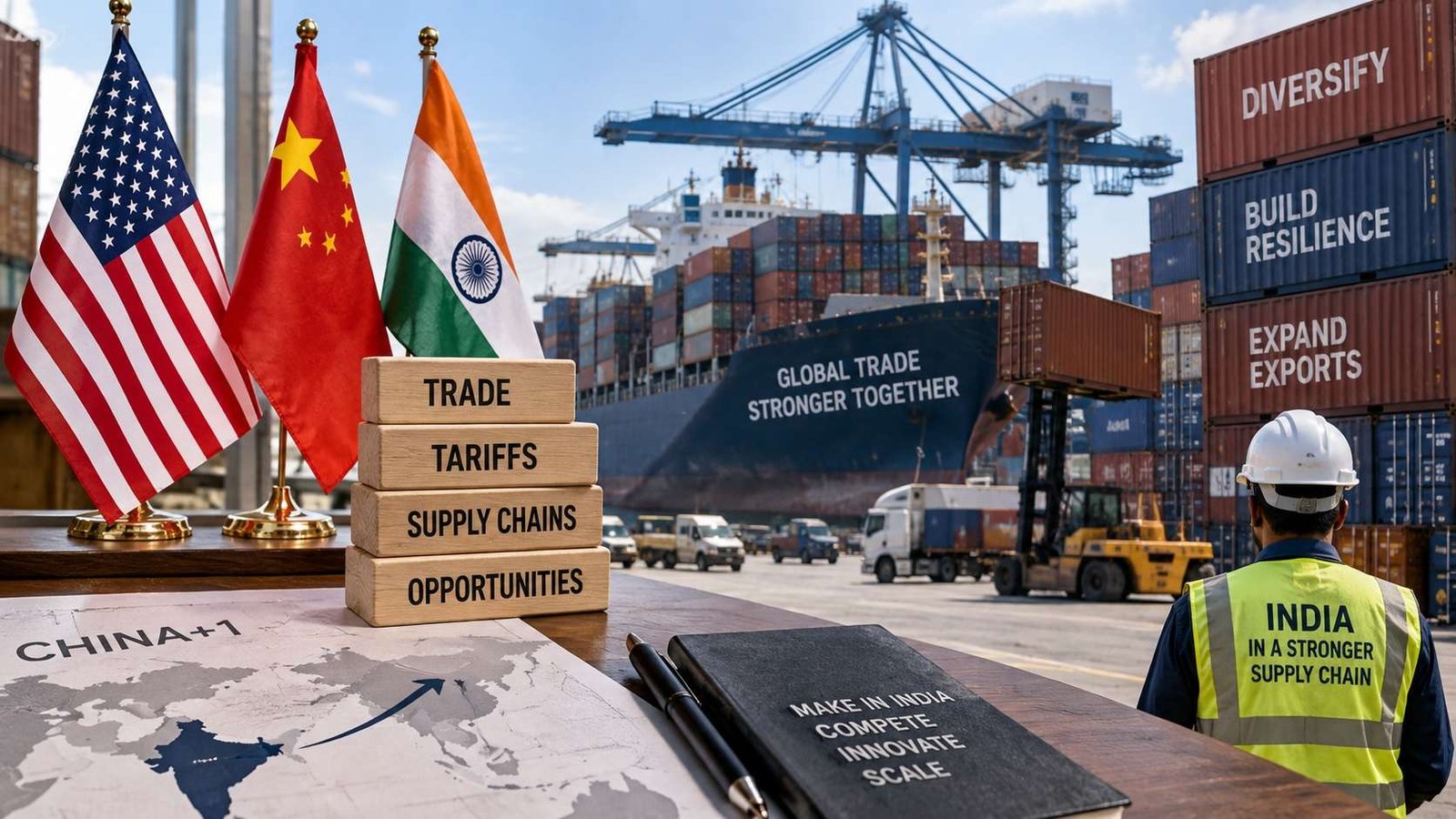
For several years, one of the most repeated phrases in global manufacturing has been “China+1.”
The idea is simple: companies that have traditionally depended heavily on China add another manufacturing location — and India, Vietnam, Mexico and several other economies have competed for that additional role.
But what happens if the world’s two largest economies decide to make their relationship somewhat less confrontational?
That question has suddenly become more relevant.
Chinese President Xi Jinping is visiting the United States from September 23 to 25, at the invitation of US President Donald Trump, with the two leaders expected to discuss trade and broader strategic issues. Current reporting points to negotiations involving tariffs, critical minerals, technology and artificial intelligence.
The answer for India is not simply “good” or “bad.”
A US-China thaw could reduce one of the immediate incentives for companies to diversify away from China. But it would not automatically erase the longer-term reasons businesses have been building additional supply-chain capacity outside China.
For India, that distinction could become crucial.
The first part of the China+1 story was tariffs
US tariffs have been a powerful reason for multinational companies to rethink where products are manufactured.
When goods made in China become more expensive to sell into the United States, companies have an incentive to consider alternative production locations.
If Washington and Beijing negotiate lower tariffs or maintain a durable trade truce, some of that urgency could decline.
That does not mean factories will suddenly pack their machines into containers and sail back to China.
Manufacturing decisions are rarely that simple.
A company that has spent years establishing suppliers, training workers, qualifying components and building relationships with customers is unlikely to reverse course because two presidents shake hands.
But future investment decisions can be different.
A multinational deciding where to build its next factory may become less worried about China if the tariff environment becomes more predictable.
That is where India could feel the difference.

But China+1 was never only about tariffs
This is where the debate becomes more interesting.
Global companies have increasingly learned that concentrating too much production in one country creates risks that have little to do with tariffs.
A pandemic can close factories.
A geopolitical dispute can restrict exports.
A shipping disruption can delay components.
An export-control decision can suddenly affect access to critical technology.
And a shortage of one specialised component can stop an entire production line.
That is why supply-chain diversification has increasingly become a form of corporate insurance.
A company may continue producing most of a product in China while maintaining a meaningful second production base elsewhere.
The objective is not necessarily to replace China.
It is to avoid being completely dependent on China.
That distinction is fundamental to understanding India’s opportunity.
The EnerVenue example tells an uncomfortable story
A striking example emerged just as the Trump-Xi summit approached.
US battery company EnerVenue had originally planned a factory in Kentucky. It ultimately chose Changzhou, China, for its first manufacturing facility.
According to Reuters, the company’s chief executive cited China’s deep industrial cluster, engineering talent, supplier network and ability to rapidly develop manufacturing equipment as important reasons for the decision.
The plant is around 95% automated and is expected to employ roughly 400 people by the end of 2026.
The episode contains a lesson that goes beyond US-China politics.
Factories follow ecosystems.
Cheap labour alone does not create a world-class manufacturing cluster.
You need suppliers nearby.
You need engineers.
You need machinery.
You need logistics.
You need testing capabilities.
You need skilled technicians.
And you need companies willing to invest alongside one another.
China has spent decades building many of these networks.
India’s challenge is therefore not simply to tell global companies, “Come here because China is becoming expensive.”
It is to make India sufficiently competitive that companies want to come even when China is not being penalised.

India has already started building that foundation
India is not starting from zero.
Government programmes such as the Production Linked Incentive schemes cover 14 sectors, while the Semicon India Programme has a financial outlay of ₹76,000 crore. The government has also highlighted the National Logistics Policy, PM Gati Shakti and industrial-corridor development as part of the effort to improve manufacturing competitiveness.
The electronics sector illustrates the change.
According to the Ministry of Electronics and Information Technology’s 2025–26 annual report, electronics production increased from ₹6.41 lakh crore in FY2021–22 to ₹11.33 lakh crore in FY2024–25.
Electronics exports rose from ₹1.17 lakh crore to approximately ₹3.27 lakh crore over the same period.
These numbers do not prove that India has already become a complete alternative to China’s manufacturing ecosystem.
They show something more useful:
India is building manufacturing depth.
Apple’s India expansion illustrates the structural side
Apple’s expansion of iPhone production in India is frequently presented as a direct China+1 story.
That is partly correct.
But large-scale electronics manufacturing also requires long-term investment in supplier networks, workforce skills and production processes.
Once those capabilities are established, moving production again is not a trivial decision.
That makes supply-chain diversification more durable than a temporary tariff advantage.
The same principle applies to pharmaceuticals, automotive components, specialty chemicals and other sectors where India has established industrial capabilities.
A company does not necessarily move because India is temporarily cheaper.
It moves because India becomes reliably competitive.
Critical minerals complicate the picture
There is another reason a US-China agreement would not automatically remove India’s strategic relevance.
China has substantial control over the global rare-earth supply chain. Reuters reported that China controls up to 70% of global rare-earth mining, about 85% of refining capacity and roughly 90% of rare-earth metal alloy and magnet production, according to AlixPartners.
That concentration has strategic consequences for automobiles, electronics, defence and advanced technology.
Even if Washington and Beijing improve their relationship, companies and governments may still want alternative sources of critical minerals.
India is increasingly trying to participate in that diversification.
A recent example is Indian critical-minerals company Lohum, which is seeking nickel assets in Indonesia and the Philippines, developing lithium projects in Zimbabwe and building battery-material and rare-earth capabilities in India.
This is a different kind of China+1 opportunity.
It is not simply about assembling a product.
It is about building alternative supply chains for the materials and components underneath that product.
The danger for India is complacency
There is, however, a serious risk in assuming that geopolitical rivalry will permanently deliver manufacturing opportunities to India.
It won’t.
If American and Chinese companies reach agreements that reduce tariffs and stabilise trade, India could face stronger competition.
Vietnam will compete.
Mexico will compete.
Indonesia will compete.
China itself will remain extremely competitive.
And multinational companies will compare locations based on cost, infrastructure, reliability, access to markets, skills, taxation, regulation and supplier ecosystems.
The world does not award manufacturing contracts for geopolitical sympathy.
It awards them for performance.
That may be the most important lesson for New Delhi.
A US-China thaw could actually be useful for India
There is an apparent paradox here.
If Washington and Beijing reduce tensions, India could lose some of the immediate geopolitical advantage created by their rivalry.
But a more stable global trading environment could also help Indian manufacturers by reducing uncertainty in shipping, commodity markets and investment decisions.
India would therefore face both greater competition and a potentially more predictable global economy.
The outcome would depend heavily on how quickly Indian industry improves its own competitiveness.
What India needs to win without the tariff tailwind
If China becomes a less risky destination for multinational companies, India needs to make its own case.
That means:
Lower logistics costs.
Faster and more predictable approvals.
Reliable electricity and industrial infrastructure.
Competitive ports and freight networks.
Skilled manufacturing labour.
Deeper domestic supplier ecosystems.
Stable trade and tax policies.
More research and development.
And perhaps most importantly, India needs to move beyond being an assembly destination toward producing a larger share of the components, materials and technologies that make finished products possible.
That is where the real economic value lies.

The China+1 strategy may be changing — not disappearing
The simplest way to understand the coming shift is this:
Tariffs can create the opportunity. Competitiveness keeps it.
If Washington and Beijing reach a deeper economic understanding, the tariff-driven part of China’s diversification story could weaken.
But the risk-management argument remains.
A multinational may still want a second factory.
A semiconductor company may still want geographically diversified packaging capacity.
A pharmaceutical company may still want alternative suppliers.
A battery manufacturer may still want access to multiple mineral and manufacturing ecosystems.
The question is therefore not whether companies will stop using China.
The more important question is whether India becomes indispensable enough to remain part of their global production map.
Doonited Editorial Perspective
India should be careful about celebrating every factory announced because of US-China tensions.
That can create a dangerous illusion.
If India’s manufacturing success depends primarily on another country’s trade dispute, India’s position remains externally driven.
A stronger model is one in which global companies choose India because its infrastructure, workforce, supply chains, market access, engineering capabilities and policy environment make commercial sense.
That is a much harder achievement.
It is also much more durable.
The coming Trump-Xi engagement therefore presents India with an unusual test.
If Washington and Beijing remain confrontational, India has an opportunity.
If they become more cooperative, India still has an opportunity — but it has to compete harder for it.
And that may ultimately be healthier for India’s industrial ambitions.
The Doonited Insight
The real China+1 opportunity is not about replacing China.
It is about ensuring that global companies have credible alternatives.
If India wants to be that alternative for the next generation of manufacturing, technology and supply chains, it cannot depend forever on tariffs, geopolitical rivalry or China’s mistakes.
India’s strongest China+1 strategy would be to become a compelling “India+1” choice for the world itself.
That is the point at which geopolitical opportunity becomes genuine industrial strength.


World Beyond the News
Bees Communicate Where Food Is
Honeybees use movement patterns known as waggle dances to communicate information about food locations.
Street Food Reflects Local History
Many famous street foods developed from migration, trade, local ingredients and the everyday needs of working communities.
A Day on Venus Is Extremely Long
Venus rotates so slowly that one rotation relative to distant stars takes longer than its trip around the Sun.
Human Achievement Continues to Push Limits
Athletes, engineers, scientists and explorers regularly establish new benchmarks in speed, endurance, scale and precision.