

From New York to 900+ Centres: How ISKCON Took Krishna Consciousness Around the World
In 1965, a 70-year-old Indian spiritual teacher arrived in New York carrying little more than books, a message and a determination to introduce the teachings of Krishna to people who knew very little about them.
Six decades later, the organisation he founded has a presence that stretches across continents.
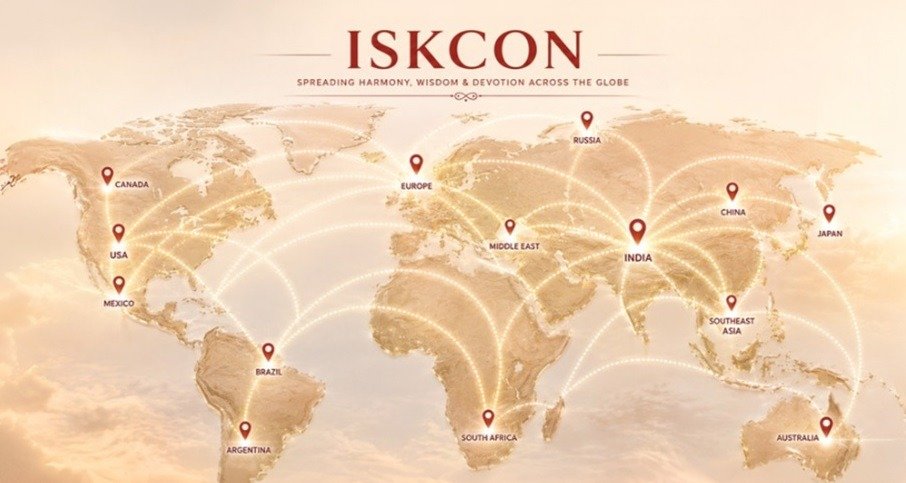
The International Society for Krishna Consciousness (ISKCON), popularly known as the Hare Krishna movement, marks its 60th anniversary in 2026. Its official website currently lists 900+ centres worldwide, alongside thousands of festivals and more than 110 vegetarian restaurants associated with its global activities.
That makes ISKCON’s story one of the more remarkable examples of an Indian spiritual tradition developing a sustained international presence.
And the story begins in an unlikely place.
From a small New York storefront to a worldwide movement
When A.C. Bhaktivedanta Swami Prabhupada arrived in New York in 1965, the city was hardly an obvious launchpad for a movement rooted in Vaishnava devotional traditions.
Yet New York became the starting point.
ISKCON was formally established in 1966, and its early activities centred on chanting, devotional practice, spiritual discussion and the distribution of Srila Prabhupada’s books.
The organisation’s own historical account places considerable importance on that first New York period. The original temple and headquarters were associated with 26 Second Avenue, the Lower East Side location that became an important part of ISKCON’s early history. Contemporary GBC records also refer to 26 Second Avenue as ISKCON’s original temple and headquarters.
It is difficult to imagine a more modest beginning for an organisation that would eventually develop hundreds of centres around the world.
India remained the spiritual heart
Although ISKCON was born institutionally in America, India became central to its global development.
Today, Mayapur in West Bengal is identified by ISKCON as its international world headquarters. The official website describes the Mayapur headquarters as part of the organisation’s global identity and places it within the wider sacred geography associated with Chaitanya Vaishnavism.
For Indians, this makes the story particularly interesting.
ISKCON is not simply an Indian organisation that opened branches overseas.
Its modern international identity was built through a two-way movement: an Indian spiritual teacher took a tradition abroad, while India subsequently became an important destination and organisational centre for people from around the world interested in that tradition.
Walk through parts of Mayapur or Vrindavan and the global nature of the movement becomes visible without needing a statistics report.
You may hear Bengali, Hindi, English, Russian, Spanish or other languages in the same pilgrimage environment.
That is globalisation with fewer PowerPoint slides and considerably more chanting.
The number has grown — and the definition matters
Your original information referred to more than 800 temples and centres.
That figure is now outdated.
ISKCON’s current official website says 900+ centres worldwide.
There is an important editorial distinction here.
“Centres” does not necessarily mean 900 identical temple buildings.
ISKCON’s governing framework recognises different forms of affiliated activity, including temples, rural communities, preaching centres, institutes and special projects.
The organisation’s online directory likewise describes itself as a worldwide directory of official ISKCON centres and branches and contains entries ranging from major cities to rural communities.
Therefore, the most accurate description is 900+ centres worldwide, rather than claiming there are 900 conventional temples of identical status.
That distinction makes the number more meaningful, not less.
What actually travels across borders?
The physical temple is only one part of ISKCON’s international presence.
Its activities include chanting and kirtan, festivals, study of sacred texts, vegetarian food, community programmes, education, environmental initiatives and charitable food distribution. The organisation describes its mission around spiritual practice, learning, community and service.
Food has become particularly important.
ISKCON’s current official figures say its wider network has served more than three billion meals and includes 110+ vegetarian restaurants. Its food-relief work also includes large-scale school meals in India through the Annamrita Foundation, which the organisation says serves more than 1.2 million meals daily under the government Mid-Day Meal programme.
These activities demonstrate why measuring the movement purely by the number of temples misses part of the story.
A temple may be a place of worship.
A community kitchen can become a social-service institution.
A festival can become a cultural gathering.
A book can become the first point of contact between a person and a philosophical tradition.
The unusual power of culture
One reason ISKCON travelled successfully across national boundaries is that it did not present Krishna consciousness solely as a matter of geography.
The movement developed a recognisable cultural vocabulary: the chanting of the Hare Krishna mantra, kirtan, devotional music, vegetarian food, festivals, colourful clothing and public gatherings.
These elements are immediately associated with the tradition.
That cultural visibility matters.
A person who has never visited India may encounter Krishna consciousness through a festival, a vegetarian meal, a book, a university programme or simply a group of people singing in a public space.
The first introduction does not necessarily happen inside a temple.
A global network does not mean a uniform community
Another important point is that ISKCON’s worldwide presence should not be confused with cultural uniformity.
The official centre directory includes locations across North and South America, Europe, Africa, Asia and Oceania, alongside many locations in India.
Local communities inevitably operate within different legal systems, languages and social environments.
The result is an organisation with a common spiritual identity but diverse local expressions.
That is one of the central challenges of any global religious movement.
How do you preserve a coherent tradition without turning every community into a carbon copy?
ISKCON’s history suggests that adaptation has been part of the process from the beginning.
Service is becoming an increasingly visible part of the story
There is also a broader dimension that deserves attention.
Modern religious organisations are increasingly judged not only by their beliefs but by what they contribute to society.
ISKCON explicitly highlights food relief, education, environmental stewardship and community service as parts of its mission.
This does not remove the importance of theological questions or debates surrounding any large religious organisation. Nor should charitable claims be accepted uncritically simply because they are made by the organisation itself.
But the expansion of service activities does show how a spiritual movement can develop institutions that interact with wider society.
That interaction may be one reason its presence has remained visible beyond its core membership.
Sixty years later, the journey is still evolving
ISKCON’s current website describes the movement as having more than 100,000 initiated devotees and millions of followers. Those are organisation-provided figures and should therefore be understood as such rather than as an independently audited global census.
The movement is also adapting to the digital age.
Its official site now promotes online resources alongside physical centres, festivals and community programmes. ISKCON News recently highlighted the tenth anniversary of Hare Krsna TV, reflecting the growing role of digital devotional media in reaching audiences beyond physical temple locations.
The next chapter, therefore, may not be measured simply by how many new buildings appear on the map.
It may be measured by how effectively an old spiritual tradition communicates with a generation that discovers much of its culture through a screen.
The DOONITED perspective
The most interesting lesson from ISKCON’s 60-year journey is not simply that an Indian spiritual movement now has 900+ centres.
It is that ideas can travel differently from people.
A.C. Bhaktivedanta Swami Prabhupada travelled from India to New York at an age when most people would be thinking about slowing down rather than starting a global movement.
He began with a relatively simple proposition: take the teachings of Krishna and make them accessible to people outside India.
Six decades later, the result is a global network in which Indian philosophical traditions, music, food, festivals and devotional practices are encountered by people of many nationalities.
That does not mean every country has embraced ISKCON in exactly the same way, nor that the movement is beyond criticism. A genuinely global organisation inevitably faces questions about governance, finances, institutional accountability and how tradition should evolve. Those questions deserve evidence-based examination rather than either unquestioning praise or casual dismissal.
But the historical achievement remains striking.
ISKCON demonstrates that India’s cultural influence overseas is not limited to Bollywood, cuisine or yoga. Spiritual ideas can travel too — provided someone is willing to carry them across the ocean, explain them patiently, build institutions around them and keep the conversation alive for the next generation.
In 1965, that journey began with one elderly Indian monk in New York.
In 2026, the map looks very different.

World Beyond the News
Bees Communicate Where Food Is
Honeybees use movement patterns known as waggle dances to communicate information about food locations.
Street Food Reflects Local History
Many famous street foods developed from migration, trade, local ingredients and the everyday needs of working communities.
A Day on Venus Is Extremely Long
Venus rotates so slowly that one rotation relative to distant stars takes longer than its trip around the Sun.
Human Achievement Continues to Push Limits
Athletes, engineers, scientists and explorers regularly establish new benchmarks in speed, endurance, scale and precision.