
Can the World Really Become One Family?
Imagine a family dinner where everyone agrees on the menu, nobody argues about money, nobody fights over the remote control and, most importantly, nobody asks who is paying the bill.
Sounds wonderful.
It also sounds slightly unrealistic.
That is precisely why one of India’s oldest philosophical ideas has acquired such an interesting new life in international politics.
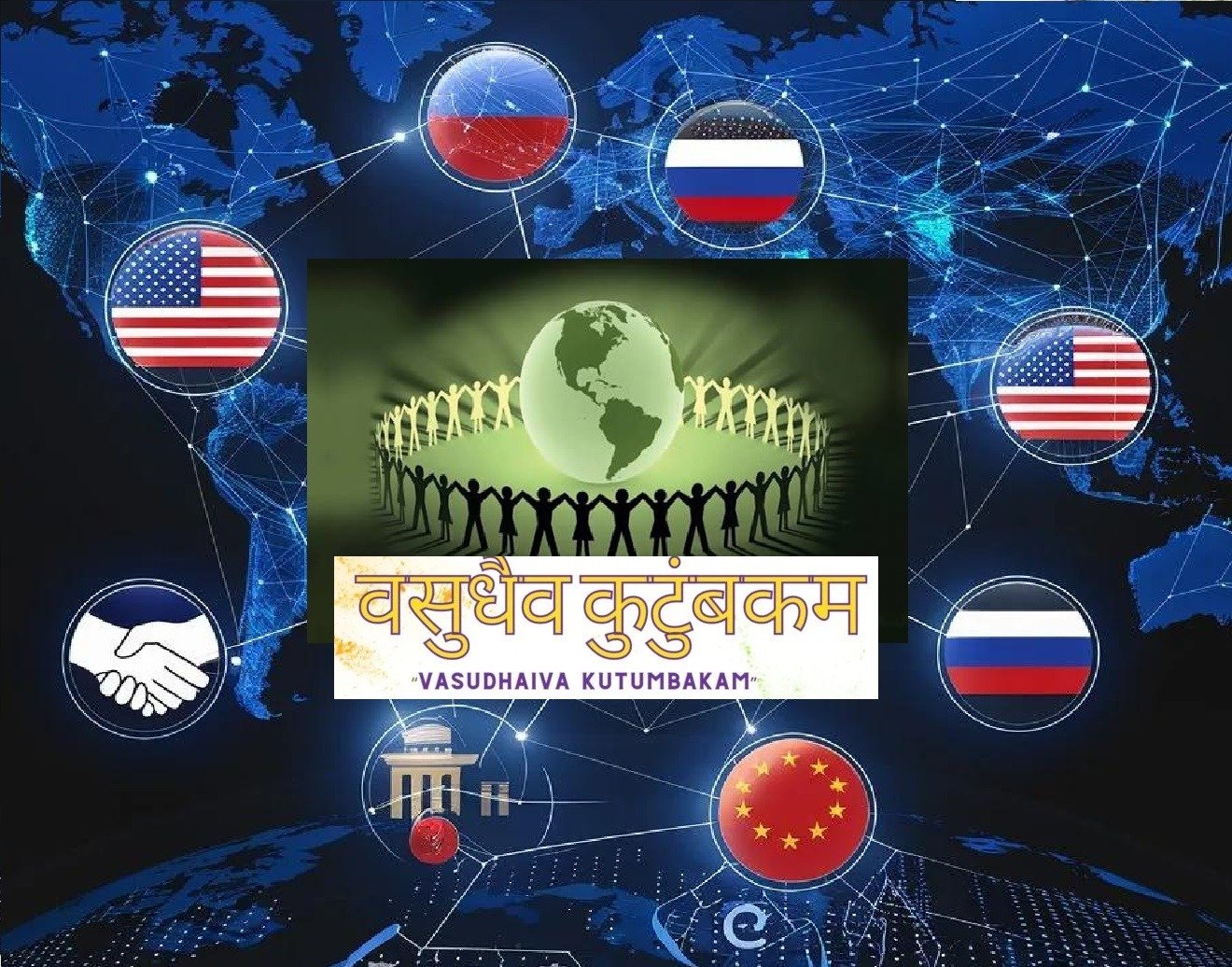
“Vasudhaiva Kutumbakam” — the world is one family.
The Sanskrit phrase has travelled an extraordinary distance: from an ancient Indian philosophical text to modern diplomatic speeches, international conferences and the vocabulary of global governance. India made it particularly visible during its 2023 G20 presidency, choosing “Vasudhaiva Kutumbakam — One Earth, One Family, One Future” as the presidency’s theme.
But there is an important question beneath the beautiful phrase:
Can an idea about universal human unity actually work in a world where countries compete for security, technology, resources, markets and influence?
The answer is neither a simple yes nor a cynical no.
It is much more interesting.
An ancient idea with a very modern message
The expression appears in the Maha Upanishad, where the broader verse contrasts narrow-minded thinking — “this is mine, that is theirs” — with the outlook of people of generous character, for whom the entire world is a family.
That context matters.
The original teaching was not a foreign-policy manual telling governments how to negotiate trade agreements or settle border disputes. It was fundamentally a moral and philosophical statement about how human beings should view one another.
Modern diplomacy has therefore adapted an ancient ethical principle to a very different world.
And perhaps that is exactly why it remains relevant.
The planet has become so interconnected that problems rarely respect national borders.
A virus can cross continents before governments finish drafting a press release.
Carbon emissions released in one part of the world can affect people thousands of kilometres away. Financial instability can travel through markets almost instantly. Cyberattacks, terrorism, climate change, food security and pandemics all demonstrate a simple reality:
Countries may have borders. Problems often do not.
That is where “one family” becomes more than poetry.
India turned philosophy into diplomatic language
India’s use of Vasudhaiva Kutumbakam in contemporary diplomacy is not new.
The Ministry of External Affairs has described the concept as part of the ethos of Indian foreign policy, linking it with development, peace and prosperity.
Prime Minister Narendra Modi also invoked the principle at the 2023 G20 Summit, describing India’s global conduct as rooted in the belief that the world is one family.
The 2023 G20 Leaders’ Declaration opened under the theme “One Earth, One Family, One Future”, explicitly connecting the idea with collective action on global challenges.
This was particularly significant because the G20 brings together major developed and developing economies.
India’s message was essentially that global governance cannot be reduced to a club of powerful nations deciding everything while everyone else waits outside the door.
The philosophy also fitted naturally with India’s effort to bring the concerns of developing countries into global discussions.
During its G20 presidency, India repeatedly emphasised the importance of including the perspectives of countries outside the G20 and finding common solutions to shared challenges.
In diplomatic language, that is inclusive multilateralism.
In simpler language:
If the family is really one family, everyone should at least get a chair at the table.
Climate change is perhaps the clearest test
Few issues demonstrate the logic of Vasudhaiva Kutumbakam better than climate change.
No country can solve climate change alone.
One nation’s emissions do not politely stop at its border. Nor does rising sea level ask for a passport before reaching a coastline.
The G20’s 2023 declaration recognised climate change, biodiversity loss, pollution, drought, land degradation and desertification as challenges affecting lives and livelihoods. It called for collective action and cooperation.
India’s approach during the G20 presidency also connected sustainable development with the principle of a shared planet.
This is where the philosophical idea becomes practical.
If humanity genuinely sees Earth as a common home, then environmental damage in one region cannot simply be dismissed as somebody else’s problem.
The family analogy suddenly becomes uncomfortable — but useful.
Because if the kitchen is burning, arguing about which member of the family owns the kitchen is probably not the best first response.
But international politics is not a family WhatsApp group
Here comes the difficult part.
Countries are not people.
A government has responsibilities to its citizens, including national security, economic prosperity and strategic interests. Countries can cooperate deeply and still disagree sharply.
That is why Vasudhaiva Kutumbakam should not be mistaken for a promise that international competition will disappear.
A 2017 Brookings analysis by W.P.S. Sidhu made precisely this realist challenge. It argued that the world may be described as a family, but international politics still involves competing centres of power, conflicting interests and questions about who makes decisions and how agreements are enforced.
This criticism deserves serious consideration.
A family may have disagreements over dinner.
Countries can have disagreements involving territory, military power, strategic resources and national survival.
The consequences are obviously rather different.
That means good intentions cannot substitute for institutions, negotiation, economic capability, diplomacy and credible national power.
The philosophy may tell countries what kind of world they should aspire to build.
It does not automatically tell them how to get there.
The real strength of the idea is not that everyone agrees
This is perhaps the most important distinction.
Vasudhaiva Kutumbakam does not have to mean “every country must agree with every other country.”
That would be unrealistic.
A more useful interpretation is:
Countries can disagree without treating one another as permanent enemies.
They can compete while maintaining communication.
They can defend national interests while cooperating where interests overlap.
They can negotiate rather than immediately escalate.
And they can recognise that some challenges are simply too large for unilateral solutions.
That is much closer to the practical requirements of modern international relations.
India’s own diplomatic language around the concept has frequently emphasised dialogue, cooperation and shared responsibility rather than the disappearance of national interests. India’s G20 messaging, for example, connected the philosophy with sustainable development, climate action and collective solutions.
From philosophy to soft power
There is another dimension that should not be overlooked.
Ideas themselves can become instruments of soft power.
Countries do not influence the world only through armies, money or technology. They also influence it through culture, institutions, ideas and the ability to present a compelling vision of international cooperation.
Vasudhaiva Kutumbakam gives India a distinctive vocabulary for doing exactly that.
It communicates something about how India would like its international role to be understood: not simply as another major power pursuing its own interests, but as a country willing to speak about common global responsibilities.
The Ministry of External Affairs has even used the principle while describing India’s engagement with foreign diplomats and its efforts to share knowledge and capacity-building with other countries.
That does not mean every Indian foreign-policy decision automatically becomes altruistic.
Nor should it.
Foreign policy inevitably involves national interests.
The important question is whether national interest and global responsibility can coexist.
They can.
In fact, increasingly, they must.
The Indian diaspora gives the phrase another meaning
There is also a very human reason the idea resonates in the 21st century.
Millions of people of Indian origin live outside India.
They work in other countries, raise families there, build businesses, teach in universities, work in hospitals and technology companies, contribute to local communities and maintain cultural connections with India.
Modern Indians therefore experience the world as interconnected in a very literal sense.
A person can be born in India, educated in another country, work in a third and have family spread across several continents.
The old distinction between “us” and “them” becomes increasingly complicated.
Globalisation has not erased national identity.
It has made identities more layered.
And perhaps that makes the ancient idea unexpectedly contemporary.
But there is a warning hidden inside the philosophy
There is a danger in turning Vasudhaiva Kutumbakam into a slogan that is repeated so often that nobody asks what it actually requires.
A genuine “one family” approach would demand more than speeches.
It would require countries to cooperate when cooperation is difficult.
It would require powerful countries to listen to weaker ones.
It would require developing nations to take responsibility for their own commitments as well.
It would require rich countries to recognise that global stability cannot be separated from inequality, climate vulnerability and development.
And it would require countries to distinguish between legitimate disagreement and dehumanisation.
That last point may be especially important in the age of social media.
International disagreement today can turn into online nationalism within minutes. A policy dispute becomes a personal insult; a disagreement between governments becomes hostility toward ordinary citizens.
That is precisely where the concept of “one family” has ethical value.
Being family does not mean pretending that everyone is perfect.
It means recognising that disagreement does not automatically make the other person less human.
DOONITED Editorial Perspective: The family needs rules
There is an intelligent criticism to be made of Vasudhaiva Kutumbakam.
The world cannot become one family merely by calling itself one.
Families need trust.
They also need rules.
International politics needs institutions, treaties, economic cooperation, diplomacy, credible security arrangements and mechanisms for resolving disputes.
Without these, “one family” risks becoming a beautiful slogan floating above a very complicated reality.
But dismissing the philosophy as unrealistic would also be a mistake.
Every major international institution begins with an idea about how human beings ought to behave.
The United Nations is an institution.
Climate agreements are institutions.
International humanitarian law is an institutional expression of certain moral principles.
The idea that countries should cooperate rather than permanently fight is itself an ideal.
So perhaps the most practical interpretation of Vasudhaiva Kutumbakam is not:
“The world is already one happy family.”
It clearly isn’t.
The better interpretation is:
“The world is interconnected enough that we must learn to behave as if our future is shared.”
That is a much harder message — and therefore a much more useful one.
India’s challenge is to ensure that the philosophy remains more than diplomatic decoration. Its credibility will ultimately depend on whether India can combine the language of universal responsibility with capable diplomacy, economic strength, technological competence, humanitarian action and consistent engagement with the rest of the world.
And the same standard should apply to every major power.
Because if Earth really is one family, then humanity has inherited one rather awkward family problem:
There is no second planet to move to when everyone starts arguing.
The takeaway
Vasudhaiva Kutumbakam is not a guarantee of world peace. It is an ethical proposition about how humanity should approach an interconnected world.
Its modern importance lies precisely in the tension between idealism and realpolitik.
Power matters.
National interests matter.
Security matters.
But so does the recognition that climate change, pandemics, technological disruption, economic instability and humanitarian crises increasingly require cooperation.
The ancient Indian phrase therefore remains relevant not because it describes the world as it is, but because it challenges the world to become something better.
The world may not yet be one family. But increasingly, it is one shared home.
And that distinction may be the most important lesson of all.

World Beyond the News
Birds Can Navigate Using Earth’s Magnetic Field
Several bird species can sense Earth’s magnetic field, helping them navigate during long-distance migration.
Fermentation Is a Global Food Tradition
People across continents have used fermentation for centuries to preserve food and create distinctive flavours.
Modern Batteries Store Energy Chemically
Rechargeable batteries repeatedly move ions between electrodes, allowing electrical energy to be stored and released.
Why Songs Become Global Hits
Streaming platforms, short-form video, playlists and international collaborations can rapidly carry music across borders.