
UPI at 10: How India’s Digital Payment Revolution Became a Global Technology Story
There was a time when paying for a cup of tea in India could involve searching for change, asking whether the shopkeeper had ₹10, and occasionally beginning a philosophical discussion about who had the correct amount.
Then came UPI.
Today, a customer can scan a QR code, enter a PIN and transfer money directly from a bank account in seconds.
What began as a relatively modest digital-payment experiment has become one of India’s most important pieces of digital public infrastructure—and increasingly, a technology that India is taking beyond its own borders.
In 2026, the Unified Payments Interface (UPI) completed a decade of operation. The numbers behind that decade are extraordinary: annual UPI transaction volume reached 24,162 crore transactions in FY2025–26, while annual transaction value reached about ₹314 lakh crore. By July 2026, 741 banks were live on the platform.
And July itself produced a record: 2,366 crore transactions in a single month, worth about ₹29.88 lakh crore.
That is no longer merely a payment app story.
It is a technology story.
What exactly is UPI?
UPI was developed by the National Payments Corporation of India (NPCI) under the regulatory framework of the Reserve Bank of India.
NPCI describes UPI as an instant payment system that allows users to connect multiple participating bank accounts through a UPI application and make person-to-person or merchant payments. The pilot launch took place on 11 April 2016.
The basic idea is remarkably simple.
Instead of asking a customer to enter a bank account number, branch details and IFSC code for every transaction, UPI allows payments through identifiers such as a UPI ID, mobile-based mechanisms or QR codes.
For the customer, the technology largely disappears.
That is actually one of its greatest achievements.
Good technology often works best when people do not have to think about how complicated it is.

From 21 banks to more than 700
The scale of UPI’s expansion is perhaps best understood by looking backward.
At launch, UPI had 21 participating banks.
By July 2026, NPCI data showed 741 banks live on the system.
The annual transaction numbers tell an even bigger story.
UPI processed only 1.78 crore transactions in FY2016–17.
By FY2025–26, that had risen to 24,162 crore transactions.
The government describes that as an almost 13,000-fold increase in annual transaction volume.
In other words, UPI did not simply grow.
It changed the everyday behaviour of hundreds of millions of people.
The vegetable vendor, taxi driver, restaurant, student, small business owner and large retailer could all participate in the same basic payment ecosystem.
That interoperability is one of the real stories behind UPI.

The QR code became India’s unlikely financial symbol
Perhaps the most visible symbol of India’s digital-payment transformation is not a bank branch.
It is the little black-and-white square sitting on a shop counter.
Scan it.
Enter the amount.
Enter the PIN.
Done.
NPCI’s system allows participating apps and banks to interact through a common infrastructure rather than forcing every customer and merchant into the same application.
That matters enormously for small businesses.
A street vendor does not need a sophisticated payment terminal.
A small shop does not necessarily need an expensive card machine.
A customer can use a participating UPI application and pay directly from a bank account.
The result is a payment system that operates at enormous scale while remaining relatively invisible to the user.
UPI is now a global story
This is where India’s experiment becomes particularly interesting.
UPI has moved beyond India’s borders.
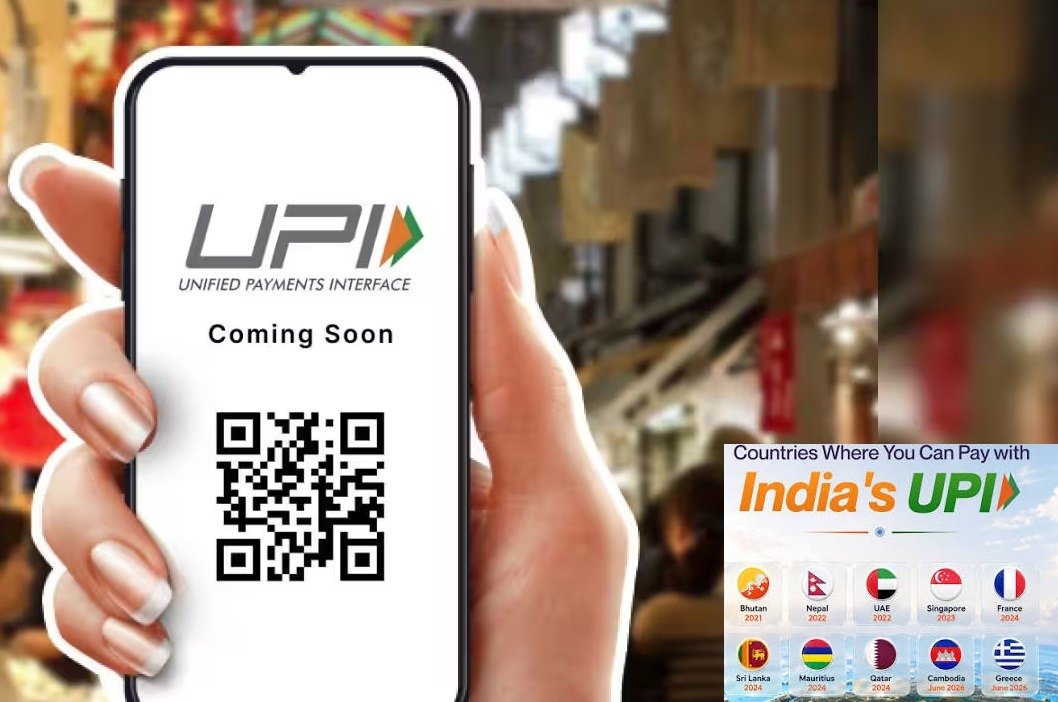
Government figures in 2026 say UPI is operational in 11 countries, while NPCI’s international partnerships and programmes have expanded the system’s reach for Indian travellers and cross-border payments.
NPCI lists international merchant-payment arrangements involving countries including Singapore, the UAE, Bhutan, Nepal, Mauritius, France and Sri Lanka, among others.
But there is an important qualification.
If an Indian traveller visits France, Singapore or the UAE, it does not mean every shop accepts UPI.
UPI Global Acceptance works at participating merchant locations. NPCI instructs users to check for the appropriate UPI or partner acceptance signage before making a payment.
That distinction may sound small.
It is not.
Good international reporting should distinguish between “UPI is available in a country” and “every merchant in that country accepts UPI.”
The latter would be an exaggeration.
Singapore shows what UPI can become
One of the most interesting developments is the UPI-PayNow linkage between India and Singapore.
The arrangement allows users in the two countries to make cross-border transfers through their respective participating mobile-payment systems. NPCI describes the linkage as enabling instant, safe and cost-effective cross-border fund transfers.
This is potentially more important than simply allowing tourists to scan a restaurant QR code.
Imagine a future in which sending money between countries becomes closer to sending money between two Indian bank accounts.
That would have implications for students, migrant workers, families, tourists and businesses.
The technology therefore has the potential to make international payments less cumbersome.
And UPI is not only for Indians
India has also been experimenting with bringing the UPI experience to foreign visitors.
NPCI’s UPI One World allows eligible international visitors to India to use a prepaid wallet linked to UPI for merchant payments without requiring an Indian bank account or Indian mobile number.
In February 2026, NPCI extended the service to international delegates from more than 40 countries attending the India AI Impact Summit.
NPCI says UPI One World can be used for merchant transactions across India, including shopping, restaurants, hotels, transport and entertainment.
This is strategically clever.
Instead of asking a foreign tourist to understand India’s banking system before buying a dosa, India can bring the payment experience to the tourist.
The dosa remains complicated only if you start discussing which chutney is superior.
Why has UPI scaled so dramatically?
There is no single reason.
The first is interoperability.
People can use different participating apps and banks while remaining connected to the same underlying payment infrastructure.
The second is simplicity.
QR codes and UPI IDs eliminate much of the friction associated with traditional bank transfers.
The third is scale.
Once millions of merchants accept the same payment method, consumers have a reason to use it everywhere.
The fourth is digital public infrastructure.
UPI is not simply one private company’s payment product. It sits within an ecosystem involving NPCI, banks, payment-service providers, regulators and technology companies.
And the fifth is perhaps the most underestimated:
habit.
Once people become accustomed to paying ₹20, ₹200 or ₹2,000 digitally in seconds, returning to cash for every small transaction starts feeling strangely old-fashioned.
The numbers are almost difficult to imagine
In FY2025–26, UPI processed about ₹314 lakh crore in annual transaction value.
The average daily transaction count in 2026 was about 66 crore, according to NPCI data cited by the Government of India.
UPI accounted for approximately 84% of India’s digital payments in FY2025–26, according to government figures, while the government has cited an estimate that India accounted for about 49% of global real-time payment volume in 2025.
These figures should be read carefully.
“49% of global real-time payment volume” refers to transaction volume, not 49% of the world’s total payment value or 49% of all payments of every kind.
Again, terminology matters.
But even with the qualification, the scale is extraordinary.

The success story has a less comfortable side
No digital system becomes this large without creating new risks.
UPI has made payments easier.
Unfortunately, scams have also learned to become easier.
Phishing, fake payment requests, fraudulent QR codes, social engineering and attempts to persuade users to reveal sensitive credentials remain important concerns.
The Government of India said in 2026 that the government, RBI and NPCI were taking measures including risk-based transaction limits and enhanced security requirements for UPI applications to improve security and transparency.
There is another issue: frictionless spending can sometimes mean thoughtless spending.
When handing over cash physically, the brain notices the transaction.
When ₹499 disappears from a phone screen with one tap, the emotional pain can be considerably smaller.
Convenience is wonderful.
Budgeting still needs adult supervision.
UPI’s biggest achievement may be financial inclusion
The deeper significance of UPI is not that urban professionals can pay for coffee without cash.
It is that digital payments can connect small merchants and ordinary consumers to the formal financial system.
The government says UPI had 55.49 crore users onboarded by June 2026.
The platform has also become deeply embedded in small-value transactions.
A large bank transfer is impressive.
But a system that can economically process millions of tiny everyday transactions is arguably more transformative.
That is where India’s digital-payment experiment becomes a development story rather than simply a technology story.
What happens next?
The next phase could be considerably bigger than QR payments.
NPCI is working on international acceptance, remittances, services for NRIs and new payment experiences.
Its UPI for NRIs programme allows eligible users with NRE/NRO accounts to use supported international mobile numbers, subject to participating-bank conditions.
UPI One World is another example of how the system can be adapted for international visitors.
The larger ambition is clear:
make instant digital payments interoperable across borders.
That will not happen overnight.
Every country has its own regulations, banks, payment infrastructure, currency controls, consumer-protection rules and financial institutions.
But India’s experience gives it something valuable to offer: a payment architecture that has already been tested at enormous domestic scale.
DOONITED Editorial Perspective
UPI’s greatest achievement is not that Indians can scan a QR code instead of carrying cash.
It is that India demonstrated something technologically and economically important:
digital public infrastructure can be designed for enormous scale without making the user understand the complexity underneath it.
The next challenge is global.
India should resist the temptation to describe UPI as if the rest of the world has already adopted it.
It hasn’t.
International acceptance remains selective, and cross-border payment systems require cooperation between countries and financial institutions.
But the direction is significant.
Ten years ago, UPI was an Indian payment experiment.
Today, it is part of India’s conversation about digital public infrastructure, financial inclusion and international technology cooperation.
The most interesting question is therefore no longer:
“Can India pay digitally?”
India has answered that one.
The next question is:
“Can an Indian-built payment architecture become part of the way the world moves money?”
If UPI succeeds internationally, India’s most influential export may not be a physical product at all.
It may be the invisible infrastructure sitting behind a payment that simply says:
Payment successful.
And somewhere, a shopkeeper has already moved on to the next customer.

World Beyond the News
Why Elephants Stay Close to Their Herd
Elephants live in highly social family groups and use calls, touch and body movements to maintain strong bonds.
Most of the Deep Ocean Remains Difficult to Explore
Extreme pressure, darkness and distance make deep-ocean exploration one of Earth’s greatest scientific challenges.
Spacecraft Can Travel Without Traditional Roads
Spacecraft use carefully calculated trajectories and gravity assists to travel enormous distances through space.
Why Movie Trailers Are Released in Stages
Major films often use teaser trailers, full trailers and final promotional spots to build awareness over time.