
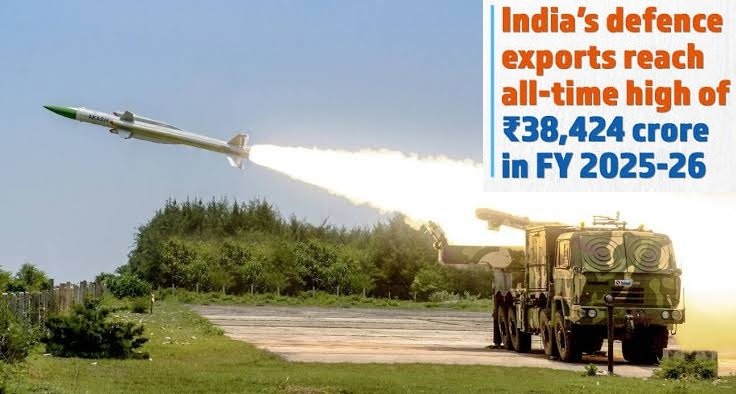
From Buying Weapons to Selling Them to the World
For decades, India had an uncomfortable reputation in defence: a major military power that also happened to be one of the world’s significant arms importers.
That picture is beginning to change.
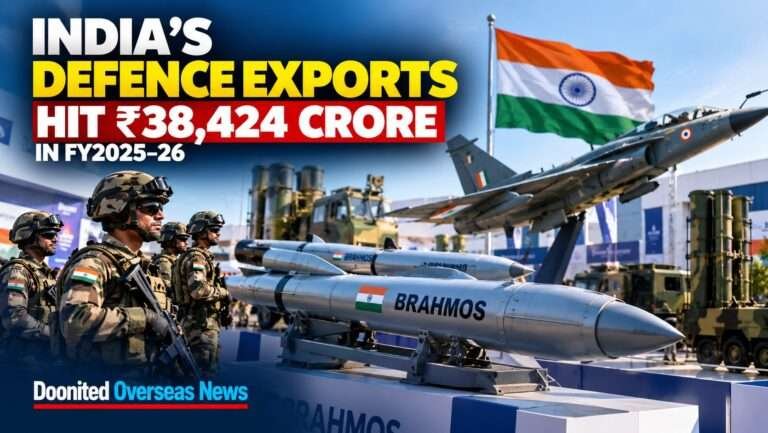
India’s defence exports reached a record ₹38,424 crore in financial year 2025–26, according to the Ministry of Defence. That is an increase of ₹14,802 crore, or 62.66%, over the previous year’s ₹23,622 crore.
The number is impressive. But the more interesting story is not simply the size of the cheque.
It is what the cheque represents.
India is increasingly trying to move from being primarily a buyer of military hardware to a manufacturer capable of selling defence products, systems, components and technology to other countries.
And that is a much bigger transformation.
₹38,424 crore — but who is actually exporting?
The headline number becomes more interesting when we look inside it.
Defence Public Sector Undertakings contributed ₹21,071 crore, or 54.84% of exports, while the private sector contributed ₹17,353 crore, or 45.16%.
The private sector’s role is particularly significant.
For a long time, Indian defence manufacturing was strongly associated with government-owned organisations. Today, private companies, smaller manufacturers, technology firms and suppliers are increasingly part of the defence production chain.
That matters because a modern defence industry is not built by one giant factory.
It requires thousands of capabilities — electronics, precision engineering, materials, software, communications, sensors, propulsion, machining, testing and specialised components.
In other words, building a missile is not merely about building a missile.
There is an entire industrial ecosystem hiding behind it.
From ₹686 crore to ₹38,424 crore
Perhaps the most striking comparison is historical.
India’s defence exports stood at just ₹686 crore in FY 2013–14. By FY 2025–26, they had reached ₹38,424 crore — more than 56 times the earlier figure.
That does not mean India suddenly became a global defence superpower overnight.
It means something more practical: Indian defence manufacturing has acquired a much larger commercial and industrial footprint.
Government policy has increasingly pushed domestic production, indigenisation and participation by private industry.
The result is visible not only in exports but also in domestic production.
India’s defence production reached a record ₹1.78 lakh crore in FY 2025–26, up 15.6% from the previous year. The private sector’s share reached about 24%, its highest level so far.
The two numbers therefore belong to the same story.
Produce more at home, and eventually there is more to sell abroad.
The world is becoming the next customer
According to the Defence Ministry, Indian defence equipment was exported to more than 80 countries during FY 2025–26, while the number of defence exporters increased from 128 to 145.
That geographic spread is important.
A defence product has to satisfy considerably more than a marketing brochure.
Potential customers examine price, reliability, performance, maintenance, training, supply chains, political relationships and long-term support.
A country buying military equipment is not buying a toaster.
If the toaster stops working, breakfast is ruined.
If a radar, communications system or weapon system fails at the wrong moment, the consequences are considerably more serious.
That is why sustained export growth can become a useful test of industrial credibility.
BrahMos, missiles, aircraft — and everything in between
India’s growing defence export portfolio is no longer limited to basic equipment.
Indian systems and components increasingly span missiles, artillery-related equipment, naval platforms, aerospace components, radars, electronics, protective equipment and other military subsystems.
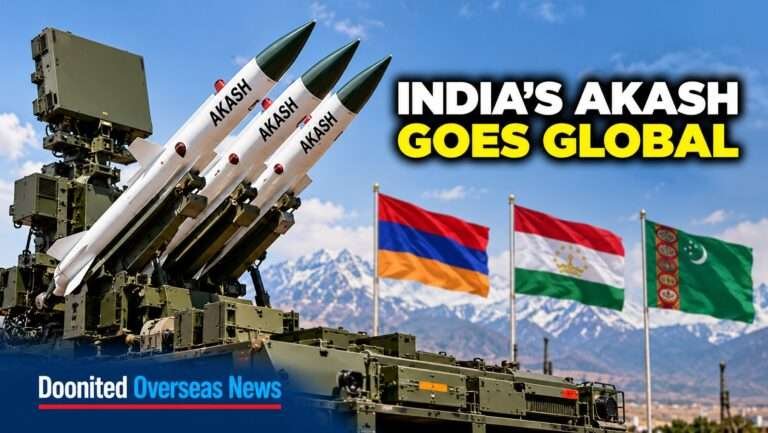
The BrahMos missile is perhaps the most visible example of India’s growing international defence profile. But the larger story is actually broader.
Modern defence exports increasingly involve systems and subsystems, meaning that Indian companies do not necessarily have to sell an entire weapon platform to participate in the global defence market.
A company making an advanced electronic component, radar subsystem, aerospace structure or specialised piece of equipment can become part of an international supply chain.
That may eventually prove just as important as selling a complete platform.
The private sector changes the equation
The official export numbers also show something else: private companies are no longer peripheral players.
Their ₹17,353-crore contribution represented 45.16% of India’s defence exports in FY 2025–26.
This is strategically important.
Large government organisations provide scale and institutional experience. Private companies can bring investment, specialised engineering, faster product development and commercial discipline.
Start-ups can add another layer, particularly in emerging areas such as drones, artificial intelligence, electronics and autonomous systems.
But there is a necessary caution here.
A growing export number does not automatically mean that every critical technology is indigenous.
Defence systems often contain international components, technologies, licences or collaborative development. Indigenous manufacturing and complete technological self-reliance are related concepts, but they are not identical.
That distinction matters if India wants to become not merely a large defence manufacturer, but a genuinely technologically independent one.
The difficult part starts after the celebration
₹38,424 crore deserves recognition.
But the real test is what happens next.
Can India maintain export growth without relying disproportionately on a relatively small number of products or customers?
Can Indian companies provide long-term maintenance and upgrades?
Can the country move further into high-value areas such as advanced engines, sensors, electronic warfare, semiconductors, sophisticated materials and next-generation aerospace technologies?
And can smaller Indian suppliers become globally competitive rather than remaining dependent on a few large prime contractors?
These questions are less glamorous than unveiling a new missile.
Unfortunately, industrial capability rarely comes with dramatic background music.
It comes with machine tools, testing facilities, engineers, supply chains, certification, quality control and years of research.
The ₹50,000-crore target
The government has set a target of ₹50,000 crore in annual defence exports by 2029, alongside a ₹3 lakh crore annual defence-production target.
That makes the present ₹38,424 crore achievement an important milestone, but not the destination.
The gap to ₹50,000 crore is significant but no longer looks purely aspirational.
The challenge will be converting a rapid increase in export value into durable global competitiveness.
That means developing products that foreign militaries actively want — not simply products that India is capable of producing.
There is a subtle but important difference.
DOONITED Editorial Perspective: From “Make in India” to “Make for the World”
The most important change may not be the ₹38,424 crore figure itself.
It is the change in mindset behind it.
For years, the central question was:
“Can India manufacture this equipment domestically?”
The next question should be:
“Can India manufacture something so reliable, competitive and supportable that another country wants to buy it?”
That is a harder question.
And it is the right one.
India’s defence-export story is therefore worth watching not because ₹38,424 crore is a record — although it certainly is — but because the country is gradually developing the industrial ecosystem required to compete in a global defence market.
The real victory will come when Indian companies are not simply exporting weapons.
They are exporting engineering capability, technology, reliability and long-term industrial partnerships.
India spent decades learning how to buy from the world.
The more interesting chapter may now be learning how to build for the world.
What readers should take away
India’s record defence exports are a genuine industrial milestone. But export growth should be judged not only by rupee value, but also by technological depth, diversification, reliability, private-sector capability and the percentage of critical technologies developed domestically.
The ₹38,424 crore milestone is the scoreboard. The real competition is building the capability behind it.

World Beyond the News
Birds Can Navigate Using Earth’s Magnetic Field
Several bird species can sense Earth’s magnetic field, helping them navigate during long-distance migration.
Fermentation Is a Global Food Tradition
People across continents have used fermentation for centuries to preserve food and create distinctive flavours.
Modern Batteries Store Energy Chemically
Rechargeable batteries repeatedly move ions between electrodes, allowing electrical energy to be stored and released.
Why Songs Become Global Hits
Streaming platforms, short-form video, playlists and international collaborations can rapidly carry music across borders.