

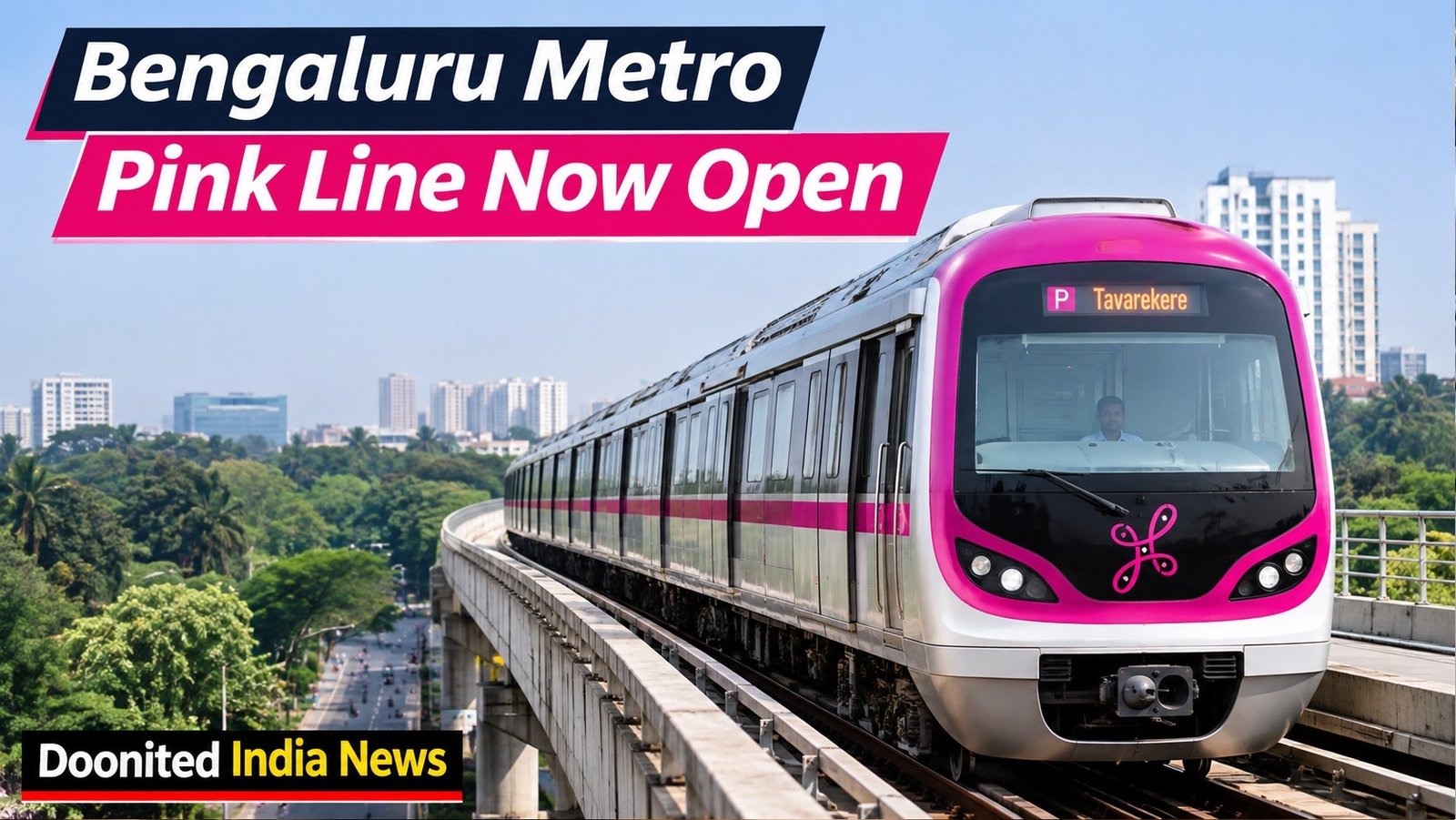
Bengaluru Metro Pink Line Opens: Six New Stations Bring Relief to South Bengaluru Commuters
The first operational 7.5-km elevated section of Namma Metro’s Pink Line began passenger services on November 14, connecting Kalena Agrahara with Tavarekere along Bannerghatta Road. Its Yellow Line interchange at Jayadeva Hospital adds a valuable new travel option, although the full north–south corridor remains under construction.
By Pradeep Banerjee | Editor, DOONITED.in
For people travelling daily along Bengaluru’s Bannerghatta Road, time spent in traffic has become a familiar part of urban life. Journeys between residential neighbourhoods, educational institutions, hospitals and workplaces can be unpredictable, particularly during peak hours.
The opening of the elevated section of Namma Metro’s Pink Line offers a new alternative. Commercial passenger services began at 6 am on November 14, 2026, on the 7.5-kilometre stretch between Kalena Agrahara and Tavarekere, also known as Suddagunte Palya (SG Palya).
The section was inaugurated a day earlier by Prime Minister Narendra Modi. Developed by Bangalore Metro Rail Corporation Limited (BMRCL), it is the first operational part of the larger Pink Line project, designed to connect South Bengaluru with Nagawara in the north.
Six stations along the Bannerghatta Road corridor
The newly opened section has six stations, running south to north:
Kalena Agrahara
Hulimavu
IIM Bangalore (IIMB)
JP Nagar 4th Phase
Jayadeva Hospital
Tavarekere (SG Palya)
For commuters, the value is not limited to the new stations themselves. The corridor brings rail connectivity closer to residential areas and major destinations around Hulimavu, Bilekahalli, IIM Bangalore and JP Nagar.
The Jayadeva Hospital station is particularly important because it connects the Pink Line with the operational Yellow Line. Passengers can change trains there to travel towards Silk Board, Electronic City and Bommasandra, extending the usefulness of the new corridor beyond its six stations.
A practical alternative to road congestion
The Pink Line runs along a busy urban corridor where road traffic can be especially demanding during morning and evening commutes. Its elevated alignment allows metro trains to bypass much of the congestion affecting surface roads.
Early passenger responses suggest that the service is already making a difference to some daily journeys. In its first-day coverage, The New Indian Express reported commuters describing shorter travel times and relief from traffic. One resident of Hulimavu, who regularly travels towards Madiwala, welcomed the new connection. These are individual commuter experiences, not a measured citywide reduction in journey times.
The corridor could be particularly useful for students, faculty and visitors travelling to IIM Bangalore, patients and hospital staff accessing the Jayadeva area, and residents of southern neighbourhoods heading towards the Yellow Line network.
Train frequency, fares and operating arrangements
Initial reports indicated that trains would operate at approximately eight-minute intervals, with four train sets deployed for regular service and one kept on standby. The frequency may be adjusted as passenger demand and operational performance are assessed.
Published fare information reported by The Economic Times gives a distance-based range of ₹10 to ₹30 for the newly opened section. Commuters should check the latest BMRCL fare information before travelling, particularly if their journey involves an interchange or a different ticketing arrangement.
The Pink Line’s infrastructure is also part of a wider public investment. The 7.5-km section was built at an estimated cost of around ₹3,470 crore. Japan International Cooperation Agency (JICA) has supported Bengaluru Metro Phase 2 through an official development assistance loan, including assistance for signalling, train-control systems, rolling stock and consultancy services.
The missing underground link
The new service is a significant step, but it is not yet the complete Pink Line.
The full corridor is planned to extend approximately 21.26 kilometres, with 18 stations. The remaining underground section, comprising 12 stations between Tavarekere and Nagawara, is expected to connect areas including Dairy Circle, Langford Town, MG Road, Shivaji Nagar, Cantonment and Nagawara. Reports have indicated a 2027 target, but the remaining stretch is not yet operational.
This limitation matters for commuters travelling towards central and northern Bengaluru. They cannot yet use the Pink Line for a continuous journey from Kalena Agrahara to Nagawara. Depending on their destination, they will still need to change to another metro line, use buses or complete part of the journey by road.
The full corridor’s eventual interchange with the Purple Line at MG Road is expected to make the network more useful for cross-city travel.
Why the opening matters beyond six stations
Bengaluru’s transport challenge cannot be solved by one metro extension. Better public transport requires reliable feeder buses, convenient station access, safe pedestrian routes, parking arrangements and sensible integration between different modes of travel.
For the Pink Line, the next priority should be making the stations easy to reach from nearby neighbourhoods. A metro station is most useful when passengers can get to it without first negotiating another traffic bottleneck.
The new elevated stretch is nevertheless a meaningful addition to the city’s transport network. It gives South Bengaluru commuters another option, links the Bannerghatta Road corridor with the Yellow Line and brings the larger north–south metro project closer to completion.
The Pink Line has begun its journey, but Bengaluru’s real transport gains will emerge when the entire corridor works as one connected system—not simply as a collection of newly opened stations.
Originally published on Doonited India: Read the original article

World Beyond the News
Dolphins Use Individual Signature Whistles
Bottlenose dolphins develop distinctive whistles that function somewhat like individual acoustic identifiers.
The Pacific Is Earth’s Largest Ocean
The Pacific Ocean covers more area than any other ocean basin and stretches between Asia, Australia and the Americas.
Artificial Intelligence Learns Statistical Patterns
Modern machine-learning systems identify patterns in large datasets and use those patterns to generate predictions or outputs.
Why Some Stories Spread So Quickly
Emotion, novelty, visual appeal and easy sharing can make a story travel rapidly across social platforms.