
IIT Kharagpur Makes Medical Education History: Where Doctors, Artificial Intelligence and Engineering Meet
India’s first IIT to introduce NMC-accredited postgraduate MD programmes is bringing clinical medicine and advanced technology together, opening a new chapter in interdisciplinary medical education.
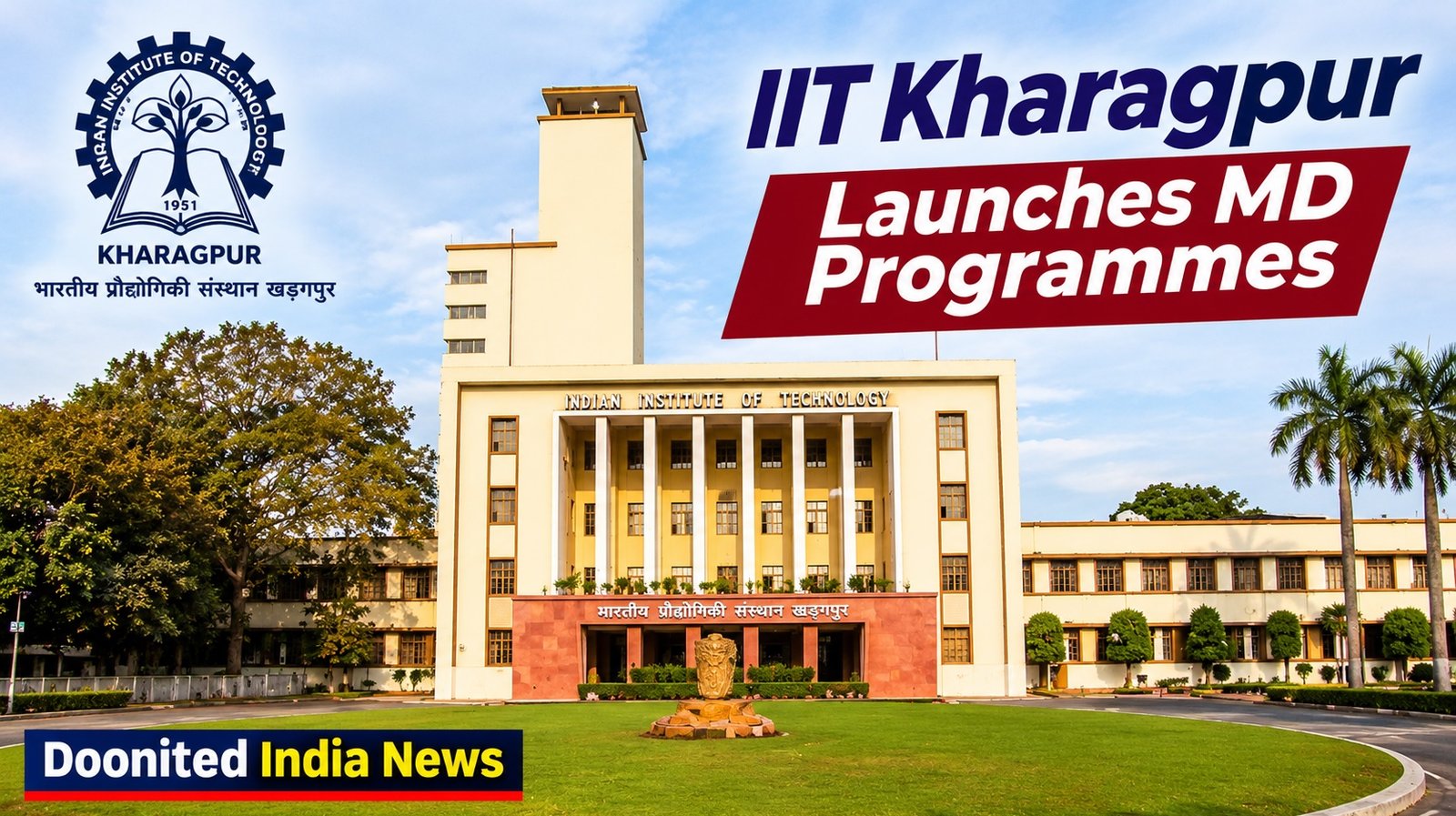
India’s medical education landscape is entering an interesting new phase. The Indian Institutes of Technology have traditionally been associated with engineering, technology and scientific research. Now, IIT Kharagpur is taking that legacy into a new territory: postgraduate medical education.
Starting with the 2026–27 academic session, the institute is introducing six postgraduate MD programmes recognised by the National Medical Commission (NMC). The initiative makes IIT Kharagpur the first IIT in India to offer NMC-accredited postgraduate medical programmes.
The significance goes beyond adding another medical qualification to India’s education system. It represents an attempt to bring two disciplines that have often operated separately—clinical medicine and advanced engineering—closer together.
The larger ambition is to develop doctors who understand not only diseases and treatment, but also the technologies that could transform diagnosis, medical research and patient care.
Six MD programmes, 12 seats: What IIT Kharagpur is offering
The first intake is deliberately small: just 12 seats across six specialisations, with two students in each discipline.
| MD specialisation | Seats |
|---|---|
| General Medicine | 2 |
| Radiology | 2 |
| Physiology | 2 |
| Pathology | 2 |
| Community Medicine | 2 |
| Biochemistry | 2 |
| Total | 12 |
The programmes will be offered at the institute’s Dr. B. C. Roy Multi-Speciality Medical Research Centre. Admission is through NEET-PG 2026 online counselling, with the seats available for consideration in Round 2, subject to eligibility and the official seat matrix.
The small intake suggests that this is a carefully structured beginning rather than an attempt to immediately compete with large conventional medical colleges.
Why combine medicine with engineering?
Consider a patient whose condition is difficult to diagnose through conventional investigations. Artificial intelligence could help analyse medical images, computational pathology could assist in examining tissue samples, and advanced diagnostic technologies could potentially identify disease earlier.
These are examples of the opportunities that interdisciplinary research can explore.
IIT Kharagpur identifies several areas for potential research engagement:
AI-assisted clinical decision-making
Advanced medical imaging
Computational pathology
Biomedical devices
Molecular diagnostics
Precision medicine
Population health
Affordable healthcare technologies
The institute also brings established expertise in artificial intelligence, microfluidics, bioengineering and computational sciences to this initiative.
The important distinction is that these are research and innovation opportunities associated with the programmes, not a guarantee that every student will specialise in every technology.
A foundation established more than two decades ago
This development did not emerge overnight.
IIT Kharagpur established its School of Medical Science and Technology (SMST) in 2001, with the objective of creating an interdisciplinary platform connecting medical science, engineering and biomedical research.
The school introduced its Master of Medical Science and Technology programme for MBBS graduates. It also developed academic and research activities in areas such as medical imaging, tissue engineering, biomaterials, medical instrumentation and healthcare technology.
The new MD programmes build upon this institutional foundation, taking the institute’s medical education ambitions into a new regulatory and academic framework.
What this could mean for Indian healthcare
India faces a dual challenge: expanding access to quality medical services while developing affordable technologies that can support an increasingly demanding healthcare system.
The convergence of medicine and engineering could help address several important needs.
For example, better diagnostic systems may improve the identification of diseases. Biomedical engineering could contribute to affordable medical equipment. Research in precision medicine may help develop more targeted treatment approaches.
Community Medicine also provides an opportunity to connect technological innovation with population-level health challenges.
However, technological sophistication alone will not solve India’s healthcare problems. Medical training must continue to prioritise clinical competence, patient safety, ethical practice and accessibility.
The real measure of success will be whether research eventually produces practical improvements in patient care, particularly for people who cannot afford expensive healthcare.
The opportunity—and the responsibility
IIT Kharagpur’s announcement is an important development, but 12 seats are only a beginning.
The institute will have to demonstrate that its interdisciplinary model can produce excellent specialists while maintaining rigorous clinical training and meaningful research outcomes.
It will also be important to understand how the academic and hospital partnerships support clinical exposure, supervision and practical training.
These are not minor administrative details. They are central to the quality of postgraduate medical education.
India does not simply need doctors who understand technology. It needs doctors who can use technology responsibly to improve healthcare.
The future of medicine needs more than doctors and machines
For decades, engineering institutions and medical institutions have largely developed along separate academic pathways.
IIT Kharagpur is attempting to bring these worlds closer.
The significance of this initiative lies not in the IIT name attached to a medical degree, but in the possibility of creating a stronger relationship between clinical experience and technological innovation.
A radiologist working with advanced imaging scientists, a pathologist collaborating with computational researchers, or a physician contributing to affordable diagnostic development could help create solutions with wider public value.
But innovation must remain connected to the patient.
A sophisticated machine has little value if it is unaffordable. An advanced diagnostic system is incomplete if it cannot reach rural hospitals. And medical research is meaningful only when its findings improve real lives.
IIT Kharagpur has opened a new chapter in Indian medical education. Its real achievement will be measured by the healthcare innovations and better patient outcomes that emerge from it.
Originally published on Doonited India: Read the original article

World Beyond the News
Dolphins Use Individual Signature Whistles
Bottlenose dolphins develop distinctive whistles that function somewhat like individual acoustic identifiers.
The Pacific Is Earth’s Largest Ocean
The Pacific Ocean covers more area than any other ocean basin and stretches between Asia, Australia and the Americas.
Artificial Intelligence Learns Statistical Patterns
Modern machine-learning systems identify patterns in large datasets and use those patterns to generate predictions or outputs.
Why Some Stories Spread So Quickly
Emotion, novelty, visual appeal and easy sharing can make a story travel rapidly across social platforms.