
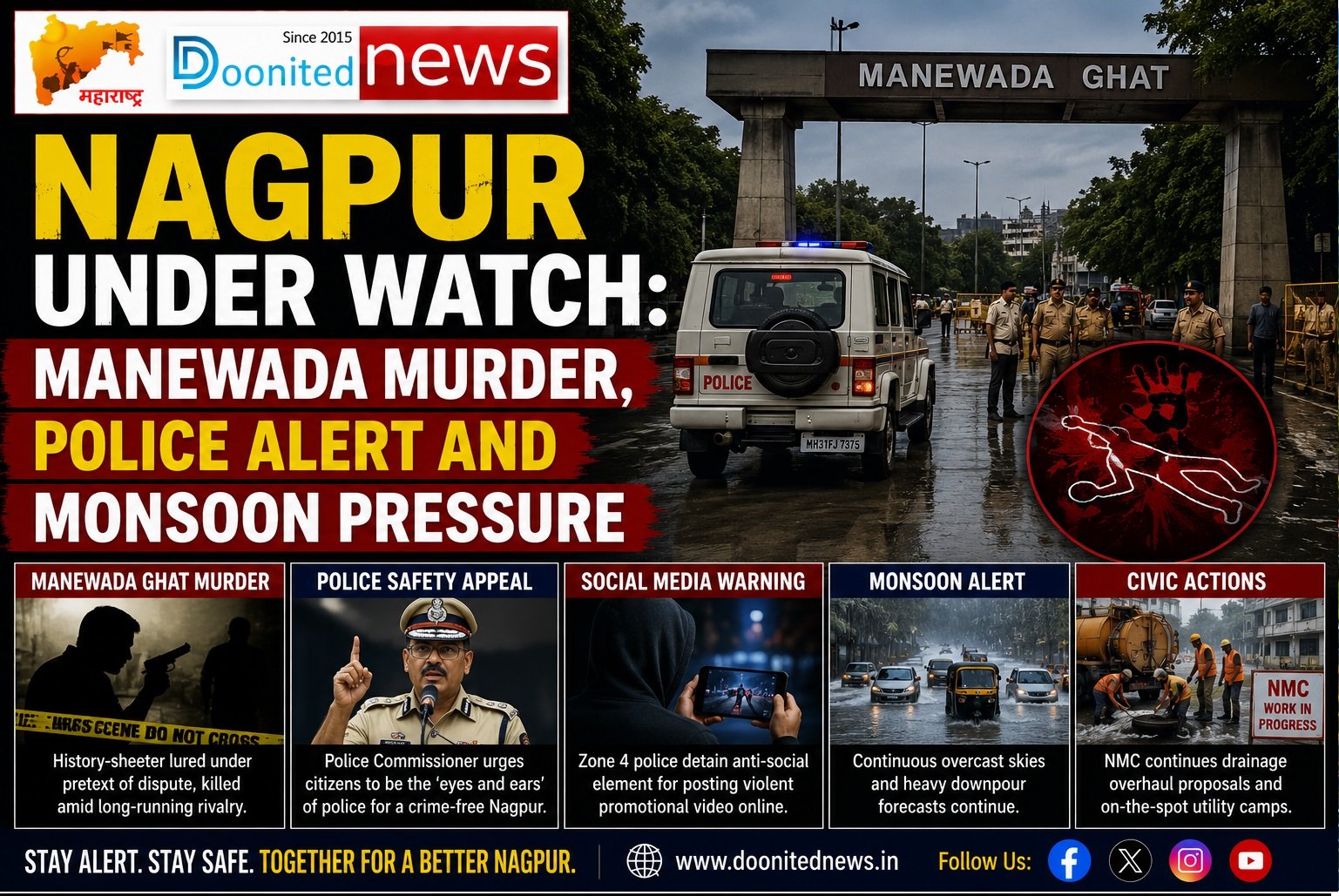

Nagpur Under Watch: Manewada Murder, Police Alert and Monsoon Pressure
By Pradeep Banerjee, Editor | Doonited News
Nagpur | August 19, 2026
Nagpur is facing a difficult combination of concerns this monsoon: a fresh episode of gang-related violence, renewed appeals for citizen participation in policing, warnings over the misuse of social media by anti-social elements, and continuing pressure on the city’s drainage and road infrastructure.
For a city that is expanding rapidly, these are not isolated headlines. They raise a larger question: can Nagpur strengthen both its security systems and civic infrastructure before small problems become major crises?

Manewada Ghat Murder: Old Rivalries, New Methods
A murder at Manewada Ghat has once again brought gang rivalry in south Nagpur under scrutiny.
According to reports, a history-sheeter was allegedly lured to the area on the pretext of settling a dispute before being attacked and killed. The incident is being investigated in the context of an ongoing criminal rivalry.
The Manewada Ghat area has already featured in a series of violent incidents this year. Earlier, the murder of 18-year-old Pawan Suryavanshi was linked by police investigations to gang rivalry, and a subsequent attempt was reportedly made on the life of his associate.
What makes the latest development particularly disturbing is the alleged use of deception to bring the victim to the location.
Social media and personal networks can now become tools for arranging meetings that may have criminal motives. That makes traditional policing alone insufficient.
Police need intelligence, surveillance and community information—but citizens also need to recognize warning signs.
Nagpur’s gang problem needs prevention, not only reaction
Arrests after a murder are necessary. But the more important question is what happens before the next confrontation.
Nagpur Police has previously emphasized community participation and urged citizens to provide information about suspicious activity. The current police leadership’s official message also stresses citizen participation in creating a safer city.
That approach deserves public support.
Police Appeal: Citizens Must Become the City’s Early Warning System
Nagpur Police Commissioner Vishwas Nangare Patil has emphasized the importance of citizens participating in public safety.
The police department’s current official communication explicitly encourages Nagpur residents to stay connected with the police and says that public participation is important in creating a safer city.
The idea of citizens becoming the “eyes and ears” of law enforcement is not about encouraging vigilantism.
It means something much simpler:
- Report suspicious activity.
- Do not ignore threats or violent behaviour.
- Share credible information with police.
- Avoid spreading unverified rumours.
- Report dangerous social-media activity.
- Cooperate with investigations.
Nagpur Police provides 112 as the emergency number and also lists cybercrime reporting services for citizens.
A modern police force cannot be present everywhere at once. Community information can therefore become an important early-warning mechanism.
Social Media Warning: When Online Promotion Crosses the Line
Police in Zone 4 have reportedly detained an anti-social element after a violent promotional video was posted on social media.
The incident may appear relatively small compared with a murder investigation, but it points toward a larger problem.
Social media has changed the way criminal groups project themselves. Videos intended to intimidate, glorify violence or establish a reputation can reach hundreds or thousands of people within minutes.
That creates a dangerous cycle:
violence → video → attention → reputation → imitation.
The response cannot simply be to remove individual videos after they become viral.
Police, platforms, parents and communities all have roles to play in preventing young people from treating criminal behaviour as entertainment or status.
Nagpur Police has already used counselling and community-based interventions aimed at keeping vulnerable young people away from criminal networks.
That preventive approach deserves to be expanded.
Monsoon Alert: Nagpur’s Next Challenge Is Water Management
While crime dominates the headlines, the monsoon is creating a completely different pressure on Nagpur.
The city has already experienced episodes of intense rainfall and waterlogging this season. Following the July 28 cloudburst-like downpour, NMC directed all ten zones to identify vulnerable locations and remain on high alert during heavy rain.
The civic body’s own Public Health Engineering Department lists strengthening stormwater drainage to address urban flooding among its projects.
NMC has also submitted a broader citywide drainage-overhaul plan, aimed at improving stormwater management and reducing recurring waterlogging.
The need is obvious.
For Nagpur residents, drainage is not an abstract engineering issue. It determines whether a heavy shower means:
rain — or flooding.
The Real Test for NMC: Prevention Before the Next Downpour
Drainage cleaning after waterlogging is visible. Preventive engineering is not.
That is why the city’s proposed drainage overhaul is important.
NMC is responsible for basic urban services including drainage, roads, sanitation and other civic infrastructure.
But a successful drainage system requires more than clearing a few drains before a storm.
It requires:
- Proper stormwater capacity
- Regular desilting
- Removal of obstructions
- Protection of natural drainage channels
- Maintenance of culverts and nullahs
- Coordination between civic agencies
- Rapid response to vulnerable locations
The objective should be straightforward:
Nagpur should not have to wait for a flood to discover where its drainage system is weak.
A City Facing Two Different Pressures
Crime and rain may seem unrelated, but they reveal a similar administrative challenge.
Both require early action.
A criminal rivalry should ideally be identified before it produces another murder.
A vulnerable drainage point should ideally be repaired before the next cloudburst.
A violent social-media video should ideally be intercepted before it inspires someone else.
And a citizen’s complaint should ideally reach the right authority before it becomes a crisis.
This is where modern urban governance is heading: from reaction to prevention.
An Editor’s View
Nagpur does not need fear.
It needs vigilance.
The Manewada murder is a reminder that criminal rivalries can still turn deadly.
The police appeal is a reminder that citizens have a role in preventing crime.
The social-media action is a warning that violence can now be promoted digitally.
And the monsoon is reminding the civic administration that infrastructure must be designed for the city Nagpur is becoming—not the city it was decades ago.
The answer lies in stronger institutions, better intelligence, reliable infrastructure and responsible citizens.
Nagpur is growing rapidly. Its systems must become smarter at the same pace.
A safe city is not one where nothing goes wrong. It is one where authorities and citizens identify danger early enough to stop it from becoming a tragedy.