
Marbat Festival of Nagpur: The 145-Year Tradition That Turns a Procession into the Voice of the City
By Pradeep Banerjee, Editor | Doonited News
Nagpur | Maharashtra
There is a day in Nagpur when enormous effigies move through the old city streets, thousands of people gather behind them, slogans rise above the crowd, and a centuries-old city tradition becomes a mirror of contemporary society.
That day is Marbat.
Celebrated on Tanha Pola, the day after Pola, the Marbat-Badgya festival is one of Nagpur’s most distinctive cultural traditions. The festival combines ritual, folklore, history, public participation and social commentary in a way that is difficult to find anywhere else in Maharashtra.
In 2026, the festival has received a significant new push from the Nagpur Municipal Corporation, which has allocated around ₹2 crore for the historic Marbat-Badgya celebrations. The civic body says it wants to preserve the tradition while presenting it as a cultural attraction for visitors from India and abroad.
But behind the crowds and spectacular effigies lies a much deeper story.

Marbat is essentially a festival of symbolically removing evil, disease, misfortune and social problems.
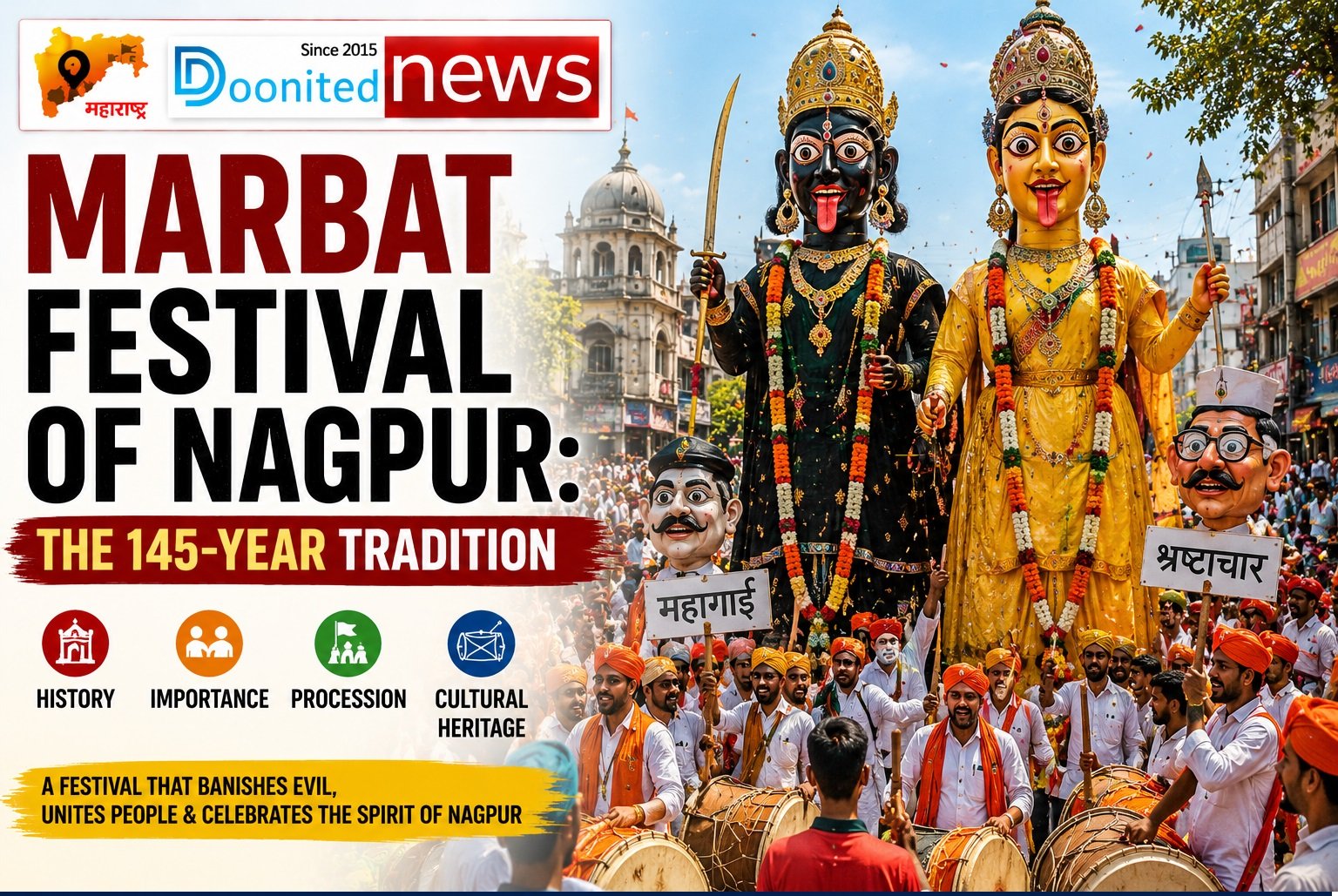
The centrepieces are giant female effigies known as Kali Marbat and Pili Marbat, accompanied by smaller male effigies called Badgyas.
The effigies are carried through the streets in a large procession before being burned.
The traditional cry associated with the festival captures its purpose:
“Ida Pida Gheun Ja Ge Marbat” — traditionally understood as a plea for the Marbat to take away troubles and afflictions.
Maharashtra Tourism describes Marbat Utsav as a distinctive Nagpur celebration that combines tradition, culture and social commentary. It notes that the festival is observed around Tanha Pola and that the effigies represent negative forces or social evils.
The ritual is therefore not simply about watching a procession.
It is about letting go of what society considers harmful.
A Tradition Going Back to the 19th Century
The exact origins of Marbat contain several parallel traditions, and historians and researchers do not present a single universally accepted explanation.
One important narrative connects the festival with rural and farming communities.
The day after Pola was associated with rituals involving small clay figures and symbolic acts intended to drive away disease, insects and evil influences.
Over time, these practices developed into the distinctive Marbat procession of Nagpur.
Another historical interpretation connects the festival with the political environment of British rule.
The Indian Express, citing research and local historians, describes several narratives surrounding the origins of the festival, including a belief that public gatherings associated with religious activity offered people a way to come together during colonial restrictions on assemblies.
That makes Marbat particularly interesting.
It was not merely a religious ritual.
It gradually became a way for ordinary people to express anger, criticism and collective concerns.
Kali Marbat and Pili Marbat: The Two Great Symbols
The two principal Marbats have different histories and interpretations.
Kali Marbat
The Kali Marbat, the black effigy, is traditionally associated with the removal of evil and misfortune.
One local historical interpretation connects the figure with Bakabai, the Bhonsle queen whose role during the British takeover of Nagpur remains controversial in local memory.
Another interpretation connects Kali Marbat with Putana, the mythological demoness associated with the story of Lord Krishna.
These different interpretations coexist within the festival’s folklore.
The Kali Marbat is traditionally made near Nehru Putla Square, and historical accounts place its origins around 1881.
Pili Marbat
The Pili Marbat, or Yellow Marbat, has a particularly strong association with the colonial period.
The effigy is traditionally connected with the image of British rulers and the anger of people who suffered under colonial rule.
The Tarhane Teli community has long been associated with making and carrying the Pili Marbat.
Historical accounts place its introduction around 1885.
The symbolism was powerful:
The people identified an oppressive force, gave it a physical form, paraded it through the streets and finally burned it.
That idea survives even though the political circumstances have completely changed.
Badgyas: The Social Commentary of Nagpur
Perhaps the most fascinating part of modern Marbat is not the giant Marbats themselves.
It is the Badgyas.
These smaller effigies are created by different groups and communities and can represent contemporary problems.
Over the years, Badgyas have addressed subjects such as:
- Inflation
- Unemployment
- Corruption
- Poor roads
- Environmental concerns
- Drug addiction
- Government policies
- Civic problems
- Social injustice
The Indian Express notes that Badgyas traditionally represent social evils and can carry placards highlighting contemporary issues.
This makes Marbat something unusual.
It is simultaneously a festival and a public commentary platform.
A newspaper editorial criticises a problem in words.
A Badgya can criticise it through a giant symbolic figure moving through Nagpur’s streets.
The Marbat Procession: When Old Nagpur Comes Alive
On the day of the festival, the atmosphere changes dramatically in the old parts of Nagpur.
The effigies begin their journey from the places where they have been constructed.
Badgyas arrive first.
The Pili and Kali Marbats eventually come together.
And the procession moves through the historic streets of the city.
The Indian Express reported a procession route of approximately 6.5 kilometres, while Maharashtra Tourism describes the wider procession through the Itwari and East Nagpur areas as extending to around 10 kilometres, reflecting differences in how the route is measured.
The important point is the scale.
This is not a small neighbourhood procession.
It transforms the old city into a giant moving cultural stage.
Nehru Putla: The Meeting Point
One of the most anticipated moments traditionally occurs when the Marbats converge in the old city.
The Nehru Putla area has historically served as a major meeting point.
For many Nagpurians, this convergence is more than a visual spectacle.
The two major Marbats, created by different communities and carrying different historical associations, become part of one procession.
It is a moment that captures the collective nature of the festival.
And then the procession continues toward its final destinations.
The Burning of the Marbats
The climax comes when the effigies are burned.
The fire is symbolic.
It represents the destruction of evil, negativity, disease and social problems.
According to the Indian Express account, the Kali Marbat is traditionally burned near Harihar Mandir, while the Pili Marbat is burned at Naik Talao. Other Marbats and Badgyas may be burned near their respective places of origin.
The flames therefore represent the final stage of the journey.
The problem has been identified.
It has been carried through the city.
And finally, it is symbolically destroyed.
Why Nagpur’s Marbat Is Different
Maharashtra has hundreds of festivals.
Ganeshotsav is celebrated on an enormous scale.
Gudi Padwa represents the Marathi New Year.
Pola honours the contribution of cattle to agriculture.
But Marbat has a personality of its own.
It combines:
ritual + history + folklore + satire + public participation + social criticism.
That combination makes it one of Nagpur’s strongest cultural signatures.
Maharashtra Tourism itself describes Marbat as a platform through which contemporary social and political issues can be expressed.
From Colonial Protest to Modern Social Commentary
The most remarkable aspect of Marbat is how its meaning has evolved.
During the colonial period, the festival acquired political symbolism.
After Independence, there was no British government to represent the old target of protest.
So the tradition changed.
The “evil” represented by Marbats and Badgyas could now be inflation, corruption, unemployment, poor infrastructure or another issue troubling ordinary people.
This ability to adapt may be one reason the festival has survived for so long.
The form remains traditional.
The message can change.
2026: NMC Gives the Festival a Major Push
The Marbat festival is now entering another important phase.
The Nagpur Municipal Corporation has allocated around ₹2 crore for the 2026 Marbat-Badgya festival—the first time the civic body has made such a large financial provision for the event, according to the Times of India.
The plan includes improving the procession route, removing potholes and hanging electrical wires, arranging drinking water and electricity, coordinating traffic management and creating facilities for visitors.
The civic administration also wants to promote Marbat as a cultural attraction capable of drawing national and international visitors.
That could be significant for Nagpur.
The city has many remarkable cultural assets, but Marbat is particularly distinctive because its history is tied directly to the city’s streets and communities.

Tradition Versus Commercialisation
Greater promotion also brings a challenge.
Can Marbat become a major cultural attraction without losing its traditional character?
That question matters.
The festival has survived because ordinary communities have carried it forward across generations.
If it becomes only a tourism spectacle, something important could be lost.
But if preservation is combined with better roads, safety, crowd management, documentation and cultural education, the festival could become one of Nagpur’s strongest heritage attractions.
The objective should not be to change Marbat.
It should be to protect the tradition while allowing more people to understand it.
A Festival That Gives Ordinary People a Voice
Perhaps this is the real reason Marbat remains relevant.
A city is full of people who have something to say.
They worry about prices.
They worry about roads.
They worry about jobs.
They worry about corruption.
They worry about the environment.
They worry about their children’s future.
Marbat gives some of those concerns a physical form.
A Badgya can carry the message.
A procession can carry it through the city.
And thousands of people can see it.
That makes Marbat more than a festival.
It is a people’s cultural newspaper—written in bamboo, paper, colour, satire and fire.
Nagpur’s Living Heritage
Today, when people talk about preserving heritage, the conversation often focuses on buildings, monuments and old photographs.
But heritage is also something people do.
Marbat is living heritage.
It is made every year.
It is carried every year.
It is watched by new generations every year.
And its social messages change with the times.
That is why the festival deserves documentation, responsible promotion and serious cultural attention.
The giant effigies may disappear in the flames at the end of the procession.
But the tradition survives.
An Editor’s View
Nagpur has many symbols.
Oranges.
Deekshabhoomi.
Zero Mile.
The Vidarbha identity.
The historic old city.
And, once every year, the towering figures of Kali Marbat, Pili Marbat and the Badgyas.
They represent something deeper than spectacle.
For more than a century, Nagpur’s people have used this tradition to say:
Take away our troubles.
The troubles may have changed.
The rulers have changed.
The city has changed.
But the desire to remove what harms society remains the same.
That is why Marbat continues to matter.
It is history, but it is not trapped in history.
It is tradition, but it continues to speak about the present.
And when those giant effigies move through the streets of old Nagpur, they carry with them something that every city needs—a reminder that culture belongs to the people who keep it alive.