
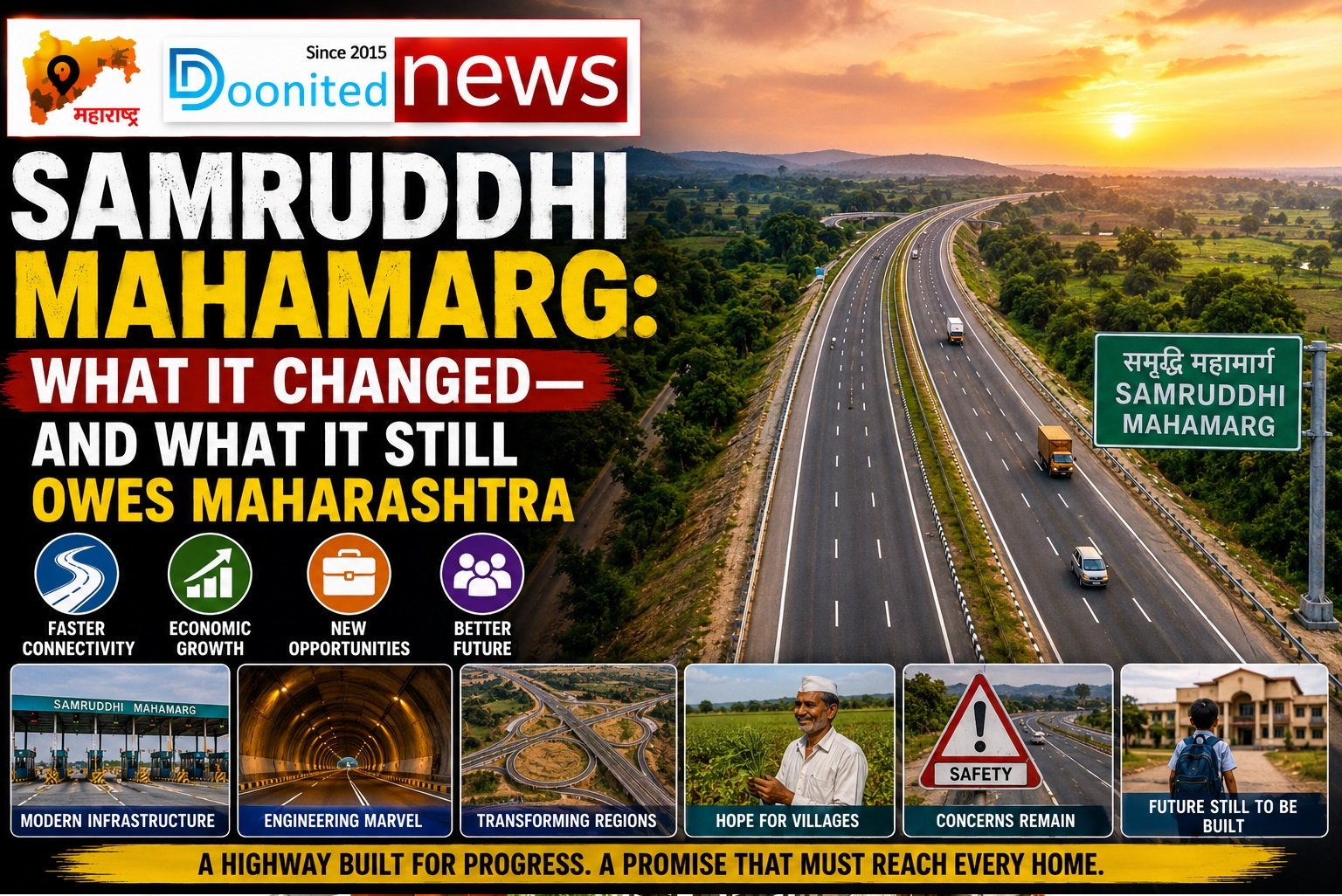

Samruddhi Mahamarg: How Nagpur-Mumbai Expressway Was Built, What It Changed—and What It Still Owes Maharashtra
By Pradeep Banerjee, Editor | Doonited News
Nagpur | Maharashtra
For decades, the distance between Nagpur and Mumbai was more than a measurement on a map.
It was a measure of time.
A journey that could take roughly 16–17 hours by road has now been transformed by one of Maharashtra’s most ambitious infrastructure projects—the Hindu Hrudaysamrat Balasaheb Thackeray Maharashtra Samruddhi Mahamarg, popularly known as the Nagpur-Mumbai Samruddhi Expressway.
The 701-kilometre, six-lane, access-controlled greenfield expressway was conceived in 2016, began construction in 2018 and became fully operational from Nagpur to Mumbai on June 5, 2025. The final 76-kilometre Igatpuri–Amane section completed the corridor.
But this is not simply the story of a road.
It is the story of land acquisition, engineering, politics, finance, villages, farmers, economic hopes—and a troubling road-safety record.
And the most important question today is no longer whether Maharashtra could build the expressway.
It is:
Has the Samruddhi Mahamarg delivered the prosperity promised to the people living along it?

The Idea: A Road Designed to Change Maharashtra’s Geography
The Samruddhi Mahamarg was conceived during Devendra Fadnavis’s first term as Maharashtra Chief Minister in 2016.
The idea was ambitious: create a modern, access-controlled highway linking Nagpur, Maharashtra’s winter capital, with Mumbai, the country’s financial centre, while connecting major regions in between.
The project was designed to directly pass through 10 districts and improve connectivity to another 14 districts, potentially affecting economic activity across approximately 24 districts.
The route crosses Vidarbha, Marathwada and North Maharashtra before reaching the Mumbai Metropolitan Region.
That geography is important.
For decades, Maharashtra’s strongest economic activity has been concentrated around Mumbai, Pune and parts of western Maharashtra.
The Samruddhi vision was to create a faster economic spine through regions that historically had fewer high-speed connections to the state’s major markets.
From ₹46,000 Crore to More Than ₹61,000 Crore
The financial journey of the project is almost as interesting as its construction.
The initial estimated cost was around ₹46,000 crore.
By 2018, the projected cost had risen to approximately ₹55,335 crore. Contemporary reporting attributed the increase to factors including higher land-acquisition compensation and additional construction requirements.
By the time the entire 701-km corridor became operational in 2025, reporting by The Indian Express put the overall project cost at more than ₹61,000 crore.
That means the final cost is substantially higher than the original estimate.
But judging a project of this scale only by its construction bill would be incomplete.
The proper question is whether the infrastructure generates enough economic activity, employment, logistics efficiency, tourism and regional investment to justify that expenditure over decades.
That answer will take time.

The Land Acquisition Story
Perhaps the biggest challenge was not concrete, asphalt or tunnels.
It was land.
The project required more than 8,800 hectares of land and affected nearly 24,000 farmers across 10 districts, according to reporting on the project.
Initially, there was strong opposition in some areas.
Farmers feared losing agricultural land and questioned the project’s impact on their livelihoods and communities. Environmental concerns were also raised because the route crossed areas with forests and sensitive terrain.
The government eventually pursued a combination of compensation and negotiated acquisition.
Some farmers received substantial compensation.
In some areas, land values subsequently increased.
But compensation and development benefits are not necessarily the same thing.
A farmer can receive money for land and still ask:
What happens to the village economy after the land is gone?
That question remains important.
Construction: From Flat Vidarbha to the Western Ghats
Building a 701-kilometre greenfield expressway across Maharashtra was never going to be a simple road project.
The eastern sections pass through relatively open terrain.
The western end is dramatically different.
The final Igatpuri–Amane section required major engineering work through hilly and forested terrain, including five twin tunnels totalling about 10.73 kilometres and 17 viaducts with a combined length of more than 10.56 kilometres.
The project also had to deal with heavy rainfall, difficult access and complex geological conditions in the Western Ghats.
That final section was ultimately the missing piece that allowed vehicles to travel continuously between Nagpur and Mumbai.

December 2022: The First Big Opening
The first major section of the expressway opened in December 2022.
Prime Minister Narendra Modi inaugurated the 520-kilometre Nagpur–Shirdi section, marking the beginning of public operations on the new corridor.
For people in Vidarbha, the opening was particularly significant.
Nagpur was suddenly connected to central Maharashtra through a high-speed access-controlled corridor.
But Mumbai was still not directly reachable through the entire Samruddhi route.
That changed in 2025.
June 5, 2025: Nagpur Finally Connected to Mumbai
The final 76-kilometre Igatpuri–Amane stretch was inaugurated on June 5, 2025.
With that section open, the entire 701-kilometre corridor became operational.
The journey between Nagpur and Mumbai, which could previously take roughly 16–17 hours by road, was projected to fall to around eight hours, depending on traffic, stops and conditions.
That is the project’s most obvious achievement.
Time.
For business travellers, truck operators, tourists, families and emergency transport, saving several hours can have enormous economic value.

What Does the Expressway Actually Give Maharashtra?
The benefits go beyond faster travel.
1. Faster movement of goods
A modern access-controlled highway can reduce transit time between production centres and major markets.
That can benefit:
- Agriculture
- Food processing
- Manufacturing
- E-commerce
- Logistics
- Pharmaceuticals
- Automobile industries
- Retail supply chains
For a state as geographically large as Maharashtra, time is an economic resource.

2. A New Route for Vidarbha’s Economy
Nagpur has historically been described as geographically central to India.
But being geographically central does not automatically mean being economically central.
The Samruddhi corridor strengthens Nagpur’s connection to Mumbai and to the industrial and commercial centres along the route.
The Union government has described the expressway as a project intended to support development across Vidarbha, Marathwada and North Maharashtra.
That could eventually help Nagpur become an even stronger logistics and distribution hub.
3. Tourism Gets a Faster Highway
The route also connects travellers to major tourist destinations including:
- Shirdi
- Ajanta-Ellora
- Lonar
- Verul
- Nashik region
- Vidarbha destinations
The central government has specifically highlighted the expressway’s connectivity to major tourism locations.
For smaller towns and villages near these destinations, increased tourist movement can create opportunities for:
homestays, restaurants, local transport, handicrafts, farm products and guides.
But again, opportunity does not automatically become income.
Local businesses need to be prepared to capture it.
What Does Samruddhi Mean for Villages?
This may be the most important part of the story.
An expressway does not automatically make a village prosperous.
A village benefits when it has access to the expressway and an economic ecosystem around that access.
The government has envisioned feeder roads, interchanges and development centres around the corridor.
The broader project concept has included Krushi Samruddhi Kendras, intended to support agro-processing, commercial activity and new urban centres.
That could eventually transform some locations along the corridor into logistics and agricultural-processing hubs.
But there is an important limitation.
The Samruddhi Mahamarg is access-controlled.
A farmer cannot simply drive a tractor onto the expressway from his field.
The benefit depends on:
village road → feeder road → interchange → expressway → market
If the first two links are poor, the expressway’s benefit becomes much smaller.

The Farmer’s Reality: The Highway Has Not Changed Every Village Yet
This is where the story becomes more complicated.
In 2024, Hindustan Times spoke to farmers along the corridor who said they had not yet experienced major economic benefits from the expressway.
Some pointed out that Vidarbha’s major crops—such as cotton, soybean and pulses—do not necessarily require expensive expressway transportation to reach nearby markets.
Other farmers said the region lacks the necessary ecosystem of cold storage, aggregation, processing units and farmer-producer organisations needed to send large quantities of perishable produce to distant markets.
This is an important reality check.
A highway alone cannot create an agricultural revolution.
A farmer also needs:
- Cold storage
- Warehouses
- Processing units
- Packaging
- Aggregation
- Reliable feeder roads
- Farmer Producer Organisations
- Transport services
- Market information
- Buyers
Only then does the expressway become a genuine economic multiplier.
The Big Opportunity: From Farm to Mumbai Market
Imagine a farmer in Vidarbha producing high-quality oranges, vegetables or processed food.
Today, the real challenge is not merely distance.
It is the entire supply chain.
If a future agricultural hub near the Samruddhi corridor provides:
collection → grading → cold storage → processing → packaging → expressway logistics
then a farmer could potentially access markets much farther away.
That is when the expressway begins to change village economics.
The road is already there.
The supporting ecosystem is the next challenge.
The Dark Side: A Highway Built for Speed Is Also Seeing Fatal Crashes
There is a serious downside that Maharashtra cannot ignore.
The Maharashtra Highway Traffic Police’s official statistics show that the Samruddhi Expressway recorded:
| Year | Total Accidents | Fatal Accidents | Deaths |
|---|---|---|---|
| 2023 | 134 | 81 | 151 |
| 2024 | 137 | 96 | 126 |
| 2025* | 185 | 128 | 152 |
*2025 figures are provisional in the Highway Police data.
The increase in total accidents from 137 in 2024 to 185 in 2025 represents approximately:
(185 − 137) ÷ 137 × 100 = 35.0%
Fatal accidents increased from 96 to 128, or approximately:
(128 − 96) ÷ 96 × 100 = 33.3%
Deaths increased from 126 to 152, or approximately:
(152 − 126) ÷ 126 × 100 = 20.6%
These are not small fluctuations.
They are a major road-safety warning.
2026: The Warning Has Continued
The situation has not improved enough in 2026.
According to Maharashtra Highway Police data reported by The Times of India, 84 people died on the Samruddhi Expressway between January and June 2026, compared with 64 in the same period of 2025.
That is a rise of:
(84 − 64) ÷ 64 × 100 = 31.25%
The report said Highway Police responded with intensified enforcement, including 24-hour drunk-driving checks at major entry points.
Officials have also identified rear-end collisions as a major category of fatal crashes, with driver fatigue, loss of control and drunk driving among reported contributing factors.

Why Are Accidents Happening?
It would be too simplistic to blame the road alone.
An access-controlled expressway removes many traditional highway hazards such as random intersections, pedestrians and frequent local crossings.
But very high-speed roads introduce different risks.
Driver fatigue
Long stretches of monotonous highway can cause drowsiness.
Excessive speed
A vehicle travelling at very high speed has less time to react.
Tyre failure
At high speeds, tyre defects can have severe consequences.
Rear-end collisions
A distracted or fatigued driver may fail to notice a slower vehicle.
Alcohol
This remains one of the most dangerous combinations with high-speed driving.
Vehicle maintenance
A poorly maintained vehicle is far less forgiving at expressway speeds.
The solution therefore requires a combination of road engineering, enforcement, vehicle checks, driver education and emergency response.

There Is Also Evidence of Improvement
The accident story is serious, but it is not correct to say that nothing has been done.
The SaveLIFE Foundation reported a 29% reduction in road-crash fatalities on the Samruddhi corridor in 2024 compared with 2023—from 151 deaths to 107 under the dataset cited in its January 2025 release. It attributed the improvement to interventions involving engineering, enforcement and emergency response.
However, the Maharashtra Highway Police’s later full-year figures show 126 deaths in 2024, so the different figures indicate differences in datasets or reporting periods/methodology.
For this article, the Highway Police figures are the more appropriate official baseline for year-to-year comparison.
The larger lesson remains valid:
Road safety interventions can work—but they need to keep pace with traffic growth.
The Biggest Pros of Samruddhi Mahamarg
Faster travel
Nagpur-Mumbai road travel has been dramatically reduced.
Better regional connectivity
The corridor links major regions of Maharashtra.
Logistics potential
Manufacturers and distributors can move goods faster.
Tourism
Faster access can increase tourist traffic to destinations along the route.
Investment
Industrial and logistics companies may find corridor locations more attractive.
Employment
Construction, logistics, hospitality, warehousing and processing can create jobs.
Urban development
New economic centres can emerge around interchanges.
Strategic connectivity
The road strengthens links between Vidarbha and western Maharashtra.
The Cons Cannot Be Ignored
High accident risk
The recent fatality figures are deeply concerning.
Toll cost
Frequent users must factor tolls into travel expenses.
Limited direct village access
Because the road is access-controlled, feeder infrastructure becomes crucial.
Land acquisition
Thousands of farmers surrendered land for the project.
Unequal economic benefits
Some villages may benefit much sooner than others.
Environmental pressure
Large greenfield infrastructure inevitably creates ecological concerns.
Development pressure
Unplanned construction around interchanges could create congestion and land speculation.
Missing ecosystem
Agriculture needs storage, processing and aggregation—not merely a fast road.
What Maharashtra Should Do Next
The next chapter of Samruddhi should not be about building more kilometres.
The road is already built.
The next task should be building the economy around the road.
Maharashtra should focus on:
1. Agricultural processing hubs
Create modern food-processing clusters close to major interchanges.
2. Cold-chain infrastructure
Particularly for fruits, vegetables and other perishables.
3. Farmer Producer Organisations
Help small farmers combine production and negotiate with larger buyers.
4. Better feeder roads
A world-class expressway is of limited value if the village road leading to the interchange is poor.
5. Rural logistics centres
Warehousing and aggregation facilities can allow village producers to participate in interstate supply chains.
6. Road-safety enforcement
24-hour checks for drunk driving, fatigue-related violations and speeding should continue.
7. Emergency response
Ambulances, trauma-care access and rapid incident response are essential on a high-speed corridor.
The Real Test: Will the Village See the Highway’s Prosperity?
This is the question that should define the next decade.
A highway can make a city richer.
But can it make the villages along its route richer too?
That depends on policy.
If the state builds agricultural nodes, warehouses, processing units, feeder roads and logistics centres, the answer could be yes.
If the expressway remains primarily a fast route between big cities, many villages may remain spectators to the economic activity passing them at 120 kilometres per hour.
That would be the biggest missed opportunity of Samruddhi.
An Editor’s View: The Road Is Complete. The Real Work Has Begun.
The Samruddhi Mahamarg is undeniably an extraordinary engineering achievement.
A 701-kilometre greenfield expressway now connects Nagpur and Mumbai.
It has reduced travel time.
It has created a new economic spine.
It has opened possibilities for tourism, logistics and industrial development.
But infrastructure should never be judged only by its size.
A ₹60,000-crore-plus road is successful only when the benefits reach beyond the vehicles travelling on it.
The farmer in Vidarbha should see a better market.
The village near an interchange should see new employment.
The young person should find a logistics or hospitality job nearby.
The small food processor should gain access to distant markets.
The tourist should discover a lesser-known Maharashtra destination.
And every family travelling on the expressway should be able to return home safely.
The Samruddhi Mahamarg has solved the problem of distance.
Now Maharashtra must solve the problems of access, opportunity and safety.
That is the real meaning of Samruddhi.
Prosperity should not simply travel through Maharashtra. It should reach the people of Maharashtra.