
Dahi Handi in Maharashtra: When the Streets Turn into a Celebration of Krishna, Courage and Teamwork
By Pradeep Banerjee, Editor | Doonited News
Maharashtra | Doonited News
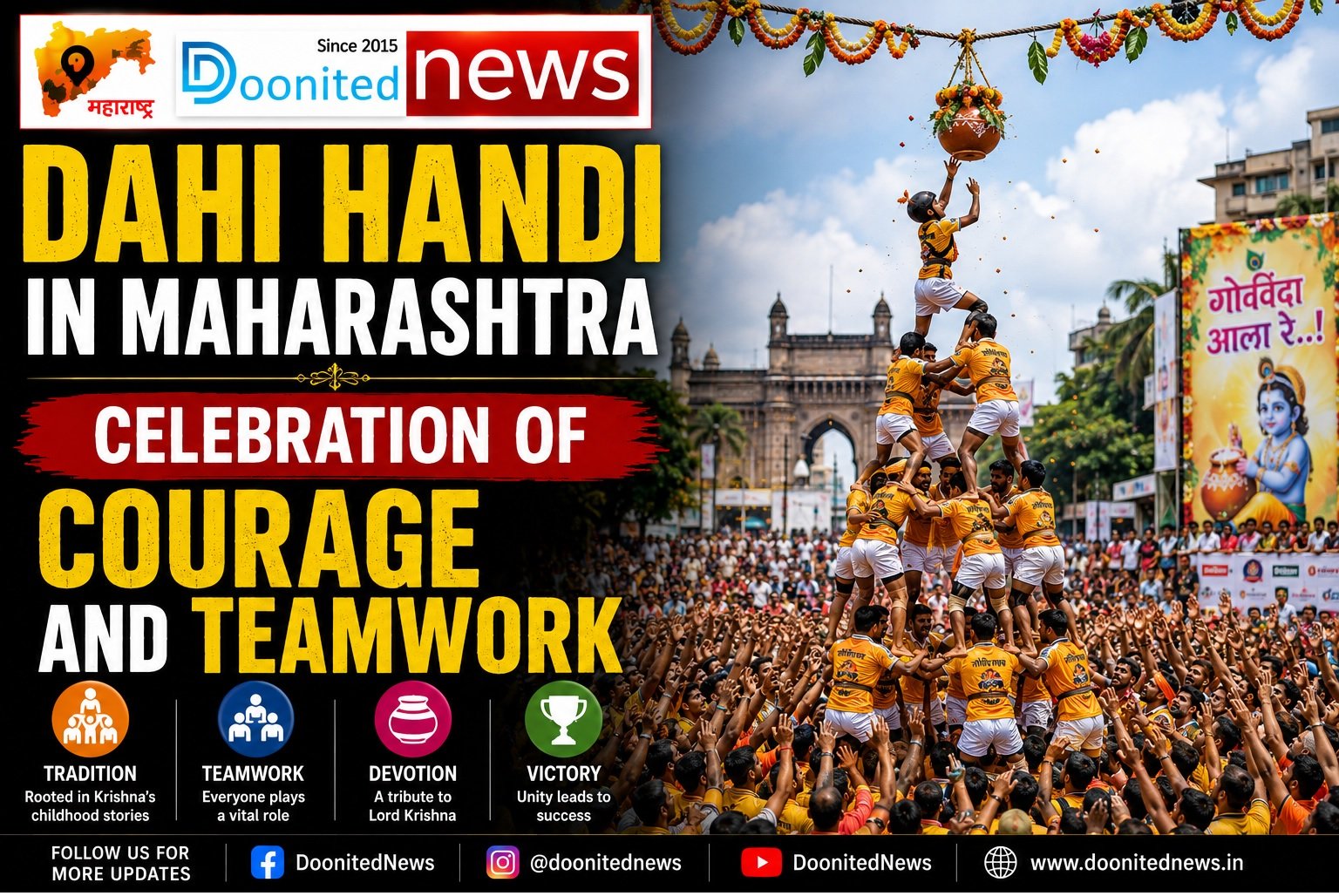
There is a moment in Maharashtra when the sound of drums becomes louder, the streets fill with colour, and hundreds of eyes turn upward.
High above the crowd hangs a small earthen pot.
Below it, a group of young men and women—Govindas—prepare to build a human pyramid.
One climbs onto another. The formation rises. The crowd begins shouting, “Govinda Ala Re!”
And then, in a moment that lasts only seconds, the topmost Govinda reaches the handi and breaks it.
Curd, butter, flowers and sometimes coins spill over the pyramid.
The crowd erupts.
This is Dahi Handi, one of Maharashtra’s most energetic public festivals and a celebration that combines devotion, folklore, physical skill, teamwork and community spirit.

From Krishna’s Childhood Story to Maharashtra’s Streets
The cultural inspiration behind Dahi Handi comes from stories of young Lord Krishna, remembered in Hindu tradition for his love of butter and curd.
According to the traditional story, Krishna and his friends would try to reach pots of dairy products kept high above the ground. They formed human pyramids to reach what was otherwise beyond their height.
Today’s Dahi Handi celebrations recreate that playful image.
Maharashtra Tourism describes the festival as a celebration of Krishna’s mischievous childhood and says the human pyramid represents teamwork, perseverance, devotion and communal harmony.
The festival is therefore not simply about breaking a pot.
The real story is about reaching something difficult through collective effort.
Why Is the Pot Hung So High?
The height is part of the symbolism.
The handi represents something valuable that cannot be reached by one person standing alone.
The Govindas must depend upon one another.
The strongest participants form the lower levels.
Others climb carefully above them.
The lightest and most agile participant generally reaches the top.
The final person breaks the pot.
The achievement belongs to the entire team, not just the person holding the stick.
That is why Dahi Handi has become such a powerful symbol of cooperation.
One person cannot do it alone.

Govindas: The People Behind the Festival
The participants are popularly known as Govindas or members of a Govinda Pathak.
For many teams, the festival is not a one-day activity.
Training begins well before Janmashtami.
Participants practise balance, coordination, strength and formation.
A large pyramid requires every member to understand his or her position. A mistake by one person can affect the entire formation.
That makes the activity physically demanding as well as highly coordinated.
The Maharashtra Tourism Department describes Govinda teams as groups that demonstrate physical strength, balance and coordination while attempting to break the suspended handi.
Mumbai: Where Dahi Handi Became a Mega Public Spectacle
If there is one place where Dahi Handi has reached extraordinary scale, it is Mumbai and the wider Mumbai Metropolitan Region.
On festival day, neighbourhoods across Mumbai and Thane become stages.
Dadar.
Worli.
Ghatkopar.
Borivali.
Thane.
From small housing societies to large public mandals, Govinda teams travel from one celebration to another.
Historical reporting by The Indian Express has documented large numbers of Govinda groups moving through Mumbai’s streets, with major organisers offering substantial cash prizes for successful pyramids.
The competition has transformed Dahi Handi into something resembling a sporting event.
Teams train.
Organisers announce prizes.
Crowds cheer.
Music and dhol beats accompany the attempts.
And the successful breaking of the handi becomes the climax.

The Prize Has Changed the Festival
Cash prizes have become an important part of modern Dahi Handi.
Large public events can offer prizes worth lakhs of rupees, attracting experienced teams and increasing the competitive character of the festival.
For some Govinda Pathaks, this has created a professional-style training culture.
But it has also generated debate.
How high should the pyramid be?
How much risk is acceptable?
Should children participate?
What safety equipment should be compulsory?
These questions have become increasingly important as the scale of competitions has grown.
Pune: Tradition, Community and a Changing Celebration
Pune’s Dahi Handi celebrations carry a different character.
The city has a strong tradition of public festivals, mandals and community participation, and Dahi Handi has become part of the broader Janmashtami celebrations.
Here, as in Mumbai, the festival combines religious devotion with music, processions, public gatherings and competitive Govinda teams.
But the underlying idea remains unchanged:
Krishna’s playful story becomes a collective community performance.
Dahi Handi Is Also About Maharashtra’s Youth
Walk through a Dahi Handi celebration and one thing immediately becomes obvious.
The festival belongs strongly to the younger generation.
Students, working professionals and local residents form teams and train together.
The festival creates an unusual meeting point between people who might otherwise have little reason to interact.
A college student may stand beside a shopkeeper.
An office employee may train with a neighbourhood friend.
A teenager may watch experienced Govindas preparing the formation.
For a few hours, the social divisions of everyday life become less visible.
The pyramid has one objective.
Reach the handi.
Women Are Becoming an Increasingly Visible Part of Dahi Handi
The traditional image of Dahi Handi often focused on young men.
That picture has changed.
Women and girls increasingly participate in Govinda groups and human-pyramid events, adding another dimension to the festival.
Recent coverage of Dahi Handi has documented participation by both young men and women, reflecting the broader transformation of the festival into a community activity rather than an exclusively male tradition.
This change is significant because festivals remain alive only when new generations find their own place within them.
Dahi Handi is doing exactly that.
The Handi Is More Than a Pot
Traditionally, the handi is filled with curd and butter, while some celebrations also include other food items, fruits or coins. Maharashtra Tourism describes the decorated clay pot as being filled with curd, butter and other offerings before being suspended above the ground.
But symbolically, the handi represents something larger.
It is a goal.
Something difficult.
Something that requires people to work together.
The pyramid is the journey.
Breaking the pot is the achievement.
And the celebration that follows is shared by everyone.
The Sound of “Govinda Ala Re”
There are few festival chants as instantly recognisable in Maharashtra as:
“Govinda Ala Re!”
It is not merely a slogan.
It is the soundtrack of the event.
Dhols and traditional drums build the atmosphere.
Crowds clap and shout.
Water is sometimes sprayed on the Govindas, making the already difficult climb even more challenging.
The energy rises with every failed attempt.
And when the pyramid finally reaches the pot, the entire street seems to celebrate together.
Historical accounts of Mumbai’s celebrations describe the streets filled with Govindas, music, crowds and repeated attempts to reach the suspended handi.
The Risk Behind the Celebration
There is another side to Dahi Handi that cannot be ignored.
Human pyramids involve genuine physical risk.
Participants can fall.
Crowds can become difficult to control.
Wet surfaces can make climbing harder.
The increasing height of pyramids has historically raised concerns about serious injuries.
During one Mumbai Dahi Handi celebration in 2023, BMC data reported 107 Govindas injured by 9 p.m. amid heavy rain.
That is why safety has increasingly become part of the festival conversation.
Safety Must Come Before the Prize
The excitement of Dahi Handi should never come at the cost of a participant’s life or long-term health.
Safety arrangements can include:
- Proper medical teams
- Ambulances at major venues
- Protective helmets
- Safety mats or nets
- Crowd-control barriers
- Adequate space around the pyramid
- Trained participants
- Weather-related precautions
- Responsible limits on pyramid height
- Strict supervision of young participants
Maharashtra’s legal and administrative approach to Dahi Handi has evolved over the years, including debates and court interventions concerning participant age and pyramid height. In 2022, the Maharashtra government announced that Dahi Handi would be recognised as an adventure sport, with provisions connected to sports benefits and relief in cases of injury or death.
The recognition also reinforces an important point:
Dahi Handi is a cultural tradition, but its physical component must be treated with the seriousness of a demanding sporting activity.
When Politics Enters the Dahi Handi Ground
Modern Dahi Handi celebrations have also developed a political dimension.
Large public events are sometimes organised or sponsored by political leaders and parties.
The size of the crowd, celebrity appearances and prize money can make a Dahi Handi event an important platform for public outreach.
This is not a new phenomenon.
Historical reporting has documented the involvement of political leaders in major Mumbai and Thane Dahi Handi celebrations.
But politics does not define the festival.
For the ordinary Govinda standing in the street, the reason for participating is usually much simpler:
faith, friendship, excitement and the pride of breaking the handi together.
Dahi Handi Is Maharashtra’s Teamwork Festival
Perhaps the greatest lesson of Dahi Handi is hidden inside the pyramid.
Look at the person standing at the bottom.
He or she may never touch the handi.
Yet without that person, the pyramid cannot rise.
Look at the participant in the middle.
That person carries the weight of those above.
And finally, look at the Govinda at the top.
The entire team carries that person toward the goal.
The victory belongs to everyone.
That is why Dahi Handi has meaning beyond the religious story that inspired it.
It teaches that reaching the highest point requires people at every level.

From Krishna’s Vrindavan to Maharashtra’s Streets
The original story belongs to the world of Krishna’s childhood.
The modern celebration belongs to Maharashtra.
Between those two lies a remarkable cultural journey.
A simple story of a child reaching for butter has become one of India’s most spectacular public festival traditions.
Mumbai has made it a mass event.
Thane has turned it into a competitive celebration.
Pune has woven it into its strong mandal culture.
And towns and cities across Maharashtra have created their own versions.
The form may differ.
The spirit remains the same.
A Festival That Keeps Evolving
Traditions survive when they are allowed to evolve without losing their core meaning.
Dahi Handi has changed dramatically.
The prizes are larger.
The crowds are bigger.
Professional training has increased.
Women participate more visibly.
Corporate sponsorship and political involvement have expanded.
Safety regulations have become more important.
Yet the central image remains exactly the same:
Govindas forming a human pyramid to reach Krishna’s handi.
That continuity is what makes the festival special.
Maharashtra’s Day of Joy, Courage and Togetherness
When the final handi breaks, the curd spills down.
The drums become louder.
The crowd celebrates.
The Govindas fall into each other’s arms.
For a moment, the competition disappears.
What remains is celebration.
Dahi Handi is therefore not merely about breaking a pot.
It is about remembering Krishna’s playful childhood.
It is about devotion.
It is about courage.
It is about physical skill.
It is about teamwork.
And it is about the extraordinary ability of a community to turn a simple traditional story into a living public celebration.
In Maharashtra, the festival has become something uniquely its own.
The handi hangs high.
The pyramid rises.
The crowd waits.
And when the pot finally breaks, the message is simple:
Together, we can reach what none of us could reach alone.