
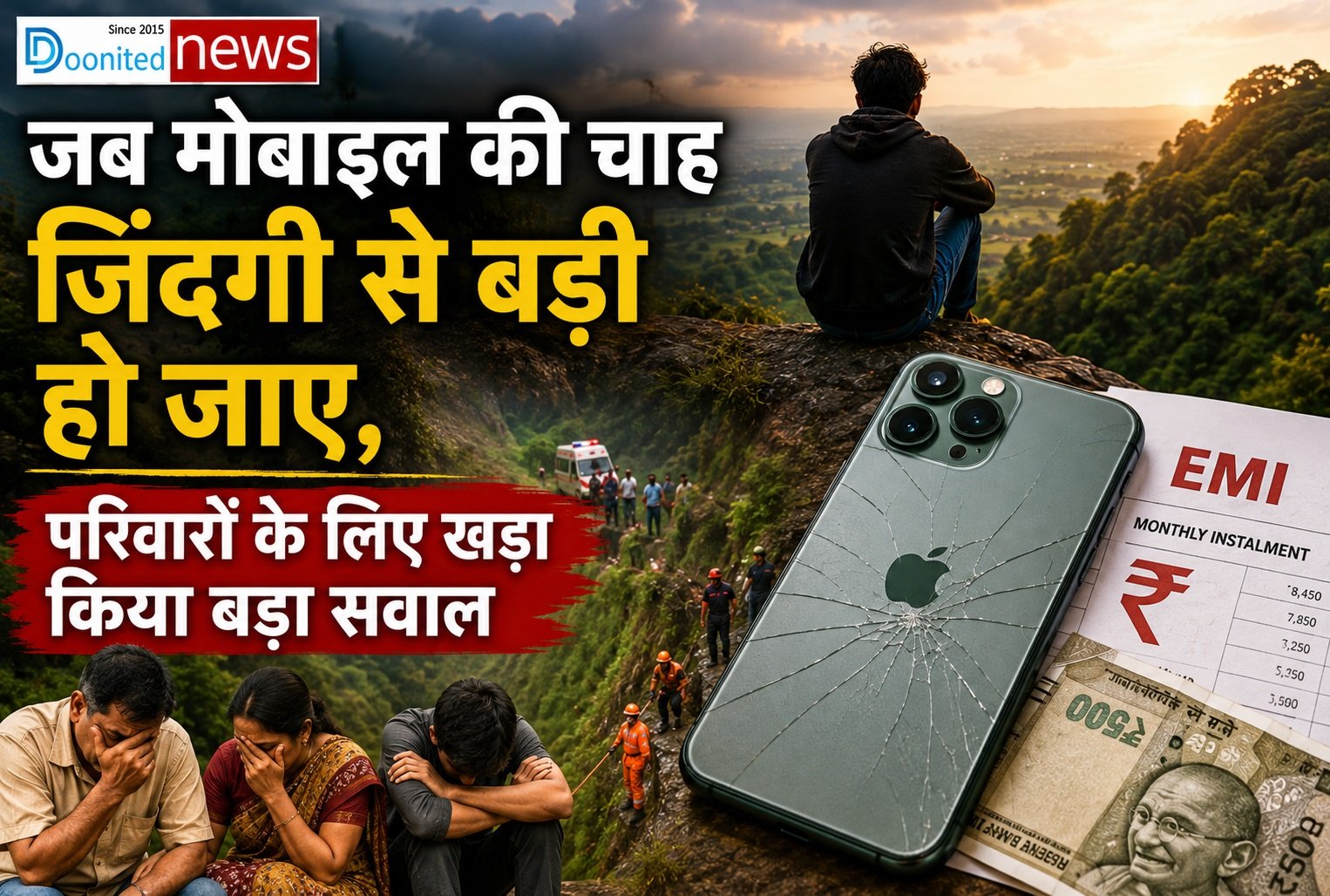

When a Phone Becomes a Status Symbol: Maharashtra Hill Tragedy Raises a Dark Question About Youth, Consumerism and Family Pressure
Doonited News | Maharashtra | Editorial Feature
Chhatrapati Sambhajinagar, Maharashtra: A smartphone was supposed to connect a young man to the world.
Instead, an argument over its instalments ended with three members of one family dead.
The incident in the Tisgaon area of Chhatrapati Sambhajinagar district is being reported as a tragedy linked to an iPhone EMI dispute. Police told media that an 18-year-old, identified in reports as Kunal Chandwade, had purchased an iPhone and was seeking money from his family to meet the instalments. A dispute with his father reportedly followed, after which the teenager went to a hill and threatened to take his own life.
For nearly three hours, family members, villagers, police and fire personnel tried to persuade him to come away from the dangerous location. Reports say his father eventually approached him in an attempt to pull him back; both fell, and the mother subsequently died as well. All three lost their lives.
This is not simply a story about an iPhone.
It is a story about expectations, consumer pressure, emotional distress, family communication and a generation increasingly being taught that what it owns determines what it is worth.

A ₹1 Lakh Phone Should Never Become a Measure of a Young Person’s Worth
The exact model and financial arrangements have been reported differently by various outlets, but the central point is consistent: the teenager had purchased an expensive iPhone and was struggling with the instalments, according to police accounts reported by multiple news organisations.
That should make every parent, teacher and young person stop for a moment.
A smartphone is a device.
It is not education.
It is not character.
It is not success.
It is not social status.
And it certainly is not worth risking a life.
Yet the consumer market increasingly tells young people something different.
Buy the newest phone.
Wear the newest brand.
Show the world what you have.
Upgrade before the previous model becomes old.
Social media adds another layer.
A young person sees what others are displaying and begins to feel that ordinary life is somehow inferior.
The phone that was perfectly adequate yesterday suddenly becomes embarrassing.
The old bike becomes unacceptable.
The ordinary clothes become “cheap.”
The family car becomes a source of embarrassment.
The pressure does not always come directly from parents.
Sometimes it comes from comparison.
The Dangerous Psychology of “I Must Have It”
There is nothing wrong with wanting a good phone.
There is nothing wrong with aspiring to own expensive products.
There is nothing wrong with working hard and eventually buying something luxurious.
The problem begins when want becomes entitlement.
And entitlement becomes desperation.
And desperation becomes emotional crisis.
This is where adults need to pay attention.
A teenager may say:
“Everyone else has it.”
What the parent hears may be:
“I want a phone.”
But what the teenager may actually be communicating is:
“I don’t want to feel inferior to the people around me.”
Those are very different statements.
The first can be answered with money.
The second requires conversation.

EMI Makes Luxury Look Affordable—Until the Bill Arrives
The rise of easy instalment financing has changed consumer behaviour.
A product that appears unaffordable when viewed at its full price can suddenly seem manageable when divided into monthly payments.
That can be useful when used responsibly.
But it can also create an illusion:
“If I can pay the monthly amount, I can afford the product.”
Not necessarily.
The real calculation is:
Monthly EMI × number of instalments + interest/fees, where applicable = actual financial commitment.
If a family is already under financial pressure, even a relatively modest monthly instalment can become a source of conflict.
A recent analysis of the Maharashtra tragedy similarly cautioned that the incident does not establish that the EMI itself caused the deaths, but said the case highlights the wider question of India’s expanding smartphone and consumer-credit culture.
That distinction matters.
An EMI did not “kill” this family.
According to the reported sequence, a family dispute, severe emotional distress and a subsequent fatal incident combined into an unimaginable tragedy.
The investigation must establish the complete circumstances.
The Most Disturbing Part Was Not the Phone
The most disturbing part of the story is what happened after the teenager reached the hill.
For hours, people tried to convince him to step away.
One person reportedly urged him to think about his mother.
Another reportedly offered to arrange an iPhone 15 Pro in an attempt to persuade him to come back. Yet the teenager reportedly remained determined to die.
That detail should frighten society far more than the brand of phone involved.
Because it suggests that, at that moment, the value of the phone was no longer the real issue.
The young man’s emotional state had apparently reached a point where an object that initially triggered the conflict could no longer resolve the crisis.
This is why reducing the story to:
“Teen wanted iPhone, parents refused, tragedy happened”
would be dangerously simplistic.
There may have been underlying emotional or psychological distress.
Police had not established whether the teenager had been experiencing depression, according to the reporting available at the time.
That remains an important unanswered question.

Parents Also Need to Listen—Not Only Lecture
Indian families often have a strong culture of parental authority.
That has advantages.
Children need boundaries.
They need to understand financial limitations.
They need to learn that parents cannot buy everything they demand.
But there is a difference between setting a financial boundary and closing the door to emotional conversation.
A parent should be able to say:
“We cannot afford this.”
And a young person should be able to respond:
“I am disappointed.”
without the conversation becoming a battle over pride, respect or obedience.
The answer to an unaffordable demand is not always another lecture.
Sometimes it is a conversation:
Why do you want it?
What makes this phone so important to you?
Are you worried about what your friends think?
Are you being bullied or mocked?
Are you under pressure from social media?
Is something else bothering you?
These questions may reveal that the phone is only the visible part of a much larger problem.
But Young People Also Need to Hear a Hard Truth
Society must show compassion to young people in distress.
But compassion should not mean removing responsibility.
Young people must learn that:
Parents have financial limits.
No brand is a necessity.
No social-media trend is worth family debt.
No friend’s opinion determines your value.
And most importantly:
A temporary disappointment must never be treated as the end of life.
Life is considerably bigger than the object someone cannot afford today.
The phone can be bought tomorrow.
Or next year.
Or never.
A life cannot be replaced.
The Tragedy Also Raises Questions About Crisis Response
The reported standoff lasted roughly three hours, during which people attempted to persuade the teenager to move away from danger. Fire personnel were also involved, and reports say safety equipment was deployed.
That raises a legitimate public-safety question:
When someone is threatening suicide from a dangerous height, what specialised crisis-response protocol should be activated?
This is not about blaming the people who tried to save him.
They were confronting an extraordinarily difficult situation.
It is about whether cities and districts need better coordinated systems involving:
- Police crisis negotiators
- Fire and rescue teams
- Trained mental-health professionals
- Safety equipment
- Rapid access to emergency medical care
- Controlled access to the site
- Family-support teams
A person in acute emotional crisis may not respond to ordinary reasoning.
Crisis intervention is a specialised skill.
And Then There Is the Social-Media Problem

The Maharashtra incident also arrives at a time when phones have become much more than communication devices.
They are:
- Cameras
- Entertainment systems
- Status symbols
- Shopping platforms
- Banking tools
- Gaming devices
- Social identities
- Windows into other people’s lifestyles
A young person can scroll through hundreds of carefully curated images every day.
Someone is travelling.
Someone has a new phone.
Someone has a new car.
Someone is wearing expensive clothes.
Someone is eating at an expensive restaurant.
Someone is showing a luxury lifestyle.
What is usually missing?
The debt.
The family arguments.
The anxiety.
The failures.
The ordinary days.
Social media shows the highlight reel.
Young people sometimes compare it with their entire life.
That is an unfair comparison.
We Are Raising Consumers Before We Raise Citizens
This is the larger editorial concern.
Advertising tells young people what they should buy.
Influencers tell them what they should wear.
Social media tells them what they should look like.
Algorithms tell them what they should desire next.
Credit systems tell them they can pay later.
And then families are expected to explain why the money is not available.
Something has gone badly wrong when an 18-year-old’s sense of self becomes connected to a consumer product.
This is not an attack on Apple.
The same criticism applies to every luxury smartphone brand, fashion label, automobile company and lifestyle product.
The problem is not one company.
The problem is a culture that increasingly confuses consumption with achievement.

What Should Parents Teach?
Parents should not simply say:
“We cannot afford it.”
They should teach children how to understand money.
Explain:
- Household income
- Monthly expenses
- Savings
- Debt
- EMI
- Interest
- Needs versus wants
- Opportunity cost
For example:
If ₹5,000 a month is spent on an unnecessary EMI for two years:
₹5,000 × 24 months = ₹1,20,000
That money could instead contribute toward education, savings, travel, emergency funds or another meaningful family goal.
Financial literacy should begin before a child gets their first credit-enabled smartphone.
What Should Schools and Colleges Do?
Schools cannot solve every family problem.
But they can teach emotional resilience.
Young people need to learn:
How to handle rejection.
How to handle financial disappointment.
How to handle failure.
How to handle comparison.
How to ask for help.
How to recognise when a friend is in crisis.
And teachers should know how to respond when a student suddenly shows major behavioural changes.
A young person saying:
“I don’t want to live.”
should never be dismissed as drama.
It should be taken seriously.
The Three Deaths Should Not Become a Viral Spectacle
There is another disturbing aspect of modern tragedy.
People record everything.
The Maharashtra incident was witnessed and partly captured on video, and portions circulated online.
News organisations and social-media users must exercise restraint.
A family has died.
This is not entertainment.
Graphic footage, repeated replay of a person’s final moments and sensational captions can cause additional harm to relatives and can potentially affect vulnerable viewers.
The public deserves the facts—not the spectacle.
The Bigger Warning for Parents and Young People
This tragedy should not produce one simplistic conclusion:
“iPhones are dangerous.”
That would miss the point.
Nor should the conclusion be:
“Today’s youth are spoiled.”
That is also too easy.
The real warning is deeper:
Consumer pressure + financial stress + emotional vulnerability + poor communication + impulsive behaviour can create a dangerous combination.
Any one of these factors may be manageable.
Together, they can become catastrophic.
Three people are dead.
A young life has ended.
Two parents who followed their child to protect him are also gone.
No smartphone is worth that.
No EMI is worth that.
No social-media image is worth that.
No argument about money is worth that.
And no family should ever have to discover, after a tragedy, that the argument they thought was about a phone was actually about something much deeper.
The answer is not to demonise young people.
It is not to blame parents.
It is not to blame one brand.
It is not even to blame EMI financing alone.
The answer is to build a culture in which young people understand that their worth is not measured by what they own, and families understand that emotional distress needs to be recognised before it reaches a crisis point.
Parents must learn to say no without humiliation.
Young people must learn to hear no without seeing it as rejection of their entire identity.
Schools must teach emotional and financial resilience.
Companies and financial institutions must encourage responsible consumer credit.
And society must stop celebrating material possessions as proof of success.
Because the most expensive lesson of this Maharashtra tragedy is also the simplest:
A phone can be replaced. Money can be earned again. An argument can be forgotten. A family cannot be brought back.
And when a young person says that death is the only answer, the conversation must stop being about the phone.
It must immediately become about saving the life.
Editorial / Reporting Note
The article does not claim that an iPhone EMI alone caused the three deaths. Police reporting indicates that an argument over the instalment preceded the teenager’s actions, while the full circumstances—including his mental and emotional state—require investigation. Multiple reports identify the deceased as Kunal Chandwade/Chandgude, his father Murlidhar and mother Sangeeta; some reports differ on Kunal’s age (18 or 19), so the article uses 18, which is supported by several current reports.
Photograph recommendation for publication: Use a non-graphic, verified photograph of the Khavdya Dongar/Tisgaon landscape or a general photograph of the hill location, together with a separate symbolic smartphone photograph. Do not publish or reproduce the footage of the teenager’s final moments.