
How Indian-Origin Leaders Reached the Top of Global Business
A boy growing up in Chennai becomes the head of one of the world’s most influential technology companies. An engineer from Hyderabad rises to lead Microsoft. A woman from Kolhapur reaches the top of Chanel. A Kanpur-born engineer helps shape the future of semiconductors.
These are not isolated success stories anymore.
Indian and Indian-origin executives now occupy some of the most influential positions in global business. Their companies span artificial intelligence, cloud computing, pharmaceuticals, semiconductors, cybersecurity, fashion and enterprise software.
Investopedia’s list of 10 prominent Indian CEOs, updated in March 2026, illustrates how far this transformation has travelled. But the more interesting story is not simply the names on the list. It is how talent educated or shaped in India has become part of the leadership architecture of the global economy.
From Hyderabad to Microsoft
Satya Nadella is perhaps the most recognisable example.
Born in Hyderabad, Nadella became Microsoft’s CEO in 2014 and subsequently chairman. His tenure has been strongly associated with Microsoft’s expansion in cloud computing and artificial intelligence. His education included electrical engineering, computer science and an MBA, while his career developed over many years inside Microsoft.
His story demonstrates an important point: reaching the top of a global corporation is rarely about one spectacular breakthrough. It is usually the result of technical knowledge, management experience and the ability to adapt as an industry changes.
Sundar Pichai and the technology generation
Sundar Pichai’s journey from Chennai to the leadership of Google and Alphabet has become one of India’s best-known corporate success stories.
Pichai became Google’s CEO in 2015 and Alphabet’s CEO in 2019. His career has coincided with major changes in search, cloud computing, hardware and artificial intelligence. He studied engineering at IIT and later attended Stanford University and the Wharton School.
For Indian students, his career carries a particularly useful lesson: global careers increasingly reward people who combine technical capability with the ability to understand markets, products and people.
The story extends far beyond technology
It would be misleading to describe the phenomenon simply as an Indian achievement in Silicon Valley.
Vasant Narasimhan leads Swiss pharmaceutical giant Novartis. His career includes work on public-health issues involving malaria and tuberculosis in India, Africa and South America.
Arvind Krishna, an IIT Kanpur graduate, became IBM’s CEO in 2020 and chairman in 2021. His leadership has focused heavily on cloud computing and artificial intelligence, including IBM’s major acquisition of Red Hat.
Sanjay Mehrotra, born in Kanpur, leads semiconductor company Micron Technology. His career in memory and storage technology includes more than 70 patents, according to Investopedia.
And Anirudh Devgan, another IIT graduate, heads Cadence Design Systems, a major company in electronic design automation — technology that sits behind the development of modern chips and complex electronic systems.
These careers reveal something important: India’s global leadership footprint is not confined to software.
Indian women at the global table
Two names on the list are particularly significant.
Leena Nair, born in Kolhapur, became global CEO of Chanel in 2022 after a long career at Unilever. Her background combines engineering education with extensive experience in organisational leadership and human resources.
Reshma Kewalramani, originally from Mumbai, became CEO and president of Vertex Pharmaceuticals in 2020. A physician by training, she has overseen a company involved in advanced medicines, including gene-editing therapies.
Their careers challenge another outdated assumption — that Indian-origin leadership in global corporations is primarily a technology story led by men.
It is much broader than that.
Cybersecurity, software and the changing global economy
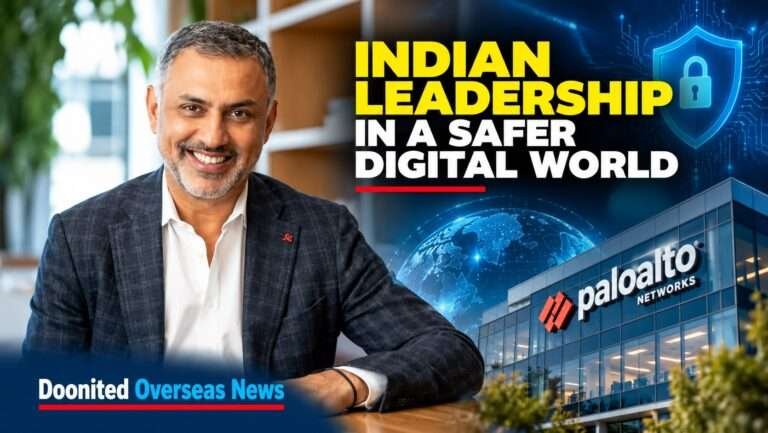
Nikesh Arora, born in Uttar Pradesh, has led Palo Alto Networks since 2018. His career previously included senior roles at Google and SoftBank. Today, cybersecurity is one of the strategic foundations of the digital economy, making leadership in this sector increasingly important.
Shantanu Narayen, meanwhile, has led Adobe for many years and is credited with helping drive its transformation toward subscription-based creative software and cloud services. As of September 2026, he remains Adobe’s CEO; however, Adobe has announced that Anil Chakravarthy will become president and CEO on December 1, 2026, with Narayen moving to executive chair.
That transition itself is a reminder that leadership lists are snapshots, not permanent records.
What India should learn from this success
There is a temptation to turn these stories into simple tales of national pride: Indian talent is conquering the world.
The reality is more nuanced.
These executives built international careers. Many studied abroad, worked for multinational organisations and developed expertise in highly competitive global markets. Their achievements demonstrate the potential of Indian talent, but they also demonstrate the importance of education, institutional opportunity, international exposure and long-term professional development.
The lesson for India is therefore not merely to celebrate successful CEOs.
It is to ask how many more Satya Nadellas, Sundar Pichais, Leena Nairs, Arvind Krishnas and Reshma Kewalramanis could emerge if millions more young Indians receive access to high-quality education, research opportunities, technology and global professional networks.
The DOONITED perspective
The most significant part of this story is not that Indians are running famous companies.
It is that Indian-origin leadership has become increasingly normal at the highest levels of the global corporate system.
That is a structural change, not a publicity moment.
But representation alone should never become the final measure of success. The bigger achievement would be to create an ecosystem in which world-class leadership is not limited to a small group who manage to cross exceptional barriers.
India’s next challenge is to turn individual success stories into a broader talent pipeline.
The global economy has already demonstrated that Indian talent can compete at the highest level.
The question now is how much more of that talent India can develop — and how much of it can eventually build globally influential organisations from India itself.

World Beyond the News
Bees Communicate Where Food Is
Honeybees use movement patterns known as waggle dances to communicate information about food locations.
Street Food Reflects Local History
Many famous street foods developed from migration, trade, local ingredients and the everyday needs of working communities.
A Day on Venus Is Extremely Long
Venus rotates so slowly that one rotation relative to distant stars takes longer than its trip around the Sun.
Human Achievement Continues to Push Limits
Athletes, engineers, scientists and explorers regularly establish new benchmarks in speed, endurance, scale and precision.