
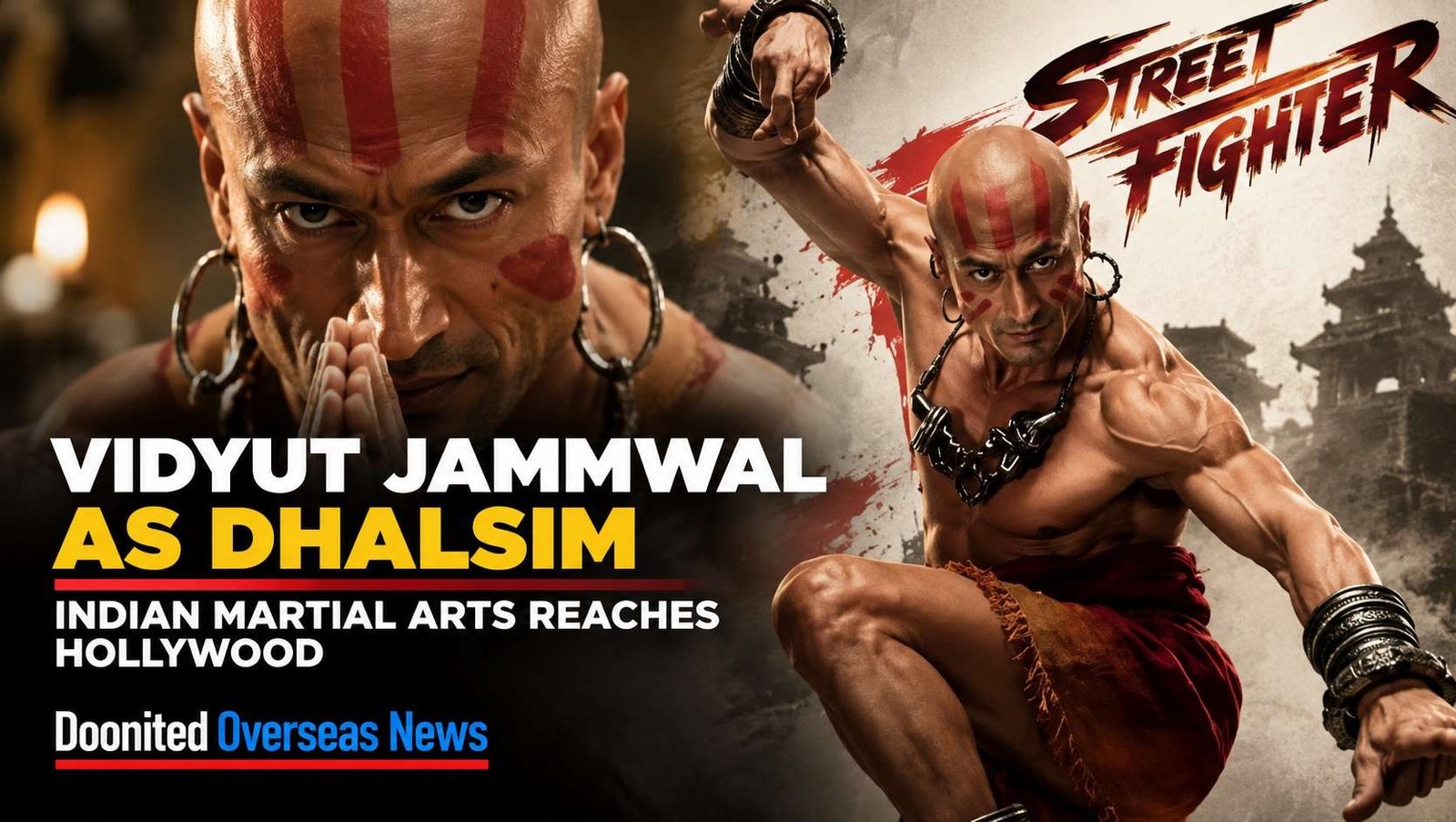
Vidyut Jammwal’s Hollywood Debut: How Kalaripayattu Could Give Indian Martial Arts a Global Stage
As Vidyut Jammwal prepares to play Dhalsim in the live-action Street Fighter, his move into a major international franchise offers a story bigger than one actor’s career. It raises questions about how Indian physical traditions are represented abroad, what global studios look for in performers, and whether international visibility can translate into lasting opportunities for Indian artists.
When Indian action actor Vidyut Jammwal appears as Dhalsim in the upcoming live-action film Street Fighter, he will be entering Hollywood through a role that connects directly with his own physical discipline. Known for his action performances and long-standing practice of Kalaripayattu, Jammwal is taking on a character whose identity in the video-game franchise is built around martial arts, yoga and extraordinary flexibility.
The film, directed by Kitao Sakurai and produced by Legendary Entertainment, is scheduled for theatrical release on October 16, 2026, with Paramount Pictures distributing it. Its ensemble includes Andrew Koji as Ryu, Noah Centineo as Ken Masters, Callina Liang as Chun-Li and other internationally recognised performers.
The opportunity, however, should not be confused with proof that Hollywood has fundamentally changed how it casts Indian talent. One role can open a door; it cannot by itself establish a new industry-wide pattern.
Why Dhalsim is a distinctive role
Dhalsim first became widely known through Street Fighter II, the 1991 arcade fighting game. In the franchise, he is an Indian yoga practitioner whose unusual reach, flexibility and fire-based abilities distinguish him from other fighters.
The character has always carried a cultural challenge. A stylised game figure can be memorable to players while also reducing a real-world culture to a handful of visual signals. Translating that character into live action therefore requires more than reproducing a costume or a set of signature moves.
In an interview with Hindustan Times, Sakurai discussed concerns that including Dhalsim might risk making the character feel like a caricature. He also explained the importance of finding a performer who could make the character work within the film’s interpretation of the game.
Still, physical authenticity does not automatically guarantee cultural depth. Dhalsim remains a fictional character with supernatural abilities, shaped by a commercial franchise. Whether the film gives him personality and context beyond his exotic abilities will matter as much as the performer’s flexibility.
From specialist skill to international casting
Jammwal has said he did not hire a Hollywood agent or actively pursue international roles before being considered for Street Fighter. According to his account, the filmmakers researched his work and approached him about the part.
Action cinema can be particularly suited to this route. Martial arts, stunt performance, movement design and physical conditioning are skills that can be demonstrated across language barriers. An actor may still need to meet the demands of an international production, but specialised ability can provide a compelling reason to consider someone beyond their domestic celebrity profile.
This is not a replacement for conventional routes such as agents, auditions, professional networks or established international careers. Nor does it mean that global studios have stopped valuing star power. Jammwal’s case instead illustrates how distinctive expertise can complement reputation and help a performer stand out.
His own experience also highlights the importance of production systems. In an October 12 interview with Cinema Express, he described international film sets as more disciplined, particularly around punctuality, stunt safety and planning. He contrasted strict insurance requirements with practices he has encountered in Indian filmmaking.
Can a Hollywood franchise create opportunities for Indian traditions?
Kalaripayattu, associated particularly with Kerala, combines physical conditioning, coordinated movement and traditional martial training. Its appearance in an international entertainment property can introduce audiences to a tradition they might not otherwise encounter.
Jammwal has said that some of his Street Fighter co-stars were familiar with Kalaripayattu and other aspects of Indian culture. His comments suggest that cultural curiosity can exist within global entertainment circles, although individual actors’ interest should not be treated as evidence of widespread knowledge among international audiences.
But visibility alone is not a business model. A fictional character performing spectacular moves may attract attention without directing viewers towards the real tradition behind them. Long-term cultural value would require reliable educational material, opportunities for qualified practitioners, responsible representation and pathways for audiences to learn more.
There is also a difference between drawing inspiration from a tradition and representing it accurately. Kalaripayattu should not be reduced to a collection of flexible poses or treated as interchangeable with yoga. Both have distinct practices and histories, even when a performer’s training brings elements of physical discipline together.
What the Indian diaspora should watch for
For overseas Indians, Jammwal’s role is relevant in three ways.
First, it offers an example of Indian cultural material entering a mainstream international franchise through a performer’s expertise. Representation does not have to depend exclusively on a film being set in India or telling an immigrant story.
Second, it demonstrates a possible professional pathway for Indian talent abroad. Actors, stunt performers, choreographers and martial-arts instructors can build careers by developing skills that international productions need. Such opportunities remain competitive and cannot be guaranteed by one successful casting.
Third, it creates a useful test of how global entertainment handles cultural identity. Does the finished film give Dhalsim agency and personality? Does it respect the character’s Indian roots? Or does it rely primarily on exotic appearance and supernatural spectacle? These questions can be assessed more fully once audiences have seen the complete film.
The same scrutiny should apply to promotional claims that a casting decision represents a turning point for an entire industry. A prominent role is meaningful, but evidence of lasting change would include repeated opportunities for Indian performers, greater creative participation and sustained demand for their specialist skills.
Beyond one debut
Jammwal’s Hollywood entry arrives at a moment when global entertainment draws on talent, intellectual property and audiences across national boundaries. The Street Fighter franchise gives him a platform with international recognition, while his background in martial arts provides a connection between a fictional character and a real Indian tradition.
The outcome will depend on more than his physical performance. The film must work as entertainment, the character must resonate with audiences, and any increased interest in Kalaripayattu must translate into a deeper understanding rather than a passing visual reference.
For Doonited Overseas readers, the larger lesson is that cultural influence can travel through professional skill as well as celebrity. Indian performers and practitioners do not need every international project to tell an Indian story. They do need opportunities to contribute their knowledge meaningfully—and for that contribution to be recognised beyond a single role.

World Beyond the News
Why Elephants Stay Close to Their Herd
Elephants live in highly social family groups and use calls, touch and body movements to maintain strong bonds.
Most of the Deep Ocean Remains Difficult to Explore
Extreme pressure, darkness and distance make deep-ocean exploration one of Earth’s greatest scientific challenges.
Spacecraft Can Travel Without Traditional Roads
Spacecraft use carefully calculated trajectories and gravity assists to travel enormous distances through space.
Why Movie Trailers Are Released in Stages
Major films often use teaser trailers, full trailers and final promotional spots to build awareness over time.