

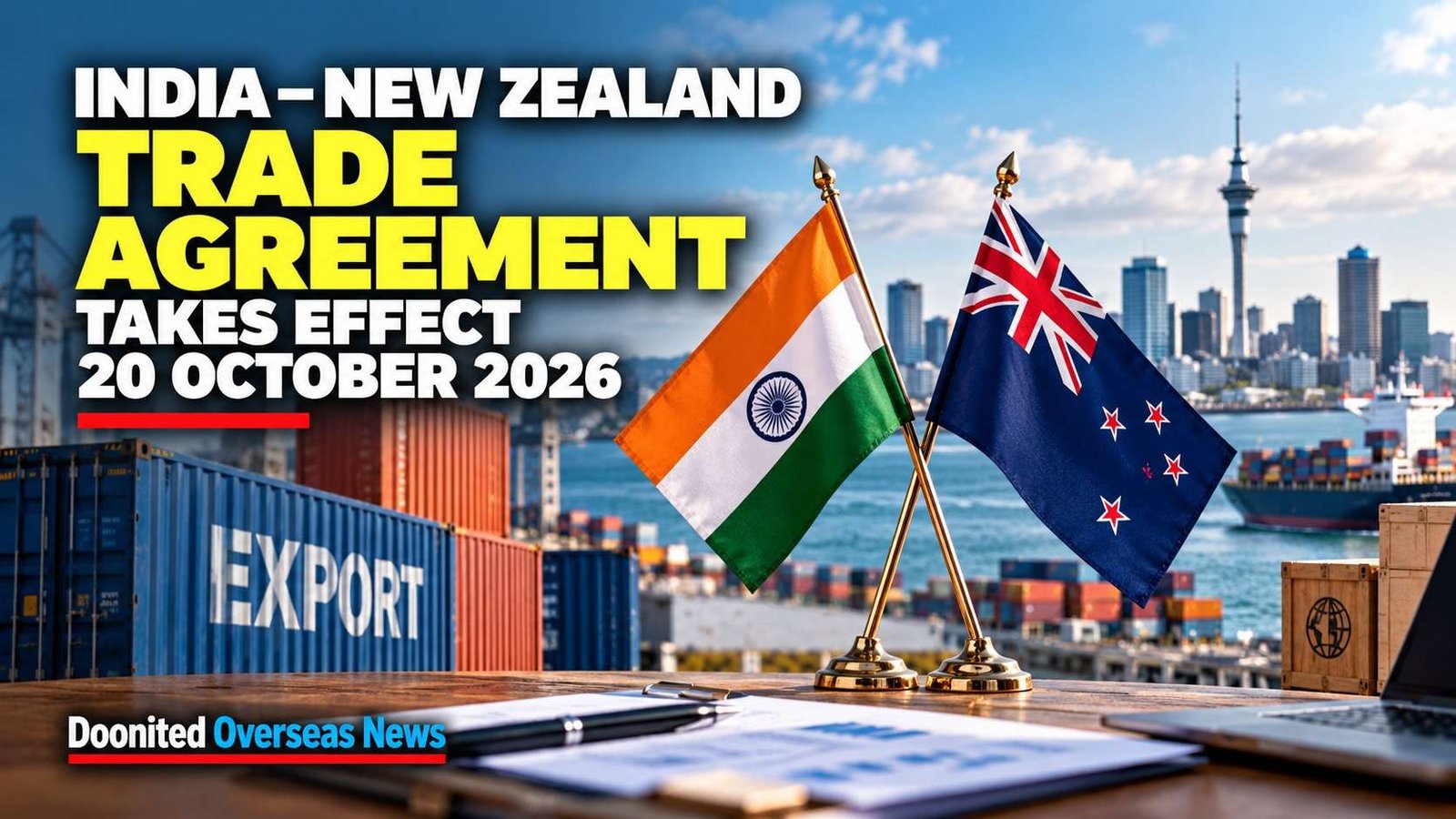
India–New Zealand FTA Takes Effect: What Indian Exporters, Professionals and Students Need to Know
The India–New Zealand Free Trade Agreement entered into force on 20 October 2026, opening duty-free access for Indian goods across New Zealand’s tariff schedule and introducing new opportunities for eligible Indian professionals and students. For the diaspora, the agreement could strengthen business links and career pathways—but tariff benefits depend on origin rules, while immigration commitments do not guarantee a job, a visa or permanent residence.
For an Indian textile exporter in Tiruppur, a pharmaceutical manufacturer in Hyderabad or a software professional hoping to work in Auckland, the India–New Zealand Free Trade Agreement (FTA) represents more than a diplomatic announcement. It creates new commercial possibilities between two countries whose connections extend well beyond trade figures: families, students, entrepreneurs and a substantial Indian-origin community already link the two economies.
The agreement entered into force on 20 October 2026, following ratification by both countries. Signed in New Delhi on 27 April, it aims to double bilateral trade in goods and services to NZ$7 billion by 2030. It also includes commitments on investment, professional mobility and education.
For Indians living in New Zealand, and for those considering studying, working or doing business there, the practical question is what has changed—and what remains subject to separate rules.
What the trade agreement changes
New Zealand has eliminated customs duties across all tariff lines for Indian exports under the agreement. That can improve the price competitiveness of eligible Indian products in a market where some goods previously faced tariffs of up to 10%.
Potential beneficiaries include textiles and apparel, leather and footwear, engineering products, pharmaceuticals, gems and jewellery, chemicals, and selected agricultural and processed-food exports. Smaller manufacturers may benefit if the reduced duty helps them win orders from New Zealand importers.
However, zero duty does not mean automatic market access. Goods must satisfy the agreement’s rules of origin to qualify for preferential treatment. These rules are designed to ensure that the products genuinely originate in the exporting country or undergo the required processing, rather than simply being shipped through it.
Exporters must also comply with customs documentation, product standards, labelling and any applicable biosecurity or regulatory requirements. New Zealand’s food-safety and import-health rules, for example, remain relevant even when customs duty is removed.
For Indian businesses, the immediate task is therefore to check the product-specific tariff schedule and rules of origin before quoting a new price or promising a buyer that the full tariff benefit applies.
Why the deal matters to the Indian diaspora
New Zealand’s Indian-origin community is an important link between the two countries. People with family, professional and business connections in both markets can help firms identify customers, understand local expectations and build relationships that are difficult to create through online sales alone.
The agreement may create opportunities for Indian-owned businesses in New Zealand that import products, distribute goods, provide professional services or connect suppliers with buyers in India. Indian manufacturers may also find new routes to the New Zealand market through diaspora entrepreneurs who understand both business environments.
But the gains will not be automatic or evenly distributed. Companies still need competitive products, dependable delivery, appropriate certification and local market knowledge. Smaller exporters may need help with logistics, marketing, customs paperwork and finding reliable distribution partners.
The agreement should therefore be viewed as an opening, not a ready-made customer base. Its long-term value will depend on whether businesses use the new rules to build durable commercial relationships.
New work pathways: 5,000 places, but no automatic visa
One of the agreement’s most closely watched provisions is its dedicated route for eligible Indian professionals. New Zealand has introduced two Temporary Employment Entry (TEE) visa categories, with a combined limit of 5,000 visa holders in New Zealand at any one time.
The pathways cover highly skilled occupations, including many already identified on New Zealand’s Green List, alongside a limited number of professions associated with India, such as yoga instruction, classical music teaching and specialist cuisine.
Applicants must still meet New Zealand’s immigration requirements. These include a qualifying job offer from an accredited employer, relevant qualifications and English-language requirements, as well as health, character and identity checks. The visas are valid for three years and do not provide a direct pathway to residence.
That distinction matters for readers planning a move. The quota is not a promise that every eligible applicant will receive a visa, nor does it mean that 5,000 jobs have been created. Applicants should verify the occupation rules, employer requirements and application process with Immigration New Zealand before paying a recruiter or making relocation plans.
The agreement also provides for a new working-holiday scheme for Indian nationals aged 18 to 30, with up to 1,000 places annually and stays of up to 12 months. Immigration New Zealand says the scheme is to be introduced within two years of the agreement entering into force; it should not be assumed to be open for applications already.
What Indian students should know
The FTA includes commitments affecting Indian students in New Zealand. From 16 November 2026, eligible Indian graduates who complete a PhD in New Zealand will be able to qualify for post-study work visas of up to four years, rather than three years under the previous arrangement.
The agreement also includes commitments on post-study work rights for eligible STEM graduates and in-study work. But eligibility depends on the course, qualification, visa conditions and the rules in force when a person applies. Students should check the official guidance rather than relying on broad claims that every Indian student will receive extended work rights.
For families weighing overseas education, the practical calculation remains the same: compare tuition fees, living costs, course quality, employment prospects and visa conditions. A trade agreement can improve the policy environment, but it cannot guarantee a job after graduation or make every course financially worthwhile.
Investment and agriculture: opportunity with safeguards
New Zealand has committed to facilitate US$20 billion in investment into India under the wider economic partnership. This is a facilitation commitment, not a guarantee that the entire amount will arrive immediately. Actual investment will depend on projects, commercial decisions, financing and implementation over time.
The agreement also includes cooperation on agricultural productivity, with initiatives involving kiwifruit, apples and honey. The stated objective is to share technology, training and practices that could help Indian farmers improve productivity and market access.
At the same time, India has retained protections for sensitive domestic sectors, including dairy, sugar and edible oils, rather than opening every product to unrestricted tariff competition. Selected New Zealand products receive preferential access under specific terms, while other products remain excluded or subject to staged concessions.
For Indian farmers and food businesses, the effect will depend on the product, local competition, implementation and whether cooperation translates into measurable gains. Trade liberalisation can create opportunities for consumers and exporters, but it can also put pressure on producers who are less prepared to compete.
What businesses and diaspora professionals should do now
For readers hoping to benefit from the agreement, five practical steps can reduce costly misunderstandings:
Exporters: Check the product’s tariff line, rules of origin, certificate-of-origin requirements and any New Zealand product standards before shipping.
Indian businesses in New Zealand: Review whether new sourcing arrangements improve costs, and confirm that suppliers can meet quality and delivery requirements.
Professionals: Consult Immigration New Zealand for the eligible occupations, qualifying job-offer requirements, visa duration and application process. Do not treat the quota as an entitlement.
Students and graduates: Confirm the precise post-study work conditions for the qualification and application date. Do not make financial decisions based solely on a headline about extended work rights.
Investors and entrepreneurs: Treat the investment announcement as a signal of policy intent, not guaranteed funding. Assess individual projects, partners and commercial risks.
The official agreement documents and immigration guidance are more useful than social-media summaries, particularly where a small difference in eligibility or origin rules can determine whether a benefit applies.
The real test begins after the announcement
The India–New Zealand FTA offers an opportunity to connect trade policy with the everyday realities of the diaspora. A garment exporter may gain a better chance of winning orders. An Indian-owned business in Auckland may find new suppliers. A qualified professional may have another route to work in New Zealand, while a student may benefit from revised post-study provisions.
But the agreement’s success should be judged by outcomes rather than the breadth of its announcement: sustained export growth, investment that actually materialises, fair competition, successful professional mobility and stronger links between businesses in both countries.
For the diaspora, the most useful role may be as a bridge between markets—helping Indian companies understand New Zealand customers while helping New Zealand firms navigate India’s scale and complexity. That role requires commercial expertise and trust, not merely shared heritage.
The FTA opens doors, but businesses and individuals still have to meet the conditions and make the opportunity work. For overseas Indians, that is the essential distinction between a promising policy change and a practical benefit.

World Beyond the News
Dolphins Use Individual Signature Whistles
Bottlenose dolphins develop distinctive whistles that function somewhat like individual acoustic identifiers.
The Pacific Is Earth’s Largest Ocean
The Pacific Ocean covers more area than any other ocean basin and stretches between Asia, Australia and the Americas.
Artificial Intelligence Learns Statistical Patterns
Modern machine-learning systems identify patterns in large datasets and use those patterns to generate predictions or outputs.
Why Some Stories Spread So Quickly
Emotion, novelty, visual appeal and easy sharing can make a story travel rapidly across social platforms.