
Indian-Origin Dr Ramya Raman Takes Charge as RACGP President in Australia, Puts Rural and Multicultural Healthcare in Focus
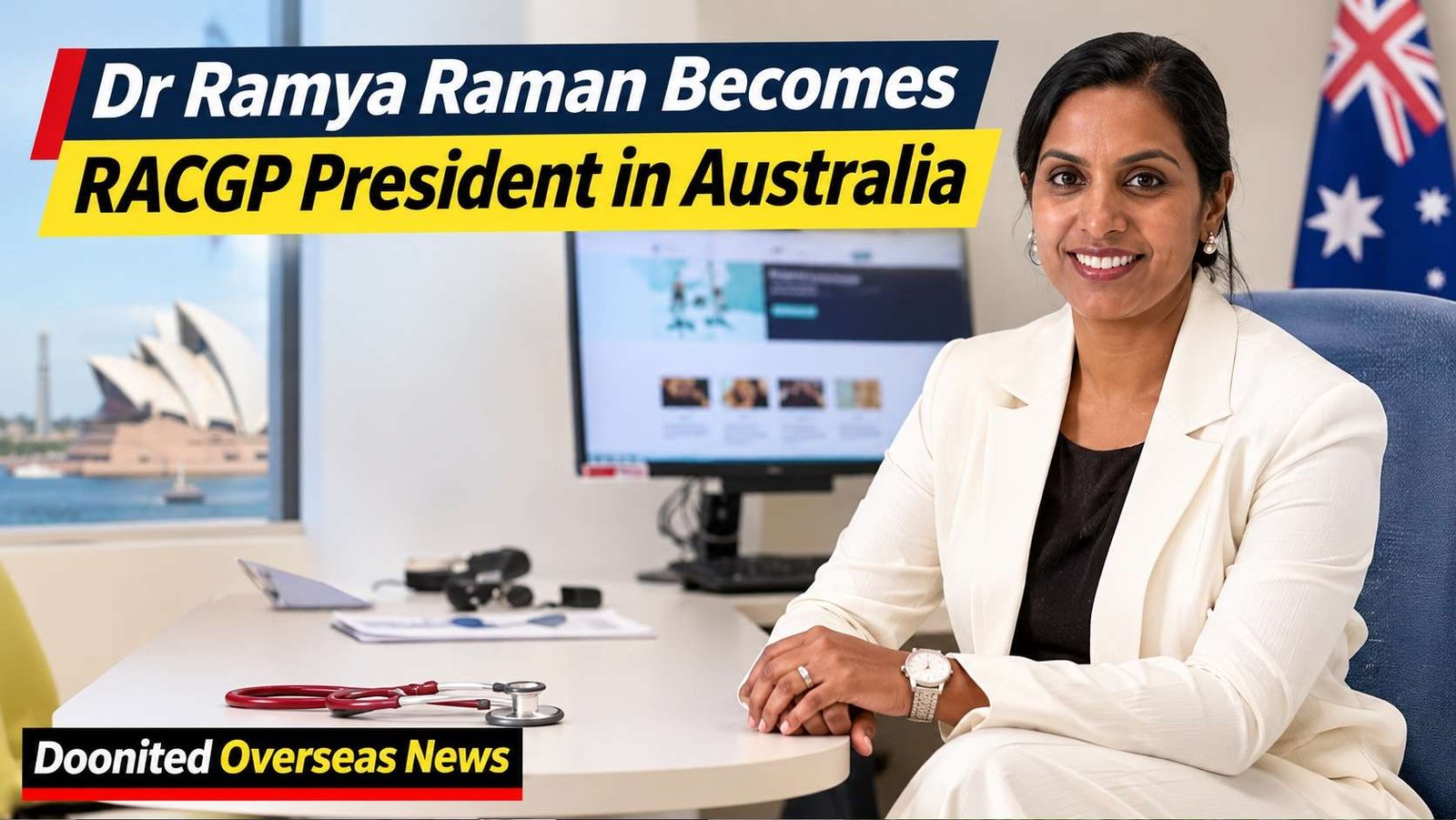
Indian-origin medical professional Dr Ramya Raman has taken over as President of Australia’s Royal Australian College of General Practitioners (RACGP), beginning a two-year leadership term on November 20, 2026. A practising general practitioner, academic and healthcare advocate based in Western Australia, she plans to strengthen the relationship between doctors and patients while addressing workforce sustainability, rural healthcare access and the needs of Australia’s multicultural communities. Her appointment also brings renewed attention to the contribution of internationally trained doctors to Australia’s healthcare system.
An Indian-origin doctor takes the helm of Australia’s leading GP college
A new chapter has begun for Australia’s general practice profession with Dr Ramya Raman assuming the presidency of the Royal Australian College of General Practitioners.
Dr Raman formally took over the position at the organisation’s 69th Annual General Meeting in Adelaide on November 20, 2026. She succeeded outgoing President Dr Michael Wright, who completed his two-year term and handed over the leadership during the meeting.
Her appointment follows an election in which she secured the support of RACGP members in August 2026. She will serve a two-year term, leading the professional organisation during a period of significant debate about primary healthcare funding, workforce pressures and access to medical services.
The RACGP represents general practitioners across Australia and plays an important role in professional standards, education, training and advocacy.
Dr Raman’s leadership is particularly notable for the combination of clinical practice, academic involvement and professional advocacy that she brings to the position.
From regional New South Wales to national medical leadership
Dr Raman’s professional journey began with an early understanding of the difficulties faced by communities with limited access to healthcare.
In an interview published by the University of Notre Dame Australia, she recalled growing up in regional New South Wales, where geographical distance and limited access to specialist services made healthcare challenging.
Her early exposure to rural general practice influenced her decision to pursue medicine.
She subsequently developed a career combining clinical medicine, medical education and professional leadership.
Based in Western Australia, she is a specialist general practitioner and practice director at The Garden Family Medical Clinic in Piara Waters, Perth. She also serves as Associate Professor and Discipline Head of General Practice at the University of Notre Dame Australia’s School of Medicine.
Her clinical interests include women’s and children’s health, with particular attention to perinatal wellbeing.
Her professional recognition includes the RACGP WA GP of the Year award in 2020 and the Australian Medical Association (WA) Advocate of the Year award in 2024.
These achievements reflect her involvement in both frontline healthcare and the broader professional discussions shaping Australia’s medical system.
Protecting the doctor-patient relationship
One of Dr Raman’s central priorities is protecting continuity in the relationship between general practitioners and their patients.
General practitioners often provide the first point of contact for patients seeking medical assistance. Over time, they build knowledge of a person’s medical history, family circumstances, ongoing conditions and treatment requirements.
Dr Raman has argued that this continuity must remain central to the future of Australian healthcare.
Her presidential agenda also highlights the need to recognise the value of general practice, strengthen practice sustainability, support doctors at different career stages and ensure that professional standards remain relevant to changing healthcare needs.
Digital healthcare is another important area. As virtual consultations and technology-led medical services expand, the challenge will be to improve convenience without weakening clinical accountability, patient safety or the continuity of care.
Her approach places the established GP-patient relationship at the centre of healthcare reform rather than treating general practice simply as a service-delivery transaction.
Why rural and multicultural healthcare matter
One of the defining issues facing Australia’s healthcare system is the uneven availability of medical professionals across metropolitan, regional and remote communities.
Dr Raman has made rural and remote general practice a priority, advocating stronger workforce support, better training opportunities and greater recognition of doctors serving geographically isolated populations.
The scale of the challenge is reflected in Australia’s workforce data.
The RACGP’s 2026 Health of the Nation report recorded 41,862 general practitioners in the primary care workforce in 2025. It also found that approximately one-third of practising GPs expected to stop working within five years.
Meanwhile, the Australian Government’s workforce projections indicate that, without intervention, the country could face a shortage of 7,700 GPs by 2033, increasing to 12,400 by 2048.
These pressures are particularly important for rural communities, where shortages can mean longer journeys, delayed appointments and greater dependence on hospital emergency departments.
Multicultural healthcare is another important dimension of Dr Raman’s leadership agenda. Australia’s culturally diverse population requires healthcare professionals who understand differences in language, communication, cultural expectations and access to medical information.
For migrant families, international students and overseas workers, navigating an unfamiliar healthcare system can be challenging. Clear communication and accessible primary care can make a substantial difference to early diagnosis, preventive healthcare and continuity of treatment.
Dr Raman’s experience in multicultural health advocacy, including her association with Ishar Multicultural Women’s Health Services, adds relevant professional experience to this discussion.
A significant connection with Australia’s Indian community
Her appointment carries particular relevance for the Indian diaspora, including Indian-origin medical professionals working throughout Australia.
Internationally trained doctors are an important component of the Australian general practice workforce. The RACGP’s 2025 workforce overview reported that international medical graduates accounted for 53% of the GP workforce by headcount and more than half of its full-time-equivalent workforce.
This makes the professional representation, training, retention and working conditions of overseas-trained doctors important national healthcare issues.
Dr Raman has specifically identified international medical graduates as an important part of the wider GP workforce that needs support.
For Indian doctors considering professional opportunities in Australia, her leadership could bring greater attention to issues such as training pathways, professional development, workforce retention and the contribution of internationally qualified practitioners.
However, her appointment does not automatically change Australian medical registration requirements, visa eligibility, specialist recognition or migration rules. Indian-trained doctors must continue to meet the applicable Australian Medical Council, Medical Board of Australia and registration requirements.
Her presidency is therefore significant as a professional leadership development, rather than a change in immigration or medical licensing policy.
The leadership team and the road ahead
Dr Raman will work alongside RACGP Vice President Dr Rebekah Hoffman and Board Chair Dr Siân Goodson.
Her immediate challenge will be translating her priorities into practical outcomes for general practitioners and patients across Australia.
The agenda includes improving the sustainability of medical practices, supporting rural doctors, strengthening training and supervision, advocating for international medical graduates and protecting the quality of patient care.
For the Indian diaspora, her elevation represents another important example of Indian-origin professionals contributing to leadership in major overseas institutions.
It also highlights a broader reality: the influence of the Indian diaspora extends beyond technology, business and finance into healthcare, education, public service and professional governance.
Dr Ramya Raman’s new position is not simply a personal professional milestone. It places an experienced clinician and advocate at the centre of discussions about how Australia delivers healthcare to its increasingly diverse population.

World Beyond the News
Dolphins Use Individual Signature Whistles
Bottlenose dolphins develop distinctive whistles that function somewhat like individual acoustic identifiers.
The Pacific Is Earth’s Largest Ocean
The Pacific Ocean covers more area than any other ocean basin and stretches between Asia, Australia and the Americas.
Artificial Intelligence Learns Statistical Patterns
Modern machine-learning systems identify patterns in large datasets and use those patterns to generate predictions or outputs.
Why Some Stories Spread So Quickly
Emotion, novelty, visual appeal and easy sharing can make a story travel rapidly across social platforms.