

Nagpur Under Pressure: Domestic Violence, Tax Recovery, Traffic Diversion and Rising Street Crime
By Pradeep Banerjee, Editor | Doonited News
Nagpur | August 18, 2026
Nagpur is facing a difficult mix of civic pressure and serious law-and-order concerns.
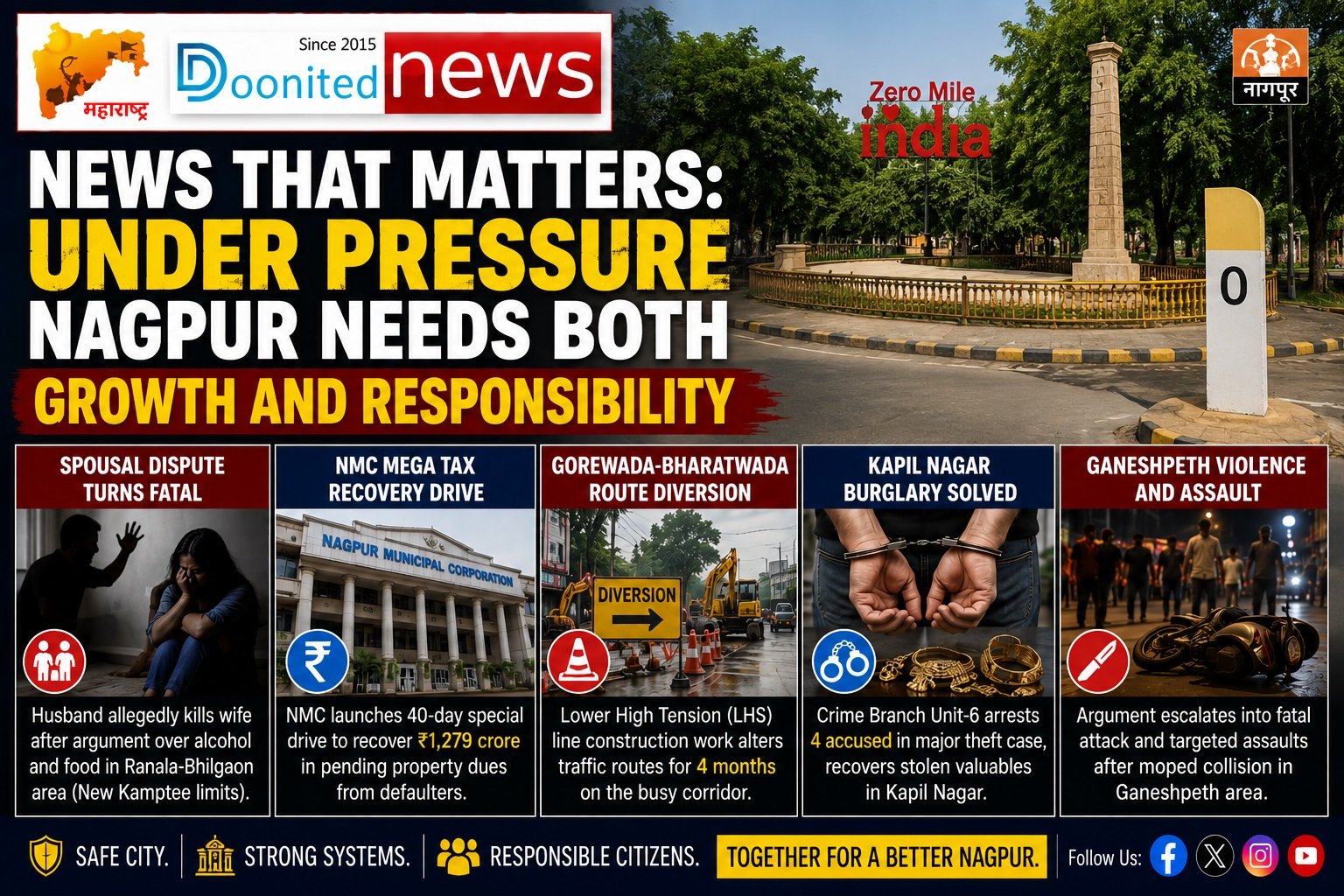
A domestic dispute in the Ranala-Bhilgaon area has ended in a woman’s death. At the same time, the Nagpur Municipal Corporation is preparing a massive ₹1,279-crore property-tax recovery drive, road construction is forcing a major traffic diversion on the Gorewada-Bharatwada route, and the Crime Branch has reported a breakthrough in a burglary investigation.
Meanwhile, another violent incident in Ganeshpeth has added to growing concerns over street-level conflicts turning dangerously violent.
These are not merely five separate police and civic stories. Taken together, they raise a larger question for Nagpur: is the city keeping pace with the pressures created by rapid urban growth, expanding infrastructure and changing social conditions?
Ranala-Bhilgaon: A Domestic Argument Ends in Tragedy
A dispute in the Ranala-Bhilgaon area under New Kamptee police limits has ended with the death of a woman after an alleged assault by her husband.
According to the report available today, the couple had an argument linked to alcohol and food. The dispute allegedly escalated when the husband assaulted his wife and slammed her head against the ground. She later succumbed to her injuries.
The incident has once again exposed the devastating consequences that domestic disputes can have when alcohol abuse, anger and physical violence combine.
A home should be the safest place for a person. When an argument inside that home becomes fatal, the tragedy goes far beyond a single police case.
The case is under investigation, and the exact sequence of events and legal findings will ultimately have to be established by investigators and the courts.
An uncomfortable question for society
Nagpur and its surrounding areas have repeatedly witnessed cases in which ordinary domestic arguments escalate into serious violence.
The warning signs are often visible much earlier—alcohol dependence, repeated quarrels, threats and previous physical violence.
The challenge is whether families, neighbours and authorities can intervene before an argument becomes a crime.
NMC’s ₹1,279-Crore Tax Recovery Drive: A Test of Civic Discipline
While the crime stories dominate public attention, another major development will directly affect thousands of Nagpur property owners.
The Nagpur Municipal Corporation is preparing a 40-day special property-tax recovery campaign from August 20 to September 30, targeting approximately ₹1,279 crore in outstanding dues. The figure includes unpaid property tax along with penalties and warrant-related charges.
The campaign is more than a revenue-collection exercise.
For a municipal corporation, property tax is one of the most important sources of recurring revenue. Money collected from property owners ultimately supports civic services such as roads, drainage, sanitation, street lighting and other urban infrastructure.
The NMC’s decision to intensify recovery efforts, particularly against major commercial defaulters, therefore has a direct connection with the quality of city administration.
The Other Side of the Tax Question
There is also a legitimate question for the civic administration.
If residents and businesses are expected to pay their taxes on time, the corporation must demonstrate that public money is being used efficiently.
Tax recovery and civic accountability should therefore move together.
Citizens should pay legitimate dues. The corporation should deliver measurable services.
That is the foundation of a functioning city.
Gorewada-Bharatwada Road: Four Months of Traffic Changes
Another immediate concern is facing motorists travelling along the Gorewada-Bharatwada route.
Traffic arrangements have been altered because of ongoing Lower High Tension (LHS) line construction work, with the changes expected to remain in place for approximately four months, according to the information supplied for this report.
For residents who use the route every day, even a temporary diversion can mean longer travel times, additional fuel consumption and congestion on connecting roads.
The challenge is particularly significant during Nagpur’s monsoon season, when road conditions, waterlogging and reduced visibility can already slow traffic.
Infrastructure vs inconvenience
Nagpur cannot stop infrastructure work simply because it causes temporary inconvenience.
Power infrastructure, roads, drainage and transport projects are essential for a growing city.
But agencies undertaking such work must also ensure:
- Clearly marked diversion routes
- Adequate warning signs
- Night-time visibility
- Coordination between traffic police and contractors
- Safe movement for pedestrians and two-wheelers
- Regular public updates about the work
The success of a project should therefore be measured not only by its completion, but by how safely the city survives the construction period.
Kapil Nagar Burglary: Crime Branch Unit-6 Scores a Breakthrough
Nagpur Crime Branch Unit-6 has reportedly solved a major burglary case in the Kapil Nagar area, arresting four individuals and recovering stolen valuables.
The development represents the other side of Nagpur’s law-and-order story.
While several recent incidents have raised questions about street crime, successful investigation and recovery of stolen property demonstrate the importance of intelligence-led policing.
The Crime Branch’s role is particularly significant in cases where local investigations need to be supported by surveillance, technical analysis and criminal intelligence.
Nagpur Police maintains official systems for citizens to access services and published crime information, while its Crime Branch continues to handle specialised investigations.
Ganeshpeth Violence: When a Small Conflict Turns Deadly
Ganeshpeth has also figured in a violent crime investigation involving an argument that allegedly escalated into a fatal attack, alongside assaults connected with a moped collision.
The development comes amid broader concern over a cluster of violent incidents reported in Nagpur around Independence Day.
A Times of India report said the city witnessed four knife attacks and two murders between August 15 and 16, prompting renewed questions about policing and prevention of street violence.
Another recent Ganeshpeth case involved a carpenter who was allegedly robbed at knifepoint near Empress Mall Gate.
The Bigger Law-and-Order Question
Nagpur Police has an important responsibility, but crime prevention cannot depend only on arrests after an incident.
Visible policing, quick response, surveillance, action against repeat offenders and better community engagement all have a role.
The city also needs citizens to understand that minor disputes—whether involving traffic, alcohol, money or personal arguments—can become dangerous within seconds.
Walking away from a confrontation is sometimes the most practical form of crime prevention.
Five Stories, One Nagpur
Look at today’s developments together and a wider picture becomes visible.
A woman loses her life following an alleged domestic dispute.
The civic corporation prepares to recover ₹1,279 crore in unpaid property dues.
A major road is placed under a four-month traffic diversion because of infrastructure work.
Crime Branch officers solve a burglary case.
And another violent confrontation raises questions about street-level law and order.
These stories belong to different departments, but they all ultimately affect the same thing: the quality of life in Nagpur.
An Editor’s View: Nagpur Needs Both Growth and Responsibility
Nagpur is changing rapidly.
New roads are being built. Infrastructure networks are expanding. Property values are rising. New residential areas are appearing. Commercial activity is increasing.
But urban growth also creates pressure.
The city needs stronger civic finances.
It needs infrastructure construction that respects commuters.
It needs policing that is visible before crime happens, not only after.
And perhaps most importantly, it needs a social culture in which domestic violence, substance abuse and aggressive confrontation are not dismissed as “family matters” or “small disputes.”
The NMC’s tax recovery drive can strengthen civic finances—but only if collection is matched by accountability.
Road construction can modernise Nagpur—but only if diversions are managed safely.
Crime Branch arrests can reassure citizens—but prevention must remain the ultimate objective.
And every domestic-violence case should remind society that intervention is needed before the police tape goes up.
Nagpur is growing. The city’s systems must grow with it.
A modern city is not measured only by its roads, buildings and projects. It is measured by how safely, fairly and efficiently its people can live.