

Australia Makes ‘No Further Stay’ Condition Mandatory on Visitor Visas from November 28: A Major Change for Indian Families
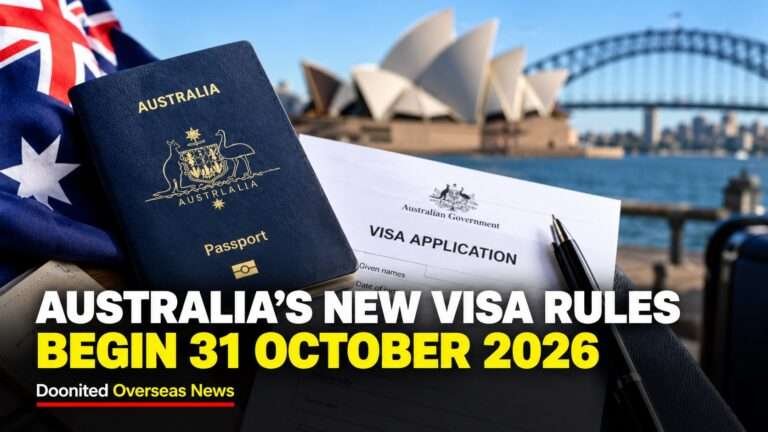
Australia is tightening the rules governing visitors who seek to change their immigration status without leaving the country. From November 28, 2026, new applications for Visitor visas will carry Condition 8503, restricting most onshore applications for another substantive visa. Indian parents visiting children in Australia, in particular, will need to plan their stays and longer-term visa arrangements more carefully.
Indian parents visiting their children in Australia may find it considerably harder to change their immigration status during a visit after a major change to the country’s visitor-visa rules takes effect on November 28, 2026.
The Australian Government has registered the Migration Amendment (Preventing Further Stay for Visitor Visas) Regulations 2026. The instrument, registered on November 13, makes Condition 8503, commonly known as “No Further Stay”, mandatory for new applications covering three visitor-visa categories: Visitor visa (subclass 600), Electronic Travel Authority (subclass 601) and eVisitor (subclass 651).
For Indian passport holders, the most directly relevant category is subclass 600. India does not appear on the Australian Government’s eligible passport lists for the subclass 601 ETA or subclass 651 eVisitor. Those categories are available to specified other nationalities.
The change is therefore particularly important for Indian families who rely on visitor visas to arrange extended family visits, care arrangements or visits around childbirth and other significant family events.
What Condition 8503 actually means
Condition 8503 restricts a visa holder from obtaining most further substantive visas while remaining in Australia. Under the new rules, an individual who enters Australia on a visitor visa carrying this condition generally cannot make a valid onshore application for another substantive visa, other than a protection visa, unless the condition is waived.
This can affect attempts to switch from a visitor visa to a student, work, partner or parent visa while inside Australia. It also removes the assumption that a visitor can simply apply for another visa before the original stay period ends.
The Australian Government says the policy is intended to reinforce the temporary nature of visitor visas and reduce onshore visa-hopping. Its explanatory statement places the reform within a broader effort to put downward pressure on Net Overseas Migration.
Why Indian parents need to plan differently
Many Indian families have children studying, working or permanently settled in Australia. Parents may visit for holidays, family occasions or to spend time with children and grandchildren.
Previously, Condition 8503 was already mandatory for certain subclass 600 streams, including Sponsored Family and Frequent Traveller, and could be imposed in other circumstances. The new regulation extends mandatory application to all subclass 600 streams.
For parents, the practical consequence is significant: they should not assume that a visitor visa can be converted into a longer-term visa after arrival. A parent who wishes to explore a longer stay or migration pathway must understand the relevant eligibility requirements and plan the appropriate application route before travelling.
There is an important distinction between visiting a child who is an Australian citizen or permanent resident and visiting a child who holds a temporary student or work visa. Parent migration pathways have their own sponsorship and eligibility requirements; simply having a child in Australia does not automatically qualify a parent for a parent visa.
The Department of Home Affairs specifically states that a person in Australia with Condition 8503 cannot lodge a Parent visa application while that condition remains in force.
Who is covered, and from when?
The new regulation commences on November 28, 2026, and applies to visa applications made on or after that date.
This application-date provision matters. The regulation does not retrospectively impose the new mandatory condition on people who already hold visitor visas granted before commencement. Applications lodged before November 28 are also outside the new mandatory rule, although existing rules may still permit Condition 8503 to be imposed in particular cases.
The measure is not restricted to Indian nationals. It applies to the specified visa subclasses regardless of the applicant’s nationality.
Can Condition 8503 ever be waived?
Yes, but a waiver is not automatic and is available only in limited circumstances.
The Department of Home Affairs says an applicant may request a waiver where a major change in circumstances has occurred after the visa was granted, was beyond the person’s control and creates compelling circumstances. Examples include a serious illness or death in the immediate family, a medical reason preventing travel, or a natural disaster or civil unrest in the home country.
By contrast, entering a relationship with an Australian citizen or permanent resident, becoming pregnant or simply wanting to remain longer are not accepted as reasons in themselves.
A waiver request does not suspend visa conditions or automatically extend lawful stay. If the visa expires before a decision is made, the applicant may become unlawful. Even if a waiver is granted, it only removes the restriction; it does not guarantee approval of another visa.
What Indian families should do now
Anyone planning a visit from November 28 onwards should read the visa grant conditions carefully and check the status through the Australian Government’s Visa Entitlement Verification Online (VEVO) service. Parents considering longer stays should examine appropriate visa pathways before travelling and obtain advice from a registered Australian migration agent or qualified legal practitioner where necessary.
The reform does not prevent Indian parents from visiting Australia, nor does it automatically shorten the stay period granted on a visitor visa. It changes what they can do after entering the country.
For Indian families, the message is clear: a visitor visa should be treated as permission for a temporary visit, not as a flexible route to changing immigration status after arrival.

World Beyond the News
Bees Communicate Where Food Is
Honeybees use movement patterns known as waggle dances to communicate information about food locations.
Street Food Reflects Local History
Many famous street foods developed from migration, trade, local ingredients and the everyday needs of working communities.
A Day on Venus Is Extremely Long
Venus rotates so slowly that one rotation relative to distant stars takes longer than its trip around the Sun.
Human Achievement Continues to Push Limits
Athletes, engineers, scientists and explorers regularly establish new benchmarks in speed, endurance, scale and precision.